Michigan judge denies request to block new wholesale marijuana tax
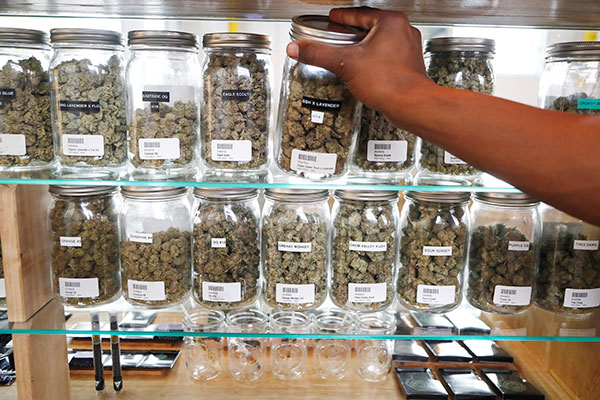
A CLERK REACHES for a container of marijuana buds for a customer at a marijuana dispensary in Detroit. (AP Photo/Carlos Osorio, file)
A group of cannabis industry advocates were unable to convince a Michigan Court of Claims judge that they would face irreparable harm if a new 24% wholesale tax on marijuana went into effect to fund the state’s future road repairs.
In an opinion issued Monday, Court of Claims Judge Sima Patel said she was denying a request for a preliminary injunction from the plaintiffs in Holistic Research Group Inc./Michigan Cannabis Industry Association v. Michigan Department of Treasury.
The consolidated lawsuits posited that the new tax, passed in October as part of a comprehensive 2025-26 budget deal to raise new revenue for road repairs and rebuilds through 2030, was unconstitutional because it violated the title-object clause of the state’s Constitution.
Patel on Monday, after hearing oral arguments in the matter in November, said the industry advocates didn’t make a supported argument that a real constitutional issue existed, nor did the group succinctly show that the Michigan Regulation and Taxation of Marijuana Act, which legalized the use and sale of cannabis in Michigan, was the only statutory mechanism to enact taxes on pot.
“The (road funding act) is consistent with the (maraijuana taxation act). The plaintiffs contend that the phrase ‘all other taxes’ … refers only to generally applicable taxes, like the 6% sales tax imposed on all retail sales. If that were true, however, the initiative could have simply said that. Instead, the initiative stated plainly that the 10% retail excise tax was in addition to ‘all other taxes.’ And the phrase ‘all other’ is broad and expansive. According to the plain meaning of these terms, ‘all other taxes’ broadly means all taxes other than the tax imposed by (the marijuana taxation act).”
Patel further noted that the Legislature did not directly amend any of the existing taxes in the regulatory act or replace it with the new tax in the road funding legislation; rather, the Legislature imposed a new separate tax, which is permitted under the regulatory act.
“The two statutes can be read together,” Patel wrote.
The industry’s claim regarding the mechanism by which a new tax could be enacted was therefore dismissed, Patel wrote.
Rose Tantraphol, spokesperson for the cannabis industry suing the state, said the Court of Claims made the wrong call, and that the plaintiffs were reviewing their options for a “swift appeal” as the case moves forward.
“While we are deeply frustrated by this ruling, I can tell you this: The fight is far from over. We remain confident in the strength of our case that this move by the Legislature violated the will of the voters who approved the 2018 citizen ballot initiative,” Tantraphol said. “Our legal team is conducting a thorough review of the decision to determine precisely how we will proceed.”
Patel did, however, allow the case to move forward to determine if the tax interferes with the intent of the voter-initiated law that allowed marijuana consumption, regulations and sales. Patel said a genuine issue of fact remained on that issue, which required further consideration before the court.
“The court must consider the intentions of the (taxation act) drafters and the impact of the new wholesale excise tax on the purposes of the (taxation act),” Patel wrote. “The court may not resolve such factual questions at the summary disposition phase. Discovery will be required to develop the evidence needed to support the parties’ positions in this regard.”
———-
Michigan Advance is part of States Newsroom, a national 501(c)(3) nonprofit. For more, go to https://michiganadvance.com.
Local News
Annual fundraiser Jan. 22 for Marquette Regional History Center
MARQUETTE — The Marquette Regional History Center will present "Legends & Lore: Marquette Unknown" at 7 p.m. ...

16 days until Christmas

Michigan judge denies request to block new wholesale marijuana tax
‘Highly variable’ winter predicted for UP

Evers vetoes bill to block Medicaid funds from undocumented residents