
Monitoring moose
Weather hampers DNR effort to get count
Trending
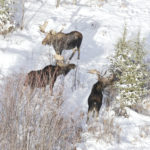
MARQUETTE -- Although winter weather conditions prevented the Michigan Department of Natural Resources from completing the 2016-17 winter moose survey, an estimate will be possible for the core range.
DNR officials recently discussed the survey when it was announced that weather prevented some flights for the aerial survey, precluding the DNR from estimating moose abundance throughout its entire range in the western Upper Peninsula.
"From 1997 through about 2013, we seem to have an increasing moose population, and then in 2015, our estimate was quite a bit lower than what we had in 2013," said Dean Beyer, wildlife research biologist based at the DNR's Marquette Customer Service Center.
Beyer said moose are found in two areas in the U.P. apart from Isle Royale. The eastern U.P., encompassing more than 1,200 square miles in parts of Alger, Chippewa, Schoolcraft and Luce counties, is believed to have fewer than 100 moose, although no formal surveys have been done there, DNR staff said.
Most of the moose are in the west central U.P. -- specifically, parts of Marquette, Baraga and Iron counties -- and are populations that originated from the 1985 and 1987 reintroduction efforts that brought in 59 moose from Algonquin Provincial Park in Ontario.
"These moose range over about 1,400 square miles, but most of the moose, 80 to 90 percent of them, actually occur in a core area of about half that size," Beyer said.
The most common way for resource management professionals to estimate moose abundance in North America is through an aerial survey, he said.
"The basic idea is you get up in a airplane or helicopter, you fly over an area that has moose and you try to count them," Beyer said.
This survey method has challenges.
Not every single animal on the ground can be counted, he pointed out. Moose live in a heavily forested conifer environment, making them difficult to spot at times, he said. Also, fixed-wing airplanes can't stop, so some animals might be missed.
So, how is an accurate estimate developed? Beyer said a sightability correction model determines the proportion of moose unseen to adjust the counts.
Experimental trials are run on radio-collared moose and surveys take place in areas with these moose.
If moose are found, measurements on factors that influence if they can be spotted -- such as if they're standing or are bedded down, or if there are visual obstructions -- are taken. If moose aren't spotted, telemetry gear is turned on, with measurements then taken.
These trials have been run twice, in the early 1990s and the early 2000s. The factors with the highest influence, he said, were visual obstruction and group size. Also, the overall sightability of moose was 39 percent in the first trial and 41 percent the second time.
Beyer said January is the best time for aerial surveying, since this is when they're most observable, with the survey conducted every other year. All high-density plots are surveyed first, with random samples taken in low-density plots.
Brad Johnson, wildlife technician with the Baraga Customer Service Center, said weather conditions were good for surveying in early January. However, a "meltdown" took place in the middle of the month when snow conditions reduced sightability.
"We tried to fly into February as well to finish the low-density plots, and we had one flyable day in February," Johnson said. "Conditions were not favorable to fly, so we didn't not finish all our low-density plots."
The most recent aerial moose survey before this was in January 2015 to estimate abundance in the western U.P., with 187 moose observed during the survey with an estimate of 323 animals made using a sightability correction model. The 2015 estimate showed a decline of about 28 percent from the 2013 estimate.
However, the DNR noted the confidence limits of the two estimates overlap, so it couldn't be certain the population decreased, although a decline in the proportion of calves in the population suggested a decrease occurred.
Given the potential moose decline and the Moose Hunting Advisory Council's recommendation to allow hunting only if a growth rate of more than 3 percent is maintained, the DNR did not recommend a 2015 hunt.
Bill Scullon, field operations manager at the Norway DNR office, said a high-density estimate should be available this summer after the Natural Resources Commission looks at the estimate data.
"Obviously, we won't be able to come up with a complete estimate, but we'll draw some conclusions from the core range at least," Scullon said.
The next moose survey will be in 2019.