
Laarman, Klenke give butterfly program at Golden K
Trending
By JOAN JOUPPI
For The Daily News
KINGSFORD -- Monday morning for the Golden K members was fast becoming a busy meeting.
Sharon Scholke, chairwoman for August, got everyone to their feet. Alyce Derwinski on piano rolled up her sleeves and got the black and whites rolling out some favorite oldies.
Guests welcomed included speaker Ed Laarman, Karen Smeester, Karen Klenke and RSVP director for the Dickinson Iron Community Services Agency, Kathy Arnold.
Happy birthday wishes for Dennis Chartier on Sept. 3 and Dorleen Uhazie on Sept. 12. Congratulations to Agatha Caviani's great-grandson, Connor Hansen, who now plays on the freshman football team. Kathy Jo Anderson had her weekend enriched with a camping trip with her grandson, and Orice Walters spent special birthday time with family and friends. Not to be outdone with celebrations, Ben Determan picked up his winnings on the 50-50 drawing.
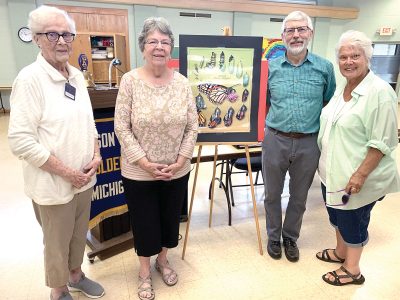
Sarah Godspodarek introduced the program for the day -- butterflies. Ed Laaman and Karen Klenke share an interest in monarch butterflies. He spoke on the life cycle process, while Klenke follows the migration patterns. Both are very focused on these particular butterflies.
Laaman led the group on a story of "Millie -- The Milkweed Monarch." With the aid of colorful pictures "Millie" began her life on Millie Hill in a patch of milkweed.
Monarchs by nature are very colorful orange and black butterflies. Using the leaf of a milkweed plant to lay her eggs assures her of a safe place for her "babies." The milkweed is a poisonous plant and possible predators are aware of that. The monarch, being a cautious mom, doesn't lay her eggs all in one spot -- she spreads them around. Milkweed plants are becoming hard to find for many reasons, however, if you are looking as Laaman and or Klenke do, walk carefully to not disturb a possible larvae. Small as a pencil tip on the underside of a leaf, there may be a potential monarch egg.
Milkweed plants have fuzzy substance on them and if you break the stem it will ooze a sticky milky liquid. Poisonous for some, life giving for others. The egg will grow and evolve slowly. Millie in the meantime uses this plant as a defense for her eggs. It is an extensive process and Millie gives her very life to the preservation of her eggs. With pictures showing the stages and development procedure, seniors were able to visualize the growth of a tiny egg larvae to caterpillar to adult butterfly.
Migration is also a strenuous procedure. Millie will travel about 1,800 miles from Millie Hill to an area in Mexico where thousands of monarchs gather. Millie will have sated herself with nectar to manage the time of migration. As an adult monarch, Millie will live on this supply of nectar and will travel about 20 miles per day depending the wind conditions. If no other source of food is available, water will do. Millie will not return to Michigan. She will die, but her offspring will go through their cycle as nature intended and a fourth generation of Millie's will again grace Millie Hill looking for their milkweed.
The two had some small, wormy caterpillars to show and hope to get them to maturity. They showed decals that monarchs are marked with. The decals are small and challenging to the eye and are placed on a wing portion of a monarch. This marks the butterfly with a tag number, date place where caught, sex and if it was wild or raised. The butterfly is not harmed in any way. Netting it an art unto itself. If you see someone with a white net on a long handle wandering around the gardens or woods next spring -- just observe, they will be fine.
Golden K conducted its Peanut Fundraiser on Friday at local businesses in Iron Mountain, Kingsford, Norway and Niagara. With community support, this enables Golden K to provide parties through the school year for the special needs children. Scholarships and donations to local charities are also included. This money, along with yearly dues, is a way for the Golden K to give back to the community. The fundraiser was only one day this year.
The picnic for the children will be Sept. 13 at City Park in Iron Mountain. Members should begin setting up by 9:30 a.m. Buses usually arrive by 10 a.m. Food and games are provided.
Members are encouraged to wear their Golden K shirts and hats.
With the COVID-19 situation still questionable, members are asked to wear masks for their own as well as the children's safety.
The Golden K will have a general meeting Sept. 20 at the First Presbyterian Church in Kingsford.