
Book explores the history of prostitution in the Florence and Iron Mountain areas

Alzemina Gertrude “Mina” Mudge (1862-1930), daughter of Lewis Mudge and madam in early Florence.
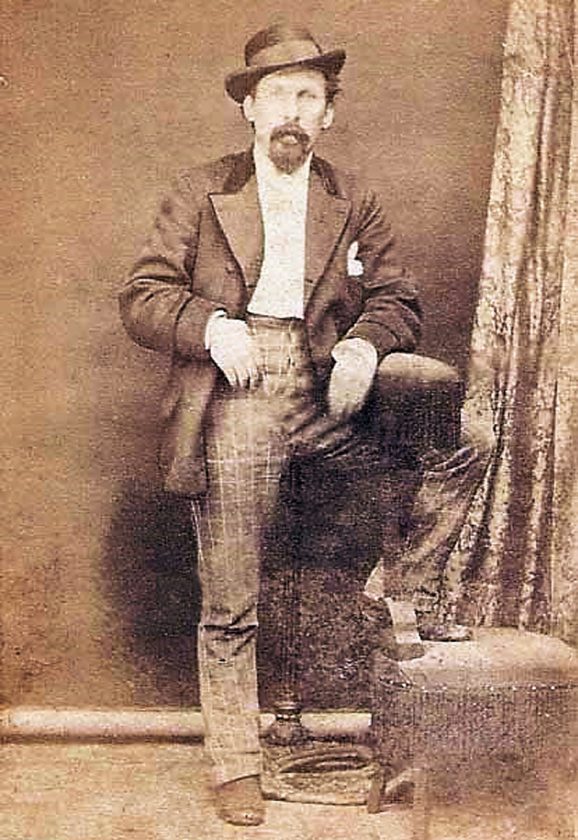
Dale Bomberg photos Lewis Cronin “Old Man” Mudge (1839-1897), infamous brothel operator in early Florence, Wis.
Alzemina Gertrude “Mina” Mudge (1862-1930), daughter of Lewis Mudge and madam in early Florence.
Dale Bomberg photos Lewis Cronin “Old Man” Mudge (1839-1897), infamous brothel operator in early Florence, Wis.
Trending
IRON MOUNTAIN -- "Soiled Doves of the Eastern Menominee Range: A History of Prostitution from 'Old Man' Mudge's Stockage in Florence, Wis., in the 1880s to Iron Mountain's Midway Brothels in the 1920s" is a new book that documents a largely untold aspect of the area's history, according to author William J. Cummings.
"Most area residents don't realize that early development of the Menominee Iron Range in Michigan's western Upper Peninsula is contemporaneous with the Old West," Cummings said. "Thus, Waucedah, Vulcan, Loretto, Norway, Quinnesec, Iron Mountain, Sagola, Felch, Foster City and Florence developed during the last quarter of the 19th century, as did Abilene, Deadwood, Denver, Dodge City, Tombstone and Wichita. The frontier communities of the Old West and the Menominee Range had many things in common -- including prostitution."
Historically, during the late 19th century, brothels in the United States were no secret. Commonly referred to as "disorderly houses," brothels were also known as bagnios, bawdy houses, cathouses, dens, houses of ill fame or ill repute, ranches and whore houses.
Research shows that houses of prostitution found in every mining camp worldwide were infamous, especially in the 19th century when long-distance imports of prostitutes became common. Entrepreneurs set up shops and businesses to cater to the miners, and brothels were largely tolerated in mining towns.
Beginning in the early 1870s, the Menominee Range Railroad was being built to accommodate the iron ore mines being opened. The vast pine forests were also being cut. Thus, several thousand young, single, virile men flocked to the area. As settlements began, saloons abounded and prospered, as did brothels.
In his 1963 book "Be-Wa-Bic Country: The Story of the Menominee Iron Range in the Upper Peninsula of Michigan" Herbert F. Larson, Sr., described the early years in Florence as follows:
"Many notorious characters were attracted to the new boom Menominee Iron Range mining camps. As the railroad pushed on from Powers to Quinnesec, Iron Mountain, Michigan, and Florence, Wisconsin, Florence became, by far, the toughest, hell-roaring town on the new Menominee Iron Range. Here were not only located two large mining camps, but also the headquarters of the large lumber companies who not only operated large warehouses, but shipped in and picked up hundreds of men to work for them in their nearby lumber camps, located along the Menominee, Paint, Michigamme and Brule Rivers. The places of business located along the single main street, which was nothing more than a long mud hole flanked by raised wooden sidewalks, were saloons, houses of prostitution or gambling dens. It was not unusual for all three to be housed under one roof. As there was no law and order, it was unsafe to walk the main street after dark. The sheriff was powerless. No one really wanted the sheriff's job, for when the men cut loose, the sheriff had to let them go."
Larson described the arrival of Lewis Cronin "Old Man" Mudge (1839-1897), perhaps the most notorious operator of a house of ill fame on the Menominee Iron Range, as follows:
"Just who Mudge was is not clearly known, but he did have an eye for business, for when he was informed that a new railroad was being built on a new iron range and that the new town of Florence, Wisconsin, was not only the end of the railroad but the headquarters of many large lumber companies, he decided that was the place to go to. Here would be the focal point for a large number of potential customers -- four hundred men building a railroad, 1,000 men in the mining camps, and another 1,200 to 1,500 men working in the various surrounding lumber camps. Most of these men were young and single, and what they needed was recreation, entertainment and 'that is just what I intend to give them,' mused Mr. Mudge."
Surviving copies of The Florence Mining News, Iron Mountain's The Menominee Range/The Iron Range and The Daily Tribune, as well as Norway's The Current provide ample coverage of prostitution during the last quarter of the 19th century.
Mudge's daughter, Alzemina Gertrude "Mina" Mudge, was also involved in her father's prostitution ring and later became a well-known madam. Her exploits were well-documented in the newspapers and included having an affair with a Florence County sheriff and the kidnapping of her 4-year-old son by her former husband, also a brothel operator.
A duel between the sheriff and the prosecuting attorney on Florence's Central Avenue in June 1884 and numerous fights in saloons and brothels -- sometimes involving firearms -- help define the lawlessness of the era.
"The Iron Mountain Press and The Iron Mountain Daily News/The Iron Mountain News also did an admirable job of keeping their readers informed regarding controversial social and moral issues during the first quarter of the 20th century," Cummings said. "As demonstrated by the transcribed articles from the Roaring '20s, there was a strong connection between Prohibition and prostitution in many area venues."
"During both eras, communities in Florence and Dickinson counties were attempting to eliminate prostitution, albeit largely unsuccessfully, through law enforcement officials. Pioneer newspaper editors brought this matter to their readership regularly," Cummings added.
"The goal of this 208-page book is not to pass judgment on the practice of prostitution, or the individuals named, but to document this aspect of our history," Cummings said. "Contemporary area newspaper accounts illustrated by over 100 historic photographs from the Menominee Range Historical Foundation's collection and other sources provide amazing insight."
Early Florence is depicted in 13 views dating from 1880 to the very early 1900s, while Iron Mountain and the surrounding area is represented in 30 images from the 1880s through the 1920s. The remaining photographs are primarily portraits of individuals and tombstones included in a biographical section for most of the individuals who played a prominent role in these pages.
A transcription of Chapter 1: Wolves -- Human and Otherwise from Chase S. Osborn's "The Iron Hunter" is also included.
Osborn was an early editor of The Florence Mining News and also served as Michigan's 27th governor from 1911 to 1913, the only individual to serve in that capacity from the Upper Peninsula.
The book is available for $20, plus tax, at the Cornish Pumping Engine and Mining Museum Gift Shop in Iron Mountain.
All proceeds go to support the Menominee Range Historical Foundation.