
The great American train chase
When I think of train hijackings, I picture bandits on horses running alongside the trains of the Wild West shooting their six-shooters like in the movies. I’m going to tell you a tale of a train and the Union soldiers who stole it during the American Civil War.
It was 1862 and the Union troops were in Tennessee under Brig. Gen. Ormsby Mitchel. They wanted to attack the city of Chattanooga because it was the vital transportation hub for the Confederate Army. The Confederate Army could quickly move troops and supplies by way of the Western & Atlantic Railroad.
The problem Mitchel had was his lack of troops to block the Confederate counterattacks from Atlanta. A civilian scout, James J. Andrews, proposed a plan to the brigadier general to steal a train, drive it north while destroying the tracks, bridges and telegraph lines to stop any communication to alert the Confederate Army. Mitchel liked the plan and decided to give Andrews the go ahead.
After several months of planning Andrews, 22 men and three experienced engineers gathered on April 7, 1862, for the final instructions. They were to make their way to Marietta, Ga., by midnight April 10. This meant that the men had to slip through the Confederate lines and make their way to the rendezvous point without being apprehended by a Confederate soldier.
They dressed in civilian clothing and were to tell anyone who asked that they were looking for a Confederate unit to enlist with. As the men made their way to Marietta, they had to battle heavy rains and rough travel conditions. Because of the conditions Andrews had to put off the raid by a day. By April 10, all but two of the men were able to make their way to Marietta and meet up with Andrews. The final plan was for the men to board the train and to make sure they all sat in the same car. When the train reached Big Shanty train station, the plan was for Andrews and the engineers to take the train while the others disengaged the trains cars.
Upon arrive at Big Shanty, Andrews and the others waited for the passengers and conductor to disembark for breakfast at the local hotel. Andrews and the engineers snuck onto the train, which was named “the General.” As they got the train ready to go, the others removed the passenger cars and jumped into the remaining box cars.
Looking out the window at the time was the conductor, William Fuller. With a clear head and quick thinking, he organized a pursuit of the General. As the train made its way up the line, they paused long enough to cut the telegraph lines to prevent communication of the stolen train. The chase was on!
After passing several train stations undetected, Andrews ordered the General to be stopped so that the men could remove a rail from the tracks in an effort to destroy them. They then continued and crossed a wooden rail bridge over the Etowah River. On the other side they saw another train, the Yonah. The men asked Andrews to destroy the engine, but much to his detriment, he did not want to fight and decided not to burn the bridge or destroy the engine.
In the meantime, Fuller, the conductor of the General, was in pursuit of the stolen train. He and his crew gathered and began to run after the train! Upon reaching the next train station they found a hand cart, took it and continued down the track. When they came upon the broken track, they lifted the hand cart off the track and around the damaged area and placed it back on the track. As they continued down the track, they came upon the Yonah. This is the engine that Andrews decided not to destroy. Fuller and his men took over the Yonah and began racing up the main line in pursuit of the stolen General.
As Fuller was moving along the track, the General had to stop for refueling. Andrews told the employees that they were carrying supplies for the Army. The employee, wanting to be helpful, gave Andrews the train schedule for the day. As the General raced up the track, they were suddenly forced to stop.
They were held up for over an hour waiting for the Confederate trains that were loaded with supplies and troops to pass. Once again on the move, they stopped further up the track and removed another rail and to cut the telegraph lines. As they were finishing and moving again, they heard the William R. Smith in the distance. Fuller had transferred to the Smith with his crew to avoid a delay at the switching station and was soon within hearing distance of the General.
Fuller, still as determined as ever to catch the General, came upon the second damaged tracks. He ordered his men out of the Smith and they began once again running down the track in pursuit of the General. As they ran down the track they came upon another train, the Texas, he commandeered that train and continued the chase. Because the Texas was traveling in the opposite direction, Fuller had to drive down the tracks backwards until he reached Adairsville where he unhooked the freight cars. Moving forward, he continued to try to catch the General.
As Fuller was dealing with switching trains, Andrews was up to doing more damage. He cut more telegraph wires and used one of the box cars to try burning down another wooden bridge they had passed over. Because of the rain and storms, the bridge was too wet to burn, so Andrews left the burning box car and continued up the tracks. They were now within sight of the Texas as it sped up the tracks.
Andrews tried to slow the Texas by throwing the removed railroad ties on the tracks. This had little to no effect on slowing down the Texas. As Andrews, still in the General, passed through Dalton they again stopped to cut the telegraph lines.
However, they were unaware that Fuller had already gotten a message off to warn of the stolen train advancing to Chattanooga. Andrews now well aware of the advance of Fuller, in the Texas, raced through Tunnel Hill but was unable to stop and damage it as had been the plan. As the General became low on fuel Andrews ordered his men to abandon the train and scatter into the wilderness.
Over the next few days as the entire raiding party was captured by the Confederate Army. Andrews and seven of his men were hung for being unlawful combatants and spies. Eight others were successfully in escaping and the remainder were exchanged as prisoners of war. The members of Andrews’ raid were among the first to receive the new Medal of Honor, which will be the topic of my next article.
During this same time, April of 1862, Maj. Gen. Ulysses S. Grant won the Battle of Shiloh and Flag Officer David G. Farragut captured New Orleans. Maj. Gen. William S. Rosecrans captured Chattanooga in September of 1863.
The Dickinson County Office of Veteran Affairs and the Veterans Board are excited to be sponsoring the Dickinson County Veterans Appreciation Picnic and Concert from noon to 8 p.m. Saturday at Lake Antoine Park in Iron Mountain.
A picnic lunch will be provided from noon to 3 p.m. for Dickinson County veterans and their families. There will be a bounce house, pontoon boat rides, games, food and music for the families.
At 1:15 p.m., the first band, The Descendants, will provide live entertainment for the picnic group to enjoy.
At 3 p.m. the public is invited to join veterans and their families to enjoy the next two bands and show their support and appreciation of area veterans.
At 3:50 p.m. the band 141 North will take the stage, followed by Mixed Tape 88 at 6:15 p.m. to close out the event.
The American Legion will host 50-50 raffles throughout the day, and they will also sell adult beverages after 3 p.m. Curious Pig BBQ will be on site selling food after 3 p.m.
They encourage area Dickinson County veterans, their families and members of the community to come out to Lake Antoine for a day of food, fun and music.
Life
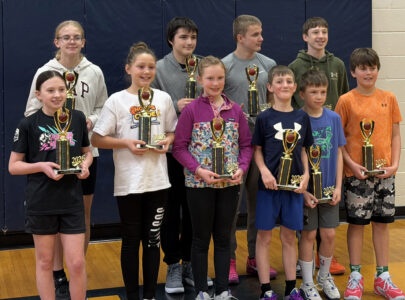
Knights of Columbus hosts 2026 free throw contest

April 6, 2026
Class Get-togethers
Tuesday — Iron River High School Class of 1965, 10 a.m., Iron River Senior Center, 814 N. Fourth Ave. in Iron ...

Giving thanks for a gift is important

Carrying the weight of a one-sided friendship
Seed swap planned today in Marquette
MARQUETTE – The Queen City Seed Library will host its annual community seed swap from 1 to 3 p.m. Eastern time ...