Brigitte Bardot dies at 91
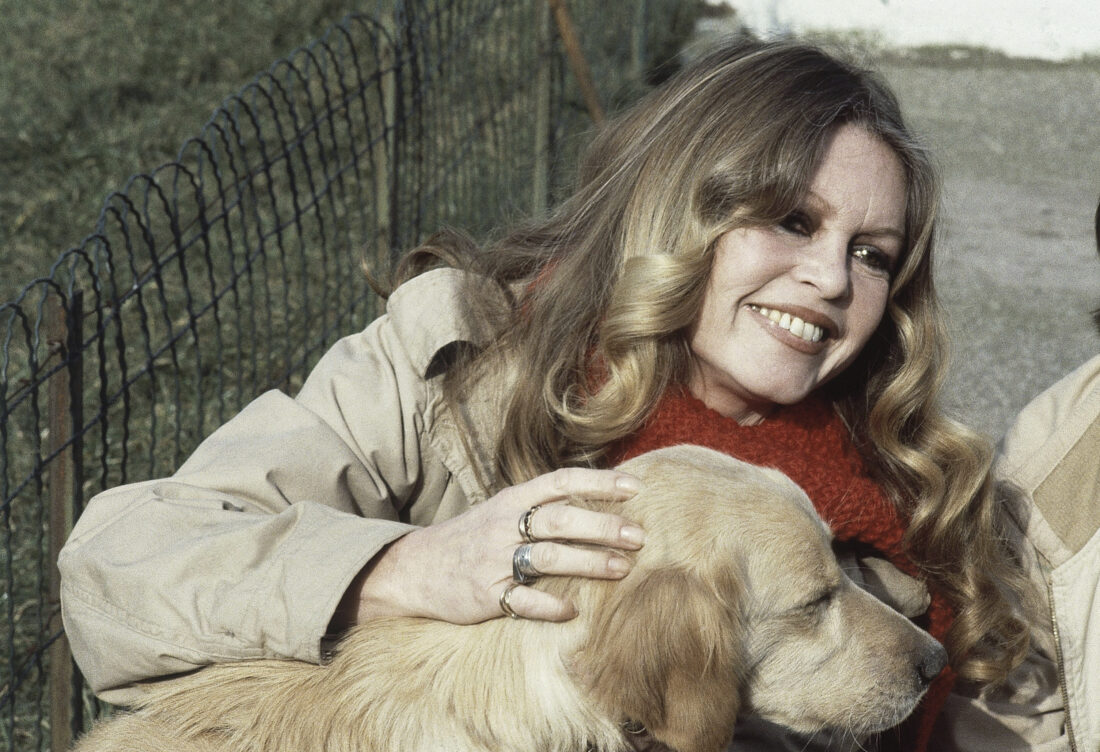
French Actress Brigitte Bardot with a dog in the Gennevilliers, Paris, while supporting the French animal protection society operation, Feb. 10, 1982. (AP Photo/Duclos, file)
PARIS (AP) — Brigitte Bardot, the French 1960s sex symbol who became one of the greatest screen sirens of the 20th century and later a militant animal rights activist and far-right supporter, has died. She was 91.
Bardot died Sunday at her home in southern France, according to Bruno Jacquelin, of the Brigitte Bardot Foundation for the protection of animals. Speaking to The Associated Press, he gave no cause of death, and said that no arrangements had been made for funeral or memorial services. She had been hospitalized last month.
Bardot became an international celebrity as a sexualized teen bride in the 1956 movie “And God Created Woman.” Directed by then husband Roger Vadim, it triggered a scandal with scenes of the long-legged beauty dancing on tables naked.
At the height of a cinema career that spanned more than two dozen films and three marriages, Bardot came to symbolize a nation bursting out of bourgeois respectability. Her tousled, blond hair, voluptuous figure and pouty irreverence made her one of France’s best-known stars, even as she struggled with depression.
Such was her widespread appeal that in 1969 her features were chosen to be the model for “Marianne,” the national emblem of France and the official Gallic seal. Bardot’s face appeared on statues, postage stamps and coins.
”We are mourning a legend,” French President Emmanuel Macron said in an X post.
Bardot’s second career as an animal rights activist was equally sensational. She traveled to the Arctic to blow the whistle on the slaughter of baby seals. She also condemned the use of animals in laboratory experiments, and she opposed Muslim slaughter rituals.
“Man is an insatiable predator,” Bardot told The Associated Press on her 73rd birthday, in 2007. “I don’t care about my past glory. That means nothing in the face of an animal that suffers, since it has no power, no words to defend itself.”
Her activism earned her compatriots’ respect and, in 1985, she was awarded the Legion of Honor, the nation’s highest recognition.
Later, however, she fell from public grace as her animal protection diatribes took on a decidedly extremist tone. She frequently decried the influx of immigrants into France, especially Muslims.
She was convicted and fined five times in French courts of inciting racial hatred, in incidents inspired by her opposition to the Muslim practice of slaughtering sheep during annual religious holidays.
Bardot’s 1992 marriage to fourth husband Bernard d’Ormale, a onetime adviser to far-right National Front leader Jean-Marie Le Pen, contributed to her political shift. She described Le Pen, an outspoken nationalist with multiple racism convictions of his own, as a “lovely, intelligent man.”
In 2012, she supported the presidential bid of Marine Le Pen, who now leads her father’s renamed National Rally party. Le Pen paid homage Sunday to an “exceptional woman” who was “incredibly French.”
In 2018, at the height of the #MeToo movement, Bardot said in an interview that most actors protesting sexual harassment in the film industry were “hypocritical,” because many played “the teases” with producers to land parts.
She said she had never had been a victim of sexual harassment.
Brigitte Anne-Marie Bardot was born Sept. 28, 1934, to a wealthy industrialist. A shy child, she studied classical ballet and was discovered by a family friend who put her on the cover of Elle magazine at age 14.
Bardot once described her childhood as “difficult” and said that her father was a strict disciplinarian who would sometimes punish her with a horse whip.
Vadim, a French movie produce who she married in 1952, saw her potential and wrote “And God Created Woman” to showcase her provocative sensuality, an explosive cocktail of childlike innocence and raw sexuality.
The film, which portrayed Bardot as a teen who marries to escape an orphanage and then beds her brother-in-law, had a decisive influence on New Wave directors Jean-Luc Godard and François Truffaut, and came to embody the hedonism and sexual freedom of the 1960s.
The film was a box-office hit, and it made Bardot a superstar.
With the exception of 1963’s critically acclaimed “Contempt,” directed by Godard, Bardot’s films were rarely complicated by plots. Often they were vehicles to display Bardot in scanty dresses or frolicking nude in the sun.
National News
Brigitte Bardot dies at 91
News briefs
Choppers collide in New Jersey HAMMONTON, N.J. (AP) — Officials say two helicopters have crashed midair in ...

Trump asserts that Russia and Ukraine both want peace

Christmas Eve winner lands $1.8B lottery jackpot

Rescuers rushed into flames to save nursing home residents