Israel recovers remains of last hostage in Gaza
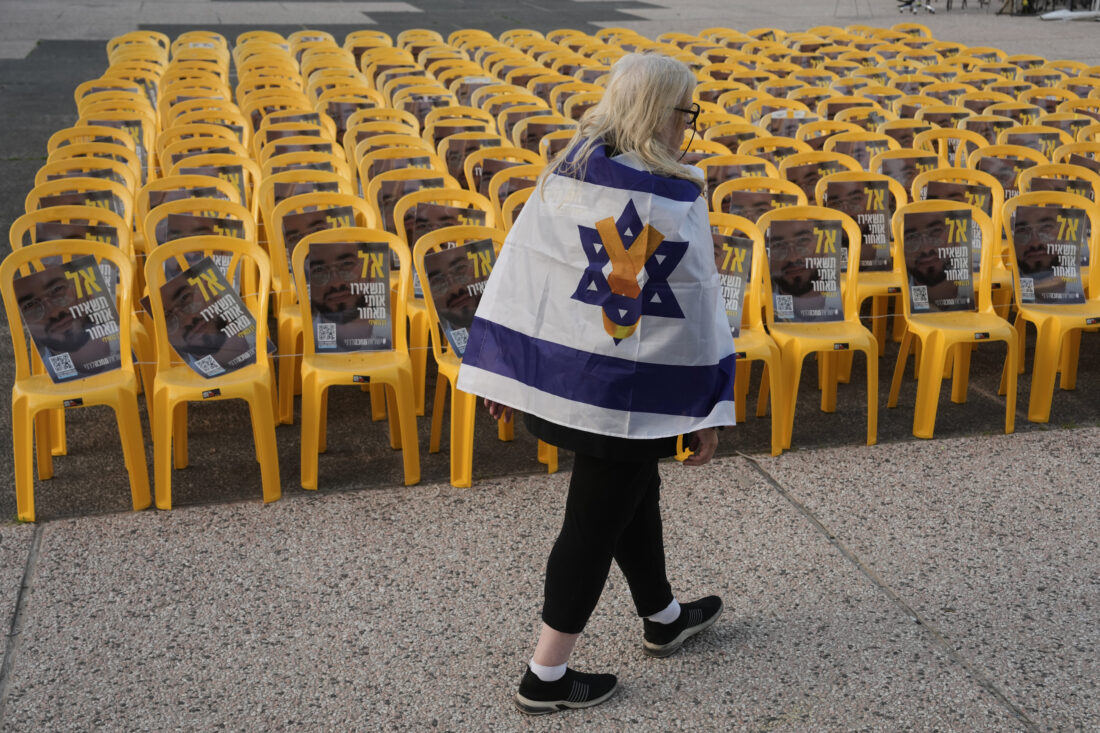
A woman walks by chairs with photos of Ran Gvili, the final hostage in Gaza who was killed while fighting Hamas militants during the Oct. 7, 2023 attack and whose remains have been recovered clearing the way for the next phase of the ceasefire that paused the Israel-Hamas war, in a plaza known as Hostages Square in Tel Aviv, Israel, Monday. (AP Photo/Oded Balilty)
JERUSALEM (AP) — Israel brought home the remains of the last hostage in Gaza on Monday, closing a painful chapter for the country and clearing the way for the next and more challenging phase of its ceasefire with Hamas.
The next step is likely to be the reopening of Gaza’s border with Egypt, enabling Palestinians to travel in both directions and eventually allowing more aid to enter the territory devastated by two years of war. The ceasefire’s second phase also calls for deploying an international security force, disarming Hamas, pulling back Israeli soldiers and rebuilding Gaza.
The remains of police officer Ran Gvili were found in a cemetery in northern Gaza.
Prime Minister Benjamin Netanyahu called it “an incredible achievement” for Israel and its soldiers. He said Gvili, who was killed during the Hamas-led attack on Oct. 7, 2023, that sparked the war, was among the first to be taken into Gaza.
Dozens of people, including relatives, military officials and friends from Gvili’s police unit, received his coffin at an army post on the Israeli side of the border with Gaza.
Many more Israelis lined nearby roads to pay their respects as a convoy carrying the coffin made its way to Tel Aviv, where it arrived Monday night.
“You should see the honor you’re receiving here,” Gvili’s father, Itzik, said, kissing his son’s coffin, which was draped in an Israeli flag. “The entire police is here with you, the entire army is with you, the entire people. I’m proud of you.”
The return of all remaining hostages, living or dead, had been a key part of the Gaza ceasefire’s first phase. Hamas said it now has met those terms.
Netanyahu’s office said Sunday that once the search for Gvili was finished, Israel would open the Rafah crossing between Gaza and Egypt, which Palestinians see as their lifeline to the world. It has been largely shut since May 2024, except for a short period early last year.
The ceasefire’s next phase will confront thornier issues, including transitioning to a new governance structure in Gaza and disarming Hamas, which has ruled the territory for nearly two decades.
“The next phase is disarming Hamas and demilitarizing the Gaza Strip. The next phase is not reconstruction,” Netanyahu said Monday while addressing the Israeli parliament.
International News
Israel recovers remains of last hostage in Gaza
Iranian prosecutor denies Trump’s claim 800 prisoners were spared execution

Ukraine, Russia, US ‘promote dialogue’

Michigan travel pitch draws Canadian criticism amid Trump trade tensions

Zelenskyy says repeated warnings to Europe feel like ‘Groundhog Day’