
NASA revamps Artemis moon landing program
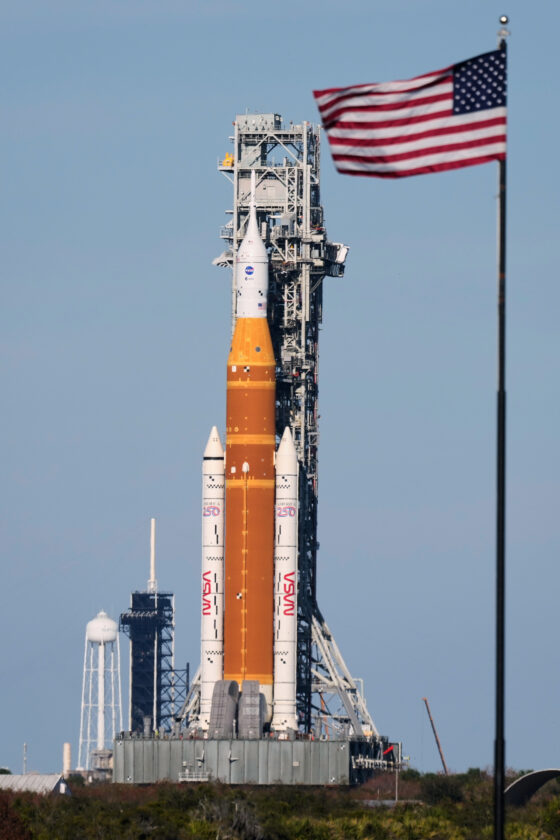
NASA's Artemis II SLS (Space Launch System) moon rocket with the Orion spacecraft slowly rolls back towards the Vehicle Assembly Building at the Kennedy Space Center on Wednesday in Cape Canaveral, Fla. (AP Photo/John Raoux)
NASA said Friday it’s revamping its Artemis moon exploration program to make it more like the fast-paced Apollo program half a century ago, adding an extra practice flight before attempting a high-risk lunar landing with a crew in two years.
The overhaul in the flight lineup came just two days after NASA’s new moon rocket returned to its hangar for more repairs, and a safety panel warned the space agency to scale back its overly ambitious goals for humanity’s first lunar landing since 1972.
Artemis II, a lunar fly-around by four astronauts, is off until at least April because of rocket problems.
The follow-up mission, Artemis III, had been targeting a landing near the moon’s south pole by another pair of astronauts in about three years. But with long gaps between flights and concern growing over the readiness of a lunar lander and moonwalking suits, NASA’s new administrator Jared Isaacman announced that mission would instead focus on launching a lunar lander into orbit around Earth in 2027 for docking practice by astronauts flying in an Orion capsule.
The new plan calls for a moon landing — potentially even two moon landings — by astronauts in 2028.
“Everybody agrees. This is the only way forward,” Isaacman said.
The hydrogen fuel leaks and helium flow problems that struck the Space Launch System rocket on the pad at NASA’s Kennedy Space Center earlier this month had also plagued the first Artemis test flight without a crew in 2022.
Another three-year gap was looming between Artemis II and the moon landing by astronauts as originally envisioned, Isaacman said.
Isaacman stressed that “it should be incredibly obvious” that three years between flights is unacceptable. He’d like to get it down to one year or even less.
Isaacman, a tech billionaire who bought his own trips to orbit and performed the world’s first private spacewalk, took the helm at NASA in December.
During NASA’s storied Apollo program, he said, astronauts’ first flight to the moon was followed by two more missions before Neil Armstrong and Buzz Aldrin landed on the moon. What’s more, he added, the Apollo moonshots followed one another in quick succession, just as the earlier Projects Mercury and Gemini had rapid flight rates, sometimes coming just a few months apart.
Twenty-four Apollo astronauts flew to the moon from 1968 through 1972, with 12 of them landing.
National News
NASA revamps Artemis moon landing program
News briefs
Pakistan strikes Kabul ISLAMABAD (AP) — Pakistan and Afghanistan have traded attacks in a dramatic ...

Clinton says he witnessed no signs of Epstein’s abuse

Justice Department reviews release of Epstein files related to Trump

Minnesota governor unveils anti-fraud legislation package
News briefs
Clintons begin depositions WASHINGTON (AP) — Former Secretary of State Hillary Clinton has told ...