Trump extends Strait of Hormuz deadline
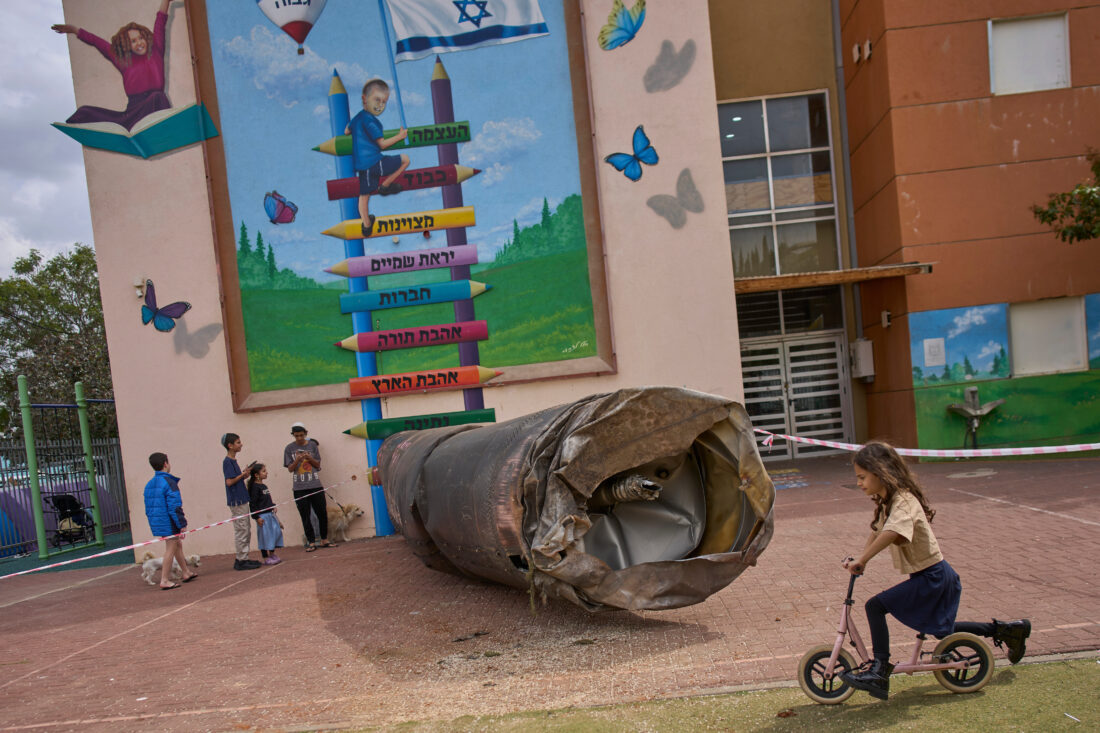
Children play beside a fragment of an Iranian ballistic missile that landed in a schoolyard in the Israeli settlement of Peduel in the West Bank on Monday. (AP Photo/Ohad Zwigenberg)
DUBAI, United Arab Emirates (AP) — U.S. President Donald Trump said Monday the U.S. was talking with an Iranian leader and claimed the Islamic Republic was eager for a deal to end the war. He also extended a deadline for Iran to reopen the Strait of Hormuz or face attacks on its power plants, saying it has an additional five days.
Trump’s turnaround, which held out the possibility of resolving the war now in its fourth week, served to drive down oil prices and jolt stocks. It offered a reprieve after the U.S. and Iran traded threats over the weekend that could have cut electricity to millions in Iran and around the Gulf, and knocked out desalination plants providing many desert nations with drinking water.
Trump told reporters Iran wants “to make a deal,” and he claimed U.S. envoy Steve Witkoff and Trump’s son-in-law Jared Kushner had held talks Sunday with an Iranian leader. He did not say who that was, but said the U.S. has not talked to Supreme Leader Ayatollah Mojtaba Khamenei.
Iran denied talks had been held. “No negotiations have been held with the US,” Iranian parliament Speaker Mohammad Bagher Qalibaf posted on X, adding that “fakenews is used to manipulate the financial and oil markets.”
Trump said if a deal is reached, the U.S. would move to take Iran’s enriched uranium, which is critical to its disputed nuclear program. Iran has adamantly refused such demands in the past, insisting it has the right to enrich uranium for peaceful purposes.
Iran has already performed 99% of the centrifuge work required to produce weapons-grade uranium for nine nuclear weapons, said Robert Goldston, a Princeton University professor who researches arms control and fusion energy. As of June 2025, the International Atomic Energy Agency estimated that Iran had 972 pounds of highly enriched uranium.
Turkey and Egypt, meanwhile, said they had spoken to the warring parties, the first sign of coordinated mediation from regional heavyweights.
The war launched by the United States and Israel has killed more than 2,000 people, shaken the global economy, sent oil prices surging and endangered some of the world’s busiest air corridors.
Trump threatened over the weekend to “obliterate” Iran’s power plants unless the country releases its stranglehold on the Strait of Hormuz, through which a fifth of all traded oil passed before the war, within 48 hours. That deadline would have expired late Monday Washington time.
The five-day extension was “subject to the success of the ongoing meetings and discussions,” Trump said.
Speaking later in Tennessee, Trump said his administration has been negotiating “for a long time” with Iran.
“They want peace,” Trump said. “They’ve agreed they will not have a nuclear weapon, you know, etc., etc. but we’ll see.” He said there’s a “very good chance” a deal will be reached this week, crediting his threat to blow up Iranian power plants.
British Prime Minister Keir Starmer indicated he was aware of talks between Iran and the U.S.
“We, the U.K., were aware that was happening,” he said Monday, without giving details.
In the wake of Trump’s turnaround, Iran’s semiofficial Fars and Tasnim news agencies portrayed the American president as backing down.
“Since the start of the war, messages have been sent to Tehran by some mediators, but Iran’s clear response has been that it will continue its defense until the required level of deterrence is achieved,” Tasnim said. “With this kind of psychological warfare, neither the Strait of Hormuz will return to prewar conditions nor will calm return to energy markets.”
Iran’s paramilitary Revolutionary Guard had promised retaliation if Trump carried out his threat, saying Iran would hit power plants supplying electricity to American bases, “as well as the economic, industrial and energy infrastructures in which Americans have shares.”
National News

Hawaii’s flood damage could top $1 billion
News briefs
Jet collides with truck NEW YORK (AP) — An Air Canada jet carrying more than 70 passengers collided with a ...
ICE officers go to TSA checkpoints
Trump extends Strait of Hormuz deadline
Unclaimed tax refunds from 2022 must be filed by April 15
WASHINGTON ― More than 1.3 million people across the nation have unclaimed refunds for tax year 2022 and face an ...