
US intel official says Iran’s regime still intact
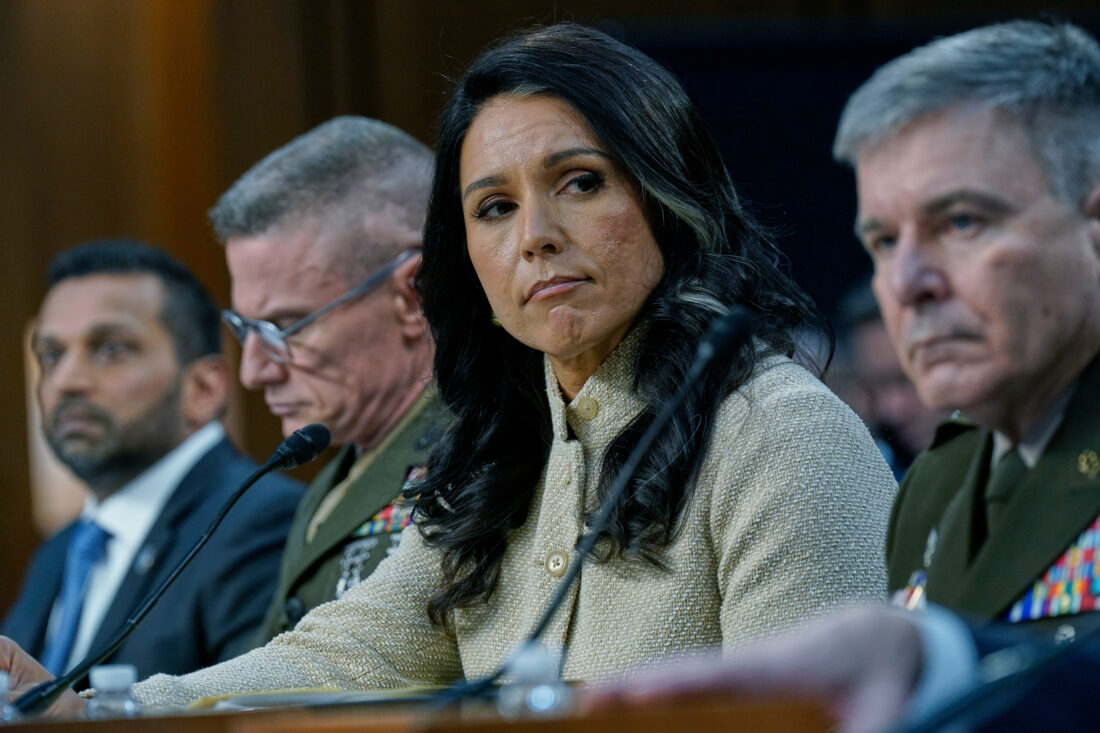
From left, FBI Director Kash Patel, Defense Intelligence Agency Director James Adams III, Director of National Intelligence Tulsi Gabbard, and Acting Commander of the U.S. Cyber Command William Hartman, listen during the Senate Committee on Intelligence hearings to examine worldwide threats on Capitol Hill on Wednesday in Washington. (AP Photo/Jose Luis Magana)
WASHINGTON (AP) — The U.S. government’s top intelligence official told lawmakers Wednesday that Iran’s regime “appears to be intact but largely degraded” yet repeatedly dodged questions about whether President Donald Trump had been warned about the fallout from the weeks-old war, including Iran’s attacks on Gulf nations and its effective closure of the vital Strait of Hormuz.
Tulsi Gabbard, the director of national intelligence, also stated in prepared remarks to the Senate Intelligence Committee that U.S. attacks on Iran last year had “obliterated” Iran’s nuclear program and that there had been no effort since then to rebuild that capability.
The statement was notable given Trump’s repeated assertions that a war with Iran was necessary to head off what he said was an imminent threat from the Islamic Republic. Gabbard pointedly said that conclusion was the president’s alone to draw as she declined to directly answer whether the intelligence community had likewise assessed that Iran’s nuclear system presented an imminent risk to the United States.
“It is not the intelligence community’s responsibility to determine what is and is not an imminent threat,” she said at one point.
Democratic Sen. Jon Ossoff of Georgia shot back: “It is precisely your responsibility to determine what constitutes a threat to the United States.”
The testimony came at the first of two congressional hearings held each year to offer the public a glimpse into the largely secret operations of the government’s intelligence agencies and the threats they confront.
The hearings this week take place at a time of scrutiny over the war with Iran and heightened concerns about terrorism at home after recent attacks at a Michigan synagogue and a Virginia university. Wednesday’s hearing also came a day after the resignation of Joe Kent as director of the National Counterterrorism Center. Kent said he could not “in good conscience” back the war and did not agree that Iran posed an imminent threat.
But the hours-long hearing offered few revelations from Gabbard, who repeatedly declined to discuss conversations with Trump, or other senior intelligence officials who testified.
“I am very disappointed,” said an exasperated Sen. Mark Warner, the top Democrat on the Senate Intelligence Committee. “It’s the only one time of year the public gets to hear from you guys in this kind of setting.”
A frequent line of questioning for Democrats: What intelligence, if any, had been given to Trump about the war’s potential consequences? Trump, for instance, has said he was surprised that Iran responded to strikes from the United States by attacking Arab nations and has been contending with the economic impact of the effective closure of the Strait of Hormuz, a body of water connecting the Persian Gulf to the world’s oceans and a vital passageway for oil and gas.
White House press secretary Karoline Leavitt said in a post on X that Trump was “fully briefed” on the possibility of Iran closing the Strait of Hormuz and that the Pentagon has been planning for the possibility of Iran closing it “for DECADES.”
But Trump’s plan to secure the waterway is unclear, especially after he said this week that NATO and most other allies had rejected his calls to help secure it. Iran has said the strait is open except to the U.S. and its allies.
Democrats got few direct answers when they pressed administration officials on what Trump understood about that possibility, with Gabbard saying she would not divulge her conversations with him and CIA Director John Ratcliffe observing that he had been in countless briefings with the president.
National News
News briefs
Truck lacked warning tool NEW YORK (AP) — Federal investigators say a runway warning system didn't sound an ...
Senators chase deal to end Homeland Security standoff
Iran vows to fight ‘until complete victory’

Minnesota sues Trump administration over shootings

Hawaii’s flood damage could top $1 billion
News briefs
Jet collides with truck NEW YORK (AP) — An Air Canada jet carrying more than 70 passengers collided with a ...