Trump budget seeks $1.5T in defense spending
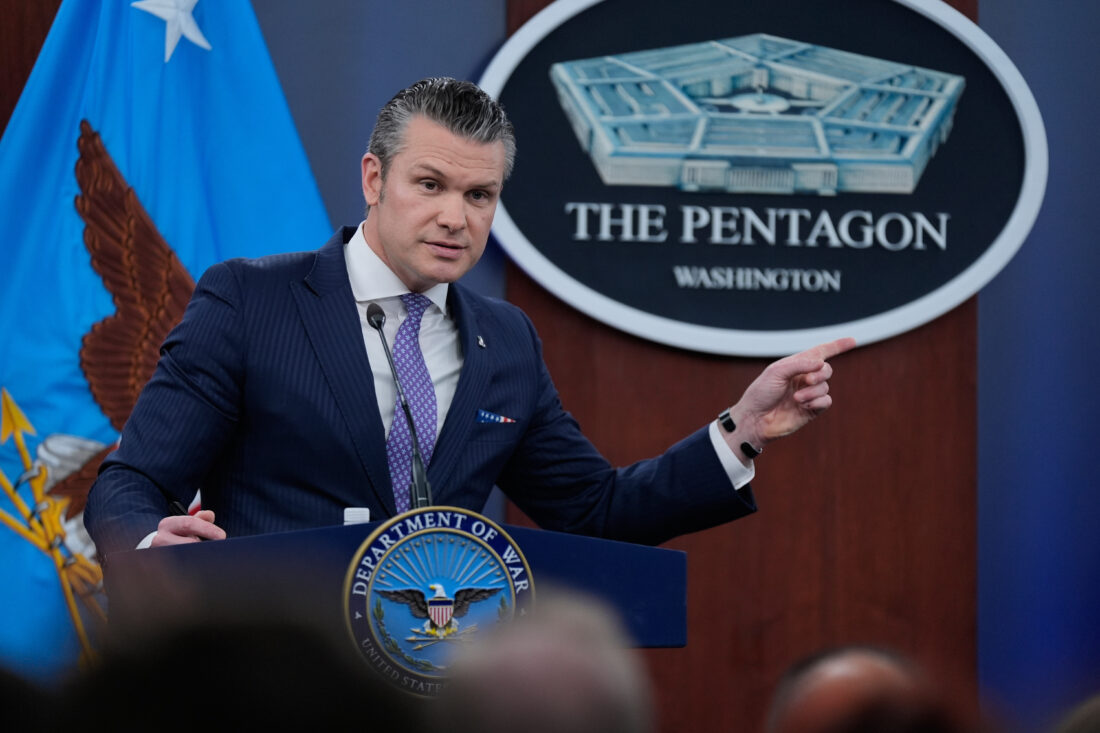
Defense Secretary Pete Hegseth speaks to members of the media during a press briefing at the Pentagon in Washington on Tuesday. (AP Photo/Manuel Balce Ceneta)
WASHINGTON (AP) — President Donald Trump has proposed boosting defense spending to $1.5 trillion in his 2027 budget released Friday, the largest such request in decades, reflecting his emphasis on U.S. military investments over domestic programs.
The sizable increase for the Pentagon, some 44%, had been telegraphed by the Republican president even before the the U.S.-led war against Iran. The president’s plan would also reduce spending on non-defense programs by 10%.
“President Trump promised to reinvest in America’s national security infrastructure, to make sure our nation is safe in a dangerous world,” wrote Budget Director Russell Vought.
The president’s annual budget is considered a reflection of the administration’s values and does not carry the force of law. The massive document typically highlights an administration’s priorities, but Congress, which handles federal spending issues, is free to reject it and often does.
This year’s White House document is intended to provide a road map from the president to Congress as lawmakers build their own budgets and annual appropriations bills to keep the government funded. Vought spoke to House GOP lawmakers on a private call Thursday.
Trump, speaking ahead of an address to the nation this week about the Iran war, signaled the military is his priority, setting up a clash ahead in Congress.
“We’re fighting wars. We can’t take care of day care,” Trump said at a private White House event Wednesday.
“It’s not possible for us to take care of day care, Medicaid, Medicare — all these individual things,” he said. “They can do it on a state basis. You can’t do it on a federal.”
Among the priorities the White House called for:
–Supporting the Trump administration’s immigration enforcement and deportation operations by eliminating aspects of a refugee resettlement aid program, maintaining Immigration and Customs Enforcement funds at current year levels and drawing on last’s year’s increases for the Department of Homeland Security funds to continue opening detention facilities, including 100,000 beds for adults and 30,000 for families.
— A 13% increase in funding for the Department of Justice to focus on violent criminals and the president’s promise to stop what the White House calls migrant crime.
— A $10 billion fund within the National Park Service for “construction and beautification” projects in Washington, D.C..
— A $481 million increase in funding to enhance aviation safety and support an air traffic controller hiring surge.
Budget cuts
— Cancels more than $15 billion from the Biden-era bipartisan infrastructure law, including funds for renewable energy projects and cuts to the National Oceanic and Atmospheric Administration, or NOAA, grants.
— 19% cut in the Department of Agriculture, ending certain university grants, a 13% cut for the Department of Housing and Urban Development, and about a 12% decrease to the Health and Human Services department, including cuts to a low-income heating assistance program.
The White House is touting cuts of what it calls “woke programs” that often direct federal investments toward low-income communities. The budget used the word “woke” 34 times
For example, the administration is looking to cut Community Services Block Grants, which funds activities such as financial and job counseling and helping people obtain adequate housing. The administration says its cuts would target grants “hijacked by radicals” to promote equity-building and green energy initiatives.
The president also seeks to cut $106 million in funding from the Agency for Healthcare Research and Quality, which it says has “pushed radical gender ideology onto children.”
Supporters and detractors
The Republican chairmen of the House and Senate Armed Services committees applauded Trump’s request for defense spending, saying the money would ensure the country’s military remains the most advanced in the world while confronting growing threats from China, Russia, Iran and others.
“America is facing the most dangerous global environment since World War II,” said Sen. Roger Wicker, R-Miss., and Rep. Mike Rogers, R-Ala.
The top Democrat on House Budget Committee, Rep. Brendan Boyle of Pennsylvania, said the president was demanding a massive increase in defense while cutting billions from health care, housing and more.
“This budget represents ‘America Last,'” Boyle said.
National News
Trump budget seeks $1.5T in defense spending

2 US aircraft shot down as war in Iran escalates
News briefs
US hiring rebounds WASHINGTON (AP) — American employers added a surprisingly strong 178,000 new jobs last ...

Astronauts savor views of Earth

Hegseth asks Army’s top uniformed officer to step down