
US bombs Iranian military sites
Trending
DUBAI, United Arab Emirates (AP) -- The United States said Monday that it bombed radar and drone sites in Iran after Tehran shot down an American drone over the weekend. Iran then said it targeted American soldiers in Kuwait with missiles, which the U.S. says it shot down.
The nominal ceasefire between Iran and the U.S. has been repeatedly tested with back-and-forth attacks, though officials from both countries are still trying to negotiate an end to the war. It’s not clear how close they are to a deal -- and there is always the risk that an attack could derail those talks.
Fighting has also been escalating between Israel and the Lebanese militant group Hezbollah, despite their nominal ceasefire, and that has increasingly threatened the emerging deal to extend the Iran war ceasefire.
On Monday afternoon U.S. President Donald Trump said Israel and Hezbollah had agreed to dial back their fighting after he held talks with Israeli Prime Minister Benjamin Netanyahu and communicated with Hezbollah through mediators. Moments later, though, Israel said it had detected missile launches from Lebanon and warned Israelis in part of northern Israel to take cover in protected spaces.
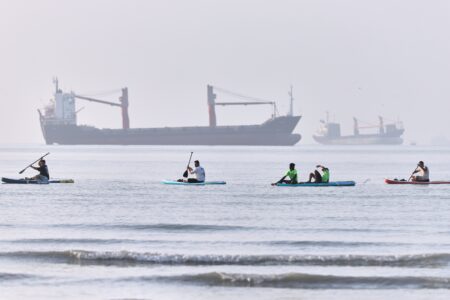
Meantime, Iran maintained its chokehold on the Strait of Hormuz, disrupting global energy supplies and driving up the price of fuel around the world, with far-reaching consequences. A cargo ship came under attack off Iraq Monday afternoon, the British military said.
The U.S. military’s Central Command said it carried out the strikes in Iran on Saturday and Sunday around the city of Geruk and on Qeshm Island, hitting air defenses, a ground control station and two attack drones it said threatened ships in the region.
“The measured and deliberate strikes occurred … in response to aggressive Iranian actions that included the shootdown of a U.S. MQ-1 drone that was operating over international waters,” Central Command said.
Traffic through the Strait of Hormuz is at a trickle compared to before the war, with ship owners deterred by the risk of an Iranian attack. Only 36 ships transited the waterway in the seven days leading up to to Friday, a third of them carrying crude oil or petroleum products, according to Lloyd’s List Intelligence, which counts only ships big enough to carry globally significant amounts of oil or cargo. That compares to an average of more than 130 ships per day before the war began.
A fifth of all the world’s traded oil and natural gas once passed through the strait. Its closure has put pressure not only on energy supplies but on chemical fertilizer, generating fears of food shortages. The Gulf region produces 30% of globally traded chemical fertilizers.
Kuwait said its air defenses opened fire early Monday morning to intercept incoming drone and missile fire.
Around the same time, Iran’s paramilitary Revolutionary Guard said it responded to an American attack without saying where, likely referring to the attack on Kuwait. In a statement carried by the state-run IRNA news agency, the Guard said that U.S. forces had targeted a telecommunications tower.
Kuwait is home to U.S. Army Central, the Mideast forward command for the Army.