
Iran’s leaders say US voters have rejected Trump’s war
Trending
Iranians on Wednesday struck a defiant tone, celebrating U.S. voters’ rebuke of President Donald Trump in the midterm elections while many in the Middle East waited to see how the results could affect the Iran war.
Concerns about the war, particularly frustration over rising prices for fuel and other goods in the U.S., helped Democrats win control of both chambers of Congress in Tuesday’s vote, a sharp setback for Trump and his Republican Party.
But Iran’s supreme leader, Ayatollah Mojtaba Khamenei, whose father and predecessor was killed in the opening strikes of the war in February, dismissed the prospect of any major change in the U.S. approach to the Islamic Republic.
“If there are still those who harbor even a slight hope for a change in behavior or partisan and factional shifts within the system of domination, or who imagine that by giving concessions to America they can dissuade it from hostility toward the Iranian nation, they are gravely mistaken,” he said on his social media account.
The broader region has been on edge for weeks over the prospect of the U.S. resuming full-scale military operations against Iran. Talks aimed at preventing renewed fighting are continuing, while other U.S. allies in the region urge Washington against resuming a war that began more than eight months ago and has rattled the global economy and devastated Iran.
Israeli Prime Minister Benjamin Netanyahu has reportedly pushed for more strikes, while Trump has alternated between threatening major military action and pushing for a deal.
Iran’s chief negotiator and parliament speaker, Mohammad Bagher Qalibaf, wrote Wednesday on X that “Americans said NO TO WAR, and we endorse this message.” He warned that if the U.S. government ignores the vote for change, “it will learn our NO comes with a Nightmare.”
Despite ceasefire agreements and repeated diplomatic efforts, military confrontations have continued in southern Iran and around the Strait of Hormuz.
Iran’s Foreign Ministry spokesperson said in a social media post that Americans had sent a clear message and warned Washington against ignoring it. If the U.S. continues to ignore reality, the spokesperson said, “the consequences of this grave miscalculation will extend far beyond what you have already witnessed.”
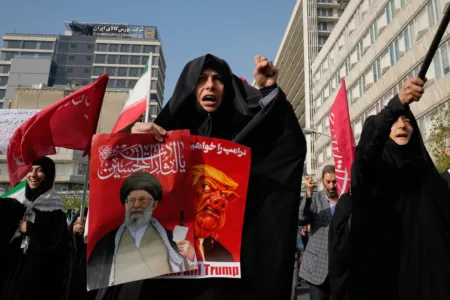
Underscoring the mutual hostility at the heart of the conflict, thousands marched through Tehran on Wednesday at a government-organized demonstration commemorating the anniversary of the 1979 takeover of the U.S. Embassy.
Pro-government demonstrators burned American and Israeli flags and chanted “Death to America” and “Death to Israel.” They displayed effigies of Trump and Netanyahu alongside caricatures of the two leaders.
“Trump has gone too far in everything and that’s one reason for his defeat in the election,” said Hananeh Jahed, a demonstrator.
Zahra Nadiminejad praised Iranian resistance, saying U.S. voters “finally figured out that this is Iran, and they can’t just come in here and do whatever the hell they want.”
“They’ve seen the consequences of the war back home, from skyrocketing gas and food prices to all the devastating effects the war has had on their own country. And whether the Democrats win or the Republicans win, our hostility toward America will never come to an end.”
Nearly five decades ago, Iranian students stormed the U.S. Embassy on Nov. 4, 1979, taking American diplomats and other citizens hostage. Fifty-two Americans were held for 444 days before being released.
The crisis helped cement the rupture between the two countries, which have had no formal diplomatic relations for years.
The United States and Israel launched the war against Iran on Feb. 28, killing the country’s longtime supreme leader, Ayatollah Ali Khamenei, and triggering a conflict that has disrupted global energy markets and shipping through the Strait of Hormuz.