
SpaceX stock soars, makes Musk the first trillionaire
Trending
NEW YORK (AP) -- Elon Musk became the world’s first trillionaire after shares of his rocket company SpaceX soared in Wall Street’s biggest initial public offering of stock.
Shares in SpaceX jumped more than 19% after opening for trading Friday, a sign that investors are looking past the billions the company is losing and instead betting that its massive investments in satellites, orbital data centers and artificial intelligence will pay off in the future.
SpaceX opened around midday at $150 a share, then rose to around $168, before finishing the day just below $161. That price gave the company a market value of $2.1 trillion, making it the sixth largest public U.S. company -- larger even than its founder and CEO’s other big business, the electric vehicle maker Tesla.
Between his holdings in SpaceX and Tesla, where he is also CEO, Musk is now worth an estimated $1.1 trillion, according to Forbes.
Musk says SpaceX, founded in 2002, is going public now because it needs money to fund its ambitions of putting satellites and data centers in space and eventually establishing a colony of people on Mars.
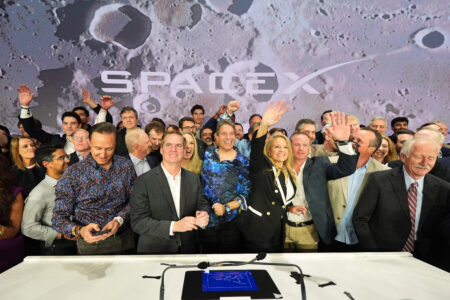
He marked the opening of trading on Nasdaq by joining a ceremonial bell ringing from Starbase, the South Texas home of SpaceX.
He reiterated his lofty goals “to make life multiplanetary.”
“Not just a few astronauts, I mean literally you,” Musk said. “Whoever you are watching this, SpaceX wants to be able to take you to the moon, take you to Mars and ultimately beyond.”
Known for his technological breakthroughs, as well as wild claims and missed deadlines, Musk was able to whip up enthusiasm for the IPO. The typical company going public has seen a 7% jump in its first day of trading, from 1980 through 2025, according to Jay Ritter, a professor at the University of Florida’s Warrington College of Business.
Institutional and retail investors alike jumped at the opportunity to buy a piece of the company at $135 per share before trading began. The $75 billion in proceeds SpaceX raised easily topped the previous record IPO from oil giant Saudi Aramco in 2019.
In addition to establishing a one-million person Martian colony, the company has promised to save humanity by establishing other outposts in space, launch data centers the size of football fields into orbit and outdo rivals Anthropic and OpenAI in the race to make money from artificial intelligence.
To reach its goals, SpaceX needs billions more than it currently takes in from its rocket and satellite business. Between the start of 2025 and March 31, 2026, the company, formally known as Space Exploration Technologies Corp., lost $8.7 billion.
Betting on SpaceX is in many ways a bet on Musk himself. In an unusual arrangement that has drawn criticism from shareholder watchdogs, he holds 82% interest in a special B class of shares, giving him sweeping power to control the company even though his ownership stake is about half that.
“There’s a lot of hype, but I see the faith that investors have in Musk,” said Yordys Coro, an IT support contractor in Miami as he watched his $14,000 investment in SpaceX shoot up to $17,000 in just a few hours. “I’m going to hold on.”
Wall Street bankers that helped take SpaceX public are also enthusiastic about the company -- and the big fees they will earn -- but not everyone thinks the stock price is justified.
Analysts at research firm Morningstar, which doesn’t earn any investment banking fees, wrote that the IPO is “significantly overvalued.”
Citing SpaceX’s technology challenges, including shielding its orbiting datacenters from radiation damage and catching up to leaders in AI such as Anthropic and OpenAI, they estimated the company is only worth $780 billion -- less than half its IPO value.
SpaceX itself has hinted at the challenges, conceding in regulatory documents that some of its business plans rest on “unproven technologies.” It also indicated that another part of the company, its artificial intelligence business called xAI, has no clear path to profitability and is burning cash to catch up with rivals.