Groups search for hemlock woolly adelgid
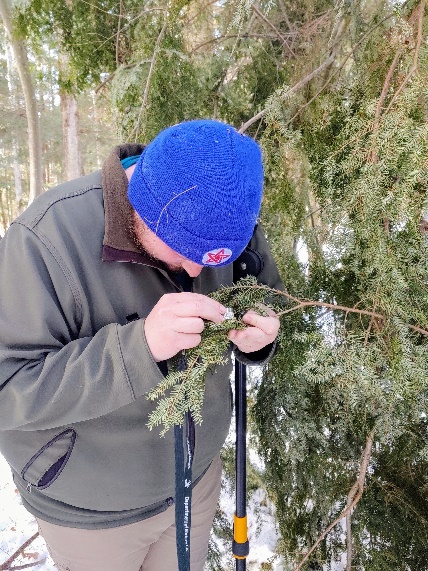
Kyle Hafeman, from Wild Rivers Invasive Species Coalition, inspects a hemlock branch.
KINGSFORD — In partnership with the Upper Peninsula Resource Conservation and Development Council and the Michigan Invasive Species Grant Program, Wild Rivers Invasive Species Coalition has been conducting hemlock woolly adelgid surveys in Menominee County.
Hemlock trees help maintain a healthy forest ecosystem and are an important resource for wildlife that rely on dense hemlock canopies for winter cover and food. With more than 170 million hemlock trees in Michigan, HWA has the capacity to devastate the forests.
These aphid-like insects have specialized mouthparts that allow them to pierce the base of hemlock needles and suck out nutrients meant for the tree. Over a period of four to 10 years, hemlock trees will usually die from an HWA infestation.
While the threat has remained highest in the eastern United States, HWA has started moving into the Midwest, with sightings reported in southwest Michigan. There is concern the insect may hitch a ride across the lake to the Upper Peninsula, so WRISC’s survey efforts have been targeting the Lake Michigan shoreline. If spotted in the Upper Peninsula, the spread likely would be slow, as studies show cold winter temperatures can increase HWA mortality.
The public can look for any small, white, cotton-like ovisacs at the base of the needle. To help prevent the spread of HWA and other invasive species, don’t move firewood from place to place and keep equipment and clothing free of seeds and outside debris.
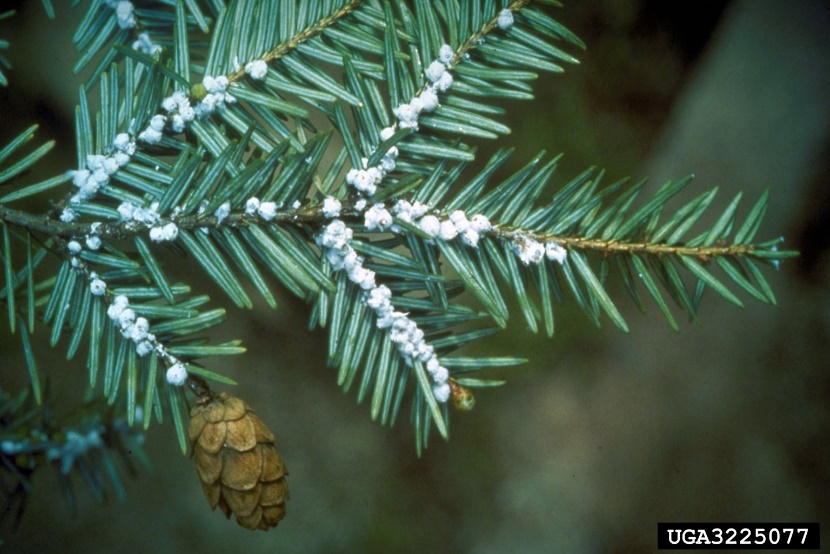
Connecticut Agricultural Experiment Station/Bugwood.org photo Branches of a hemlock tree shows hemlock woolly adelgid, an invasive species. The Wild Rivers Invasive Species Coalition surveys for HWA during the winter months, as HWA produces waxy ovisacs at the base of needles that are easy to spot.
To learn more about HWA, go to WRISC’s website at www.wrisc.org, or www.michigan.gov/invasives.
Wild Rivers Invasive Species Coalition is a cooperative invasive species partnership operating in Dickinson, Menominee, Florence, Forest, and Marinette Counties. They are dedicated to the management of invasive species on lands and waters through cooperation, education, prevention, and control.
-
- Kyle Hafeman, from Wild Rivers Invasive Species Coalition, inspects a hemlock branch.
-
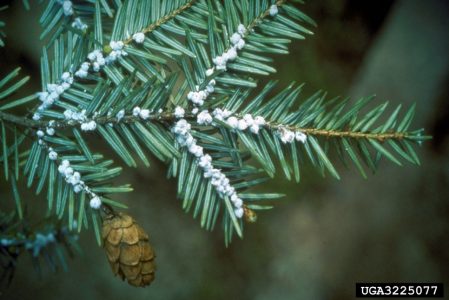
- Connecticut Agricultural Experiment Station/Bugwood.org photo Branches of a hemlock tree shows hemlock woolly adelgid, an invasive species. The Wild Rivers Invasive Species Coalition surveys for HWA during the winter months, as HWA produces waxy ovisacs at the base of needles that are easy to spot.
Local News
Career Day at Florence County High School
Dickinson clerk issues 2025 report
IRON MOUNTAIN — Dickinson County Clerk/Register of Deeds Carol K. Bronzyk has issued her annual activity report ...
Animal rights group sues Michigan over coyote killing seasons
Kingsford seeks engineering bids for two city projects
IM to end deer pen at City Park