
Don’t tempt them: Bears out in search of calories
Northwoods Notebook
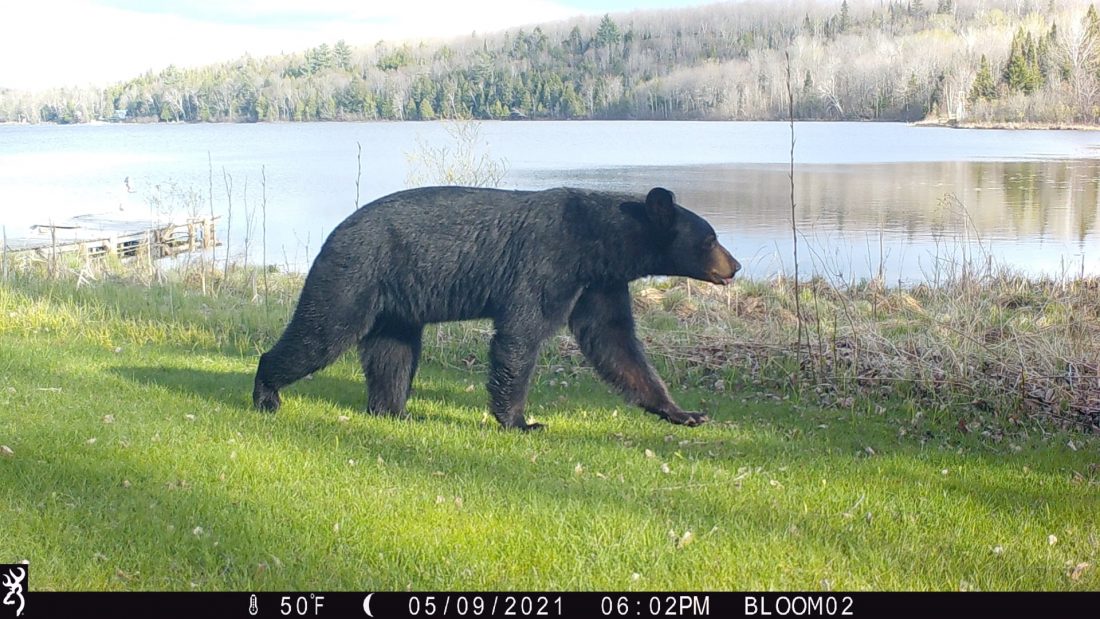
A black bear strolls unaware of a trail camera at Six Mile Lake in northern Dickinson County on Mother’s Day.
Mother’s Day brought an unexpected visitor to Six Mile Lake.
It probably wasn’t the first time this particular bear had been in the backyard — a metal hopper-style bird feeder left out overnight by mistake a couple weeks earlier had ended up on the ground, one side’s perches twisted beyond use, the handle warped into a cone shape and the metal hook it was on pulled from aiming skyward to toward the ground and almost broken off from the deck post.
But the Mother’s Day bear was the first brazen enough — or hungry enough — to make a daytime appearance, crouching underneath the platform feeders to scoop up fallen sunflower seeds. My mom rapping on the glass from the window seat got it to retreat, but it lingered long enough to capture several images on both her cell phone and the trail camera in the yard. She was able to drive it off and bring in the bird buffet of grape jelly, oranges, nectar feeders and, most importantly, suet.
Bear activity definitely is up in the Upper Peninsula, home to roughly 80 to 85% of Michigan’s black bears, said Cody Norton, large carnivore specialist with the state Department of Natural Resources.
Michigan’s bear population generally has been rising over the past decade, with the most recent estimated count in 2019 at 9,900, not including cubs, up 16% from 2012.
In the past few weeks, “definitely, it’s been rampant, up and around the U.P.,” Norton said.
While most bears emerge from hibernation in mid-April, it takes awhile for them to get the metabolism back up after months of sleeping, Norton said.
But once fully roused, bears need calories. Yet natural foods usually haven’t grown or become available enough to put the pounds back on, Norton explained.
Bird feeders stocked with black oil sunflower seeds or peanuts offer protein and fat. Add tasty chunks of rendered beef tallow laced with seeds or peanut butter and, well, who can blame the bear?
“That’s what our nuisance calls are — people having attractants,” Norton said.
If a bear plunders feeders, Norton normally recommends removing everything for at least a couple of weeks, so the bear doesn’t come to consider it a reliable food source. While bears don’t have territories, they do patrol a home range — 10 square miles for females, 77 square miles for males — so likely will return in time, Norton said.
If you decide it’s safe to resume feeding, only put out feeders that can be taken in each evening, as most bears come in after dark.
The other main draws for bears are garbage and grills. Consider your own reaction to the scent of grilling meat. Then keep in mind a bear has a much more sensitive nose. Any drippings and scraps left after grilling out can lure them in, so Norton recommends thoroughly cleaning the grill after use.
As to garbage, storing all refuse in a sturdy building until it can be picked up or otherwise disposed of off-site is essential. Cans probably won’t thwart a determined bear unless enclosed in some way. And even sheds, outbuildings and porches can be vulnerable if they have a window the bear can pop off and wriggle through.
For those getting into the growing hobbies of keeping chickens or bees — another major source of bear nuisance complaints — Norton strongly suggests electronic fencing around the coop or hives to deter bear break-ins.
The good news is the bears rarely are a real danger to humans. Most bears flee when confronted, as long as they aren’t cornered and have an escape route, Norton said.
The other good news is as May stretches into June, the natural foods should increase, making them less motivated to risk coming up to human habitation to raid the feeders. Though that’s no guarantee they’ll not stop by occasionally to check out what’s available.
“They’re kind of masters of taking advantage of different food sources,” Norton said.
The bad news is come June through mid-July, the sows that have yearling cubs will start looking for mates for the next batch — and send their juveniles out to fend for themselves. It’ll likely trigger another round of complaints, this time from young bears looking for an easy meal.
If a bear becomes a true nuisance, the DNR can step in to look at relocation or hazing, but that’s usually a last resort, Norton said. Instead, he recommends those who have bear problems contact their local DNR office — for Dickinson and Iron counties, it’s primarily the Crystal Falls site at 906-875-6622 — so a report can be filed to better document bear activity in the region, see if a pattern has developed and whether it might be one rogue bear or multiple.
The DNR also can have someone visit the location to help determine what steps can be taken to discourage the bear from coming back, Norton said.
Betsy Bloom can be reached at 906-774-2772, ext. 240, or bbloom@ironmountaindailynews.com.
Local News
Migration hits the brakes in icy weather

Evers vetoes GOP bills for no tax on overtime and tips
Trump administration plans closure of 4 Michigan forestry research centers
The Archives seeks township information
FELCH TOWNSHIP — The Archives — representing Breen, Felch and West Branch townships — is updating its files ...
Northwood Beekeepers to host apiary inspector
FLORENCE, Wis. — Northwoods Beekeepers will host Patrick Sizemore, apiary inspector for the state of Wisconsin, ...
Registration open for ‘Raise the Roof’ golf outing
KINGSFORD — Registration is open for the 2026 "Raise the Roof" golf outing, a major fundraiser for Habitat for ...