
WWII US Navy veteran Earl Snyder still going strong at 98
A Salute to Our Veterans
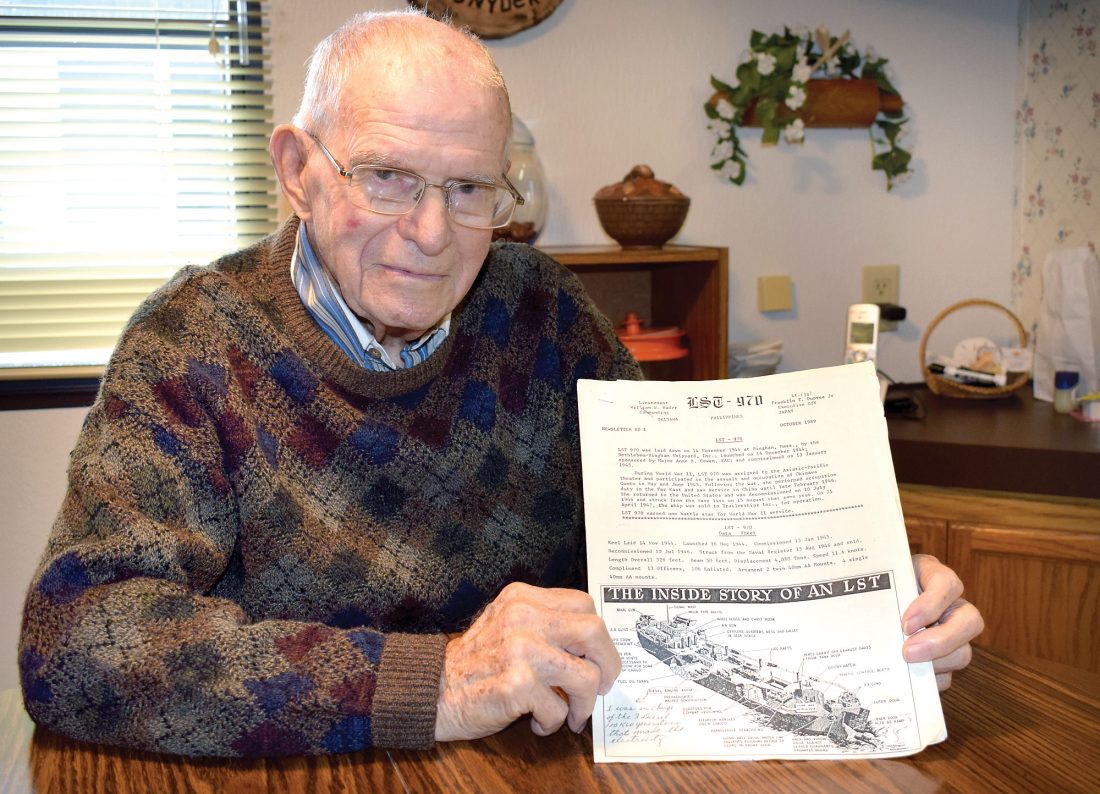
WORLD WAR II veteran Earl Snyder of Iron Mountain displays a newsletter from 1989 that a former shipmate put together for a number of years about LST-970, the ship Snyder served on as a motor machinist’s mate 1st class. He said the newsletter taught him many things about the U.S. Navy vessel that he didn’t know while serving. (Terri Castelaz/Daily News photo)

IRON MOUNTAIN RESIDENT Earl Snyder stands by his photo on the wall of the USS LST 393 Museum, where a ship is harbored on Lake Michigan in Muskegon, Mich. (Submitted photo)
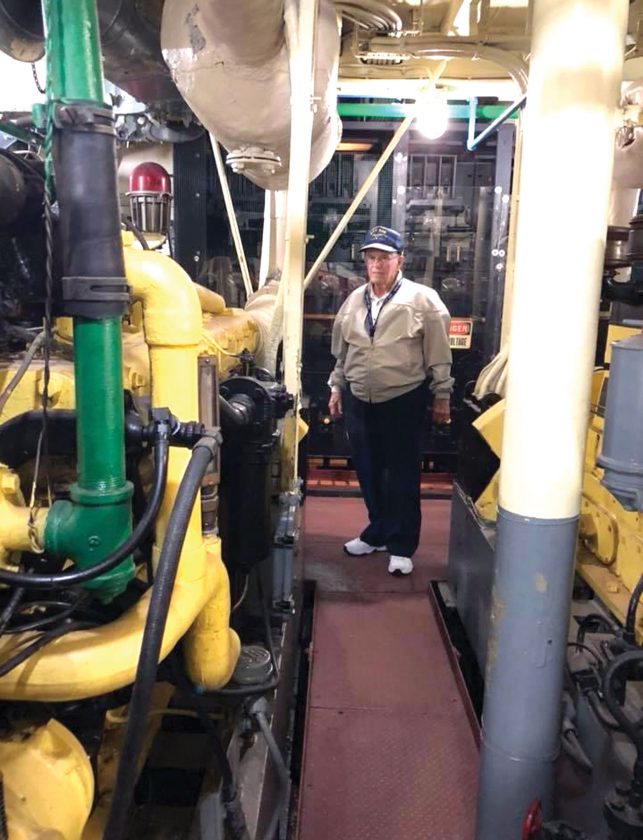
Earl Snyder tours the engine room of the LST Museum in Muskegon. (Submitted photo)
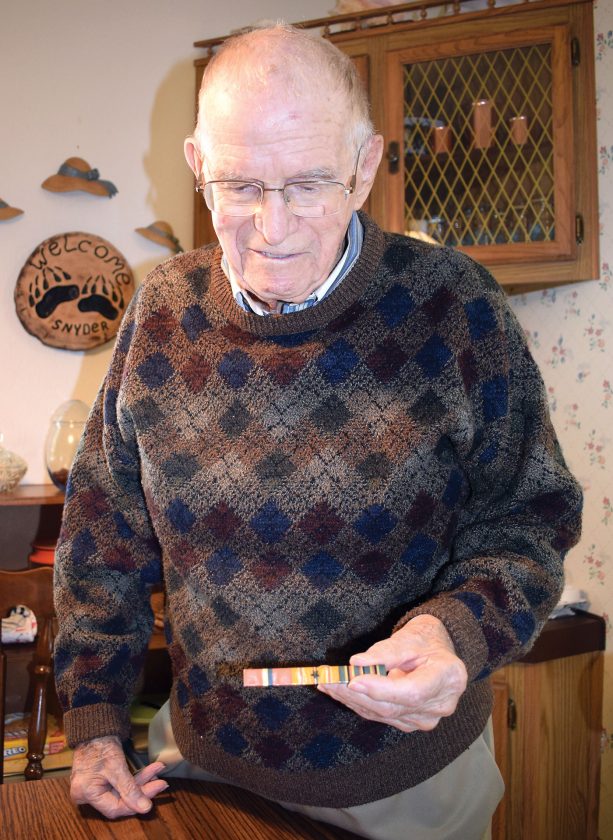
WORLD WAR II veteran Earl Snyder of Iron Mountain shows one of the medals he received while serving in the U.S. Navy from 1942 to 1945. (Terri Castelaz/Daily News photo)
WORLD WAR II veteran Earl Snyder of Iron Mountain displays a newsletter from 1989 that a former shipmate put together for a number of years about LST-970, the ship Snyder served on as a motor machinist’s mate 1st class. He said the newsletter taught him many things about the U.S. Navy vessel that he didn’t know while serving. (Terri Castelaz/Daily News photo)
IRON MOUNTAIN RESIDENT Earl Snyder stands by his photo on the wall of the USS LST 393 Museum, where a ship is harbored on Lake Michigan in Muskegon, Mich. (Submitted photo)
Earl Snyder tours the engine room of the LST Museum in Muskegon. (Submitted photo)
WORLD WAR II veteran Earl Snyder of Iron Mountain shows one of the medals he received while serving in the U.S. Navy from 1942 to 1945. (Terri Castelaz/Daily News photo)
Trending
IRON MOUNTAIN -- It's been 76 years since World War II veteran Earl Snyder served his country, but the stories the 98-year-old Iron Mountain resident shares are as fresh as the day he experienced them.
At age 19, Snyder joined the U.S. Navy. In August 1942, he left to do two months of basic training at Naval Station Great Lakes in North Chicago, Ill., before being sent to diesel school at the University of Missouri in Columbia, Mo.
"The Navy decided what trade I would learn," Snyder said. "The military had a big need for diesel mechanics, as war was being fought around the world."
By Christmas 1942, he was on a troop ship in Guantanamo Bay, Cuba, heading to Trinidad in the British West Indies.
While en route, the Navy ships kept a close watch for enemy submarines, he said, adding, "They were everywhere."
The Navy's repair base in Trinidad was for vessels on the escort route that needed service. "It had a complete foundry and machine shop -- everything we needed," Snyder said.
He kept very busy for the 20 months he was stationed in Trinidad, he said.
He laughs about the nights spent on the beach drinking rum and Coca-Cola. "Rum was the drink, as they had sugar cane fields," he said.
Snyder also proposed to his wife, Ethel, while in Trinidad. "I sent my parents money to buy an engagement ring for Ethel's birthday in February (of 1944), as we planned to marry when I had a 30-day leave in August," he said.
After his leave, he received his orders assigning him to the USS LST-970 in Boston.
Motor Machinist's Mate 1st Class Snyder was in charge of the diesel generator room while aboard.
"The ship was launched in December of 1944 and was commissioned in January of 1945," he said.
Snyder explained that these tank landing ships were used for everything during the war -- primarily for troops, tanks, jeeps and trucks to hit the beach.
The LST-970 was assigned to the Asiatic-Pacific Theater. "We delivered 100 ton of ammunition to Okinawa so they could 'shell' the beach," Snyder said.
Being only about 350 miles from Japan, the worst thing they dealt with was suicide planes that would try to dive into the ships. "They would give their pilots a drink of sake and send them on their way as a human bomb," he said. "This went on all the time, morning and night."
He said the destroyers, which were parked halfway between Okinawa and Japan, would warn other ships that the kamikazes were coming. The 60 to 80 ships in the open waters would create a smoke cover so the planes were unable to locate them.
"Each night it was like fireworks," he said. "The larger ships would fire onto the beach, with the direction of the Army telling them where to place them."
This would "soften it up," he explained, so the Marines and Army could advance a little each day.
"That's the way they took Okinawa -- it was a bloody deal," said Snyder, as it took three months -- April to June -- to take over the island.
"The Japanese wouldn't give up," he said. "They would rather die than give up."
Shipmate and cook aboard the USS LST-970 was actor Harry Dean Stanton, who was known for many roles in his six-decade career, including "Pretty In Pink," "Christine," "Alien," "Cool Hand Luke" and "Repo Man."
Snyder said they ate pretty well, considering limited supplies. A special treat for the crew would be ice cream, which they received from the larger ships after delivering ammunition.
Laundry also was challenging while on the ship, as they would have to tie their clothes to a rope and hang it off the back so the agitation of the propellers would clean their uniforms.
Snyder said his pay started at $54 a month when he joined, but after diesel school and becoming motor machinist's mate 1st class he jumped up several pay grades.
"As soon as you go out of the U.S. you got 10 percent more pay, which put me a little over a $100 a month," he said.
They received very little news of what was happening during the war.
Letters went back and forth but would be a little slow in reaching them.
"Ethel had sent me a package at Easter time, which included hard-boiled eggs. I didn't get them until a month later -- they were rotten," he said with a laugh, but he did get to enjoy the candy.
On Sept. 15, 1945, he headed for home on the Liberty ship from Manila in the Philippines. He noted that cook Stanton also was discharged at the same time.
The military used a point system for sending soldiers home, with 40 points needed to qualify. One point was given for every month served overseas. "I only had 32 months in, but I was married, which earned me 10 points, so that put me over," he said.
Snyder was asked to stay, as they wanted to promote him, but he declined.
His return trip took awhile, as they were on the Liberty 20 days, with a layover in Pearl Harbor and San Francisco. "Then we got on a train that took three days to come back to Great Lakes, because there was no diner and they needed to stop three times a day to eat," he said.
Snyder received the Asiatic Pacific Medal with one star, American Area Campaign Medal and Philippine Liberation Medal.
After the service, he went on to have a career as a printer for 40 years in Green Bay, Wis.
"A shipmate gave me the address to his father's printing business in downtown Green Bay. After meeting with him over lunch, he asked me if I wanted to go under the G.I. Bill as an apprentice pressman," Snyder said. He spent a decade there before leaving to work at a paper mill.
He and his wife enjoyed 68 years of marriage until Ethel died Aug. 4, 2012. They had six children -- Gloria Sandberg of Oconto, Wis.; Mary Snyder of Florida; Steven Snyder of Gwinn; Amy Anders of Iron Mountain; William Snyder of Fond du Lac, Wis.; and the late Kathy Snyder. In addition, he has five granddaughters, 10 great-grandchildren and five great-great-grandchildren.
After retiring, he moved to Iron Mountain in 1987. They also spent six months of the year in Florida.
The son of Bill and Margaret Snyder grew up in Oak Orchard, in the town of Pensaukee in Wisconsin's Oconto County. His older brother, Frank, now deceased, served in the U.S. Army during World War II and his younger brother, Don, now 91, served in the Korean War.
In 2018, he was able to tour the LST-393 Museum that is harbored on Lake Michigan in Muskegon, Mich.
"His granddaughter had learned about the museum and saw they had shipmates' pictures hanging, so she contacted them and now his photo is on the wall," said his daughter, Amy Anders.
She said they had to go down to the LST's engine room so he could explain his duties. "It was so fascinating, seeing everything and him telling us about how everything worked," Anders said.
He was able to be part of the U.P. Honor Flight in 2011 and last year had a brick with his name on it placed at the Veterans Memorial on top of Pine Mountain.
For his birthday in April, he was presented with a flag from Wisconsin Sen. Ron Johnson that had flown over the U.S. Capitol.
Snyder's family says he is a true historian -- he pores through newspapers and often brings out articles he saved.
"He loves to read and goes to the library all the time," Anders said.
He still has the notification, dated May 7, 1945, from President Harry Truman proclaiming Germany's unconditional surrender and encouraging soldiers to now go forward to a speedy and complete victory in the Pacific.
"I can't remember what I had for supper last night," Anders noted, "but he can remember details like these."
Snyder still resides in his own home, does his own housework and drives himself. A recent bout of COVID-19 that caused some dizziness did make him use a cane but only temporarily and he now is considered fully recovered.
"I like to stay busy -- it keeps me going," he said.