As nature sees it …
Northwoods Notebook
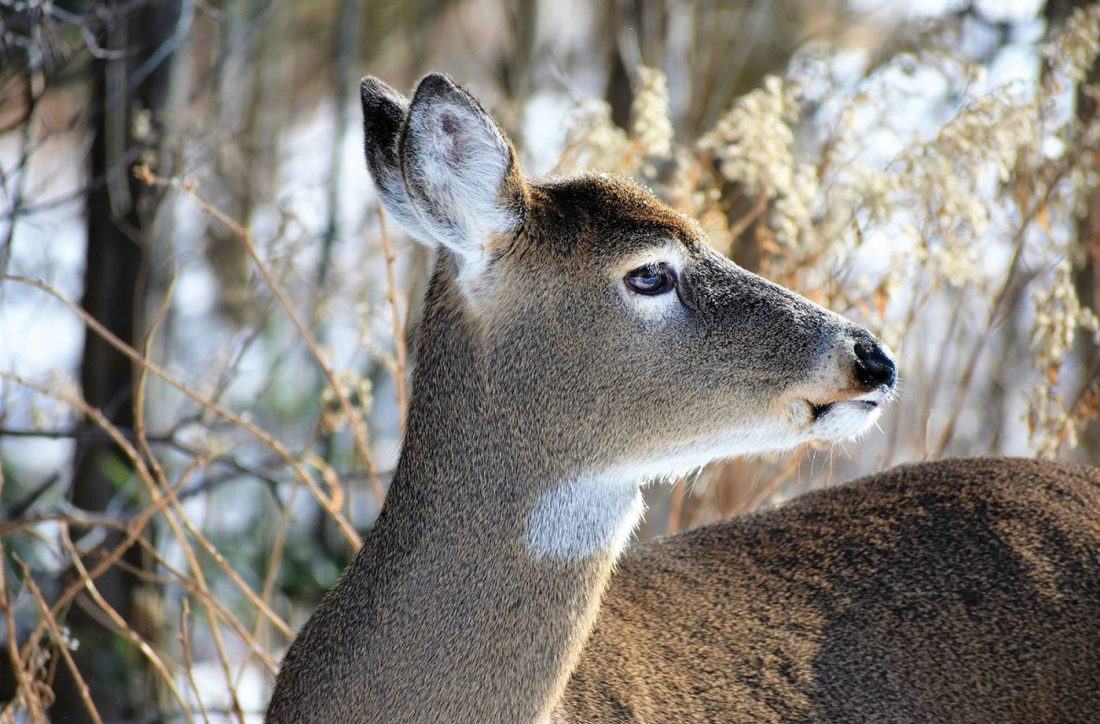
Deer share the trait of rectangular pupils with sheep, goats, horses and antelope. It helps create a panoramic view for detecting predators. (Betsy Bloom/Daily News photo)
Among all critters, the shape of pupils serves a purpose
In watching the backyard deer, especially in winter, some of the does that visit frequently become almost familiar, especially if they have a trait or two that can distinguish them from the rest of the herd.
One in particular has been around at least three years. She has a more domed forehead, is bigger boned and has a shorter-legged, stouter frame. But even more distinctive are paler, near-amber eyes, in contrast to her mostly brown-eyed brethren.
The lighter color makes her rectangular pupils stand out, which cued my curiosity: Why do animals have different types of pupils?
The three most common pupil shapes are round, vertical and rectangular, or horizontal. Turns out the type of pupil an animal has can provide clues as to its probable role in the natural world, according to research the journal Science Advances published in August 2015.
Deer share the trait of rectangular pupils with sheep, goats, horses, antelope — sensing a pattern here? All are potential prey species that need to be able to scan a wide area to watch for predators.
“Horizontally elongated pupils create sharp images of horizontal contours ahead and behind, creating a horizontally panoramic view that facilitates detection of predators from various directions and forward locomotion across uneven terrain,” according to Science Advances, www.science.org.
These species have their eyes set far back on the sides of the head as well, to further extend the field of vision.
Researchers also found that grazers such as horses and sheep were able to rotate their eyes in the socket, in different directions, to keep the view level with the horizon even with their heads down.
Predators, however, usually have round or vertical pupils, along with eyes set in front of the face. Smaller predators — cats, foxes — tend to have the vertical shape that helps in focusing and estimating distance from prey, useful for hunting by ambush. It seems to aid in night vision as well, as it can be contracted to mere slits to protect the retina in daytime.
But in an interview on National Public Radio in August 2015, two of the scientists behind the Science Advances research article said vertical pupils are only useful if the animal is short, so its eyes aren’t too high off the ground.
“So for example foxes, in the dog lineage, have vertical pupils, but wolves have round pupils,” Bill Sprague, then at the University of California, Berkeley, told NPR.
The same with lions and tigers — and humans. Round pupils seem to be common in taller hunters that actively chase down their prey, Martin Banks, a professor at the University of California, Berkeley, told NPR.
Owls and other birds of prey, too, have round pupils, which fits with the hunting from heights theory, while snakes and crocodilians — built low to the ground — have vertical pupils.
Going back to deer, some other facts gleaned off the internet on deer eyesight, based on research done at the University of Georgia: they see more poorly than humans from distance but have much better night vision; they can make out the colors yellow and blue but do badly discerning reds or greens; they key to even small movements and need to look from different angles to get a 3-D image given the wide spacing between the eyes.
Betsy Bloom can be reached at 906-774-2772, ext. 240, or bbloom@ironmountaindailynews.com.
Local News

High school artists featured at Florence visitors center
County boards get update on mental health services
IRON MOUNTAIN — Northpointe Behavioral Healthcare System provided services to 1,582 people in Dickinson, Iron and ...
Blizzard brings region to standstill, to have effects for days

Report: Michigan lags US in outdoor economy growth
Knotty Pine walk April 25 to benefit UP Pink Power
GWINN — A 17-mile walk from the Knotty Pine to the Up North Lodge will take place Saturday, April 25, to support ...