Avian lockdown: Stop backyard feeding to fight bird flu, some experts say
Northwoods Notebook
-
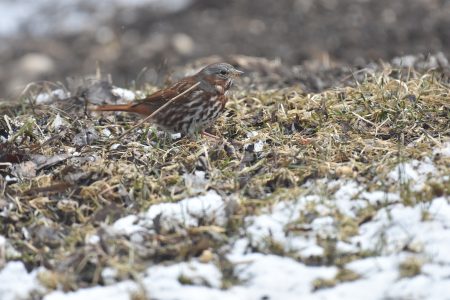
- A fox sparrow forages for seeds through the grass, dirt and snow at Six Mile Lake in Felch Township. Sparrows are among the earlier migrants to return in spring; fox and song sparrows both made an appearance in the backyard this past week. They tend to prefer to chicken-scratch on the ground rather than land on the feeders. (Betsy Bloom/Daily News photos)
-
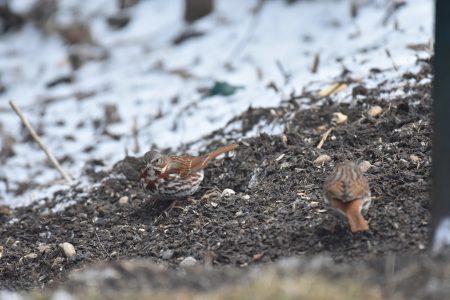
- A pair of fox sparrows provide a front and back view of how the species got its name. Sparrows are among the earlier migrants to return in spring; fox and song sparrows both made an appearance in the backyard this past week.
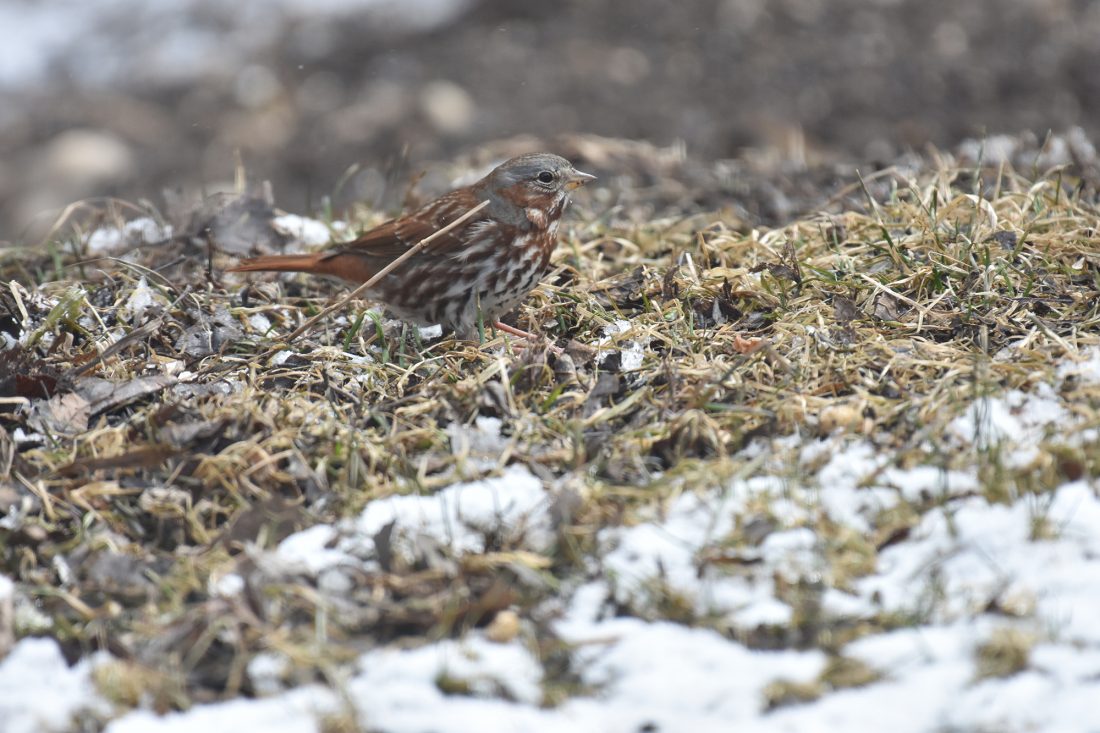
A fox sparrow forages for seeds through the grass, dirt and snow at Six Mile Lake in Felch Township. Sparrows are among the earlier migrants to return in spring; fox and song sparrows both made an appearance in the backyard this past week. They tend to prefer to chicken-scratch on the ground rather than land on the feeders. (Betsy Bloom/Daily News photos)
Avian influenza — “bird flu” — officially arrived in the Upper Peninsula this past week, in Menominee County.
While it occurred in a non-commercial backyard poultry flock of about 50 domestic fowl, it can be assumed it was spread by wild birds. The birds at the Menominee County site were expected to be “depopulated,” which means euthanized.
This Eurasian strain of avian influenza already had been reported in Wisconsin and in downstate Michigan, likely brought in as spring migration has advanced.
The onset of this highly pathogenic avian influenza, or HPAI, has raised questions about continuing to feed backyard birds, a practice that for some — myself included — has become something of an obsession.
The experts, for now, are mixed in their advice. The Raptor Center at the University of Minnesota this week recommended putting all feeders away for several months “until the rate of virus transmission in wild birds dramatically decreases.”
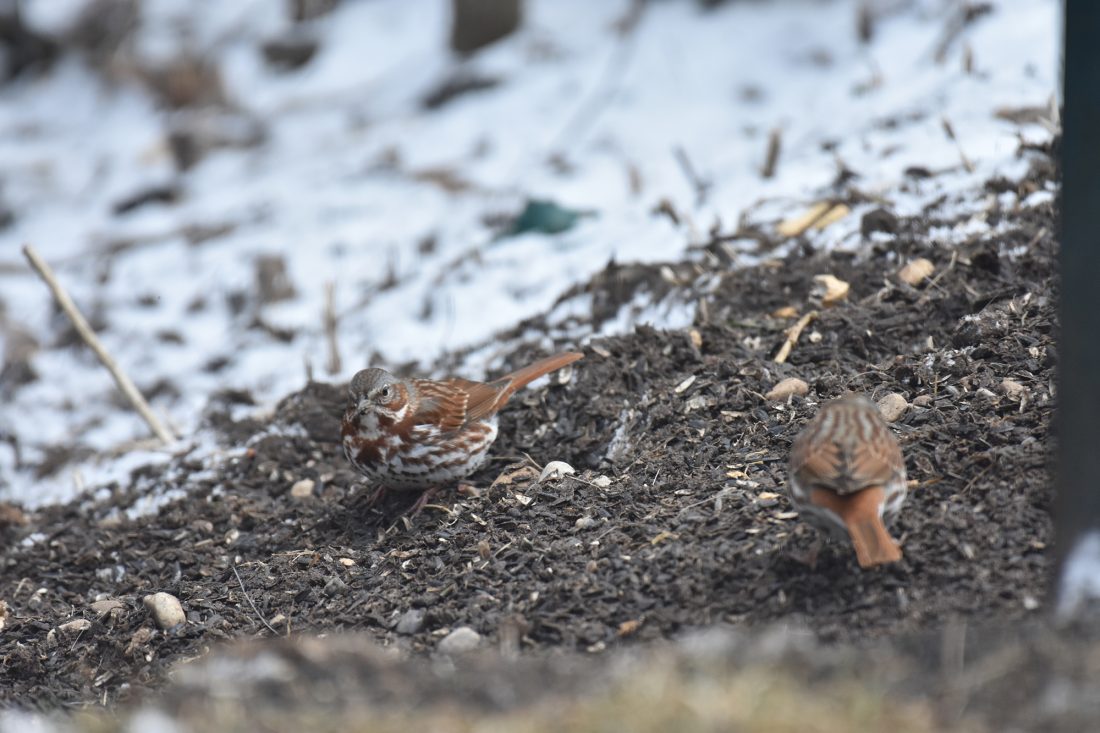
A pair of fox sparrows provide a front and back view of how the species got its name. Sparrows are among the earlier migrants to return in spring; fox and song sparrows both made an appearance in the backyard this past week.
The center has been dealing daily with birds of prey, especially bald eagles, that “are intensely suffering from fatal neurological illness due to HPAI,” Dr. Victoria Hall wrote in a message posted on the center’s website at https://raptor.umn.edu/. The only option, she said, is euthanasia.
Raptors seem to be most affected and for them it’s lethal; it’s also caused severe illness in waterfowl — geese, swans, ducks — and the corvids such as jays, crows and ravens, according to the center.
While songbirds don’t seem to suffer similar effects, “it is important to remember that all bird species are susceptible to HPAI — but how they show or do not show signs of illness and the role they play in carrying and spreading the disease will vary. This virus is shed in the feces and respiratory secretions of infected birds and is very hardy, with virus particles able to survive for weeks in cool, damp environments,” the center advised.
Its recommendation: “Because the science is unclear on the role of songbirds in this current H5N1 outbreak, one consideration is to not encourage birds to gather together at places such as bird feeders or bird baths. These are places where things like viruses could easily be exchanged between individuals.”
Hall concluded her message with “Not only will this action help to protect those beautiful feathered creatures that visit your yard, but will also help all wild bird species that are already having it hard this spring because of HPAI. We have it in our power to take a short-term action so we are not accidentally assisting in the virus’ spread. This outbreak won’t last forever and I, for one, am greatly looking forward to when I can safely hang my bird feeders back up!”
The Wisconsin Department of Natural Resources didn’t go as far as the Raptor Center in its guidance on feeders after H5N1 was detected in wild birds and domestic fowl in the state in March.
The Wisconsin DNR posted on its website: “Based on research findings, songbirds are considered a low-risk species for infection when in their natural environment. At this time, we are not recommending that people take down their bird feeders, however, if waterfowl are attracted to bird feeding sites, we recommend discontinuing those feeders during this HPAI event.”
The Wisconsin DNR does ask that anyone who observes a bird in Wisconsin showing neurological signs such as circling, tremors or holding their heads in an unusual position make a report to the DNR Wildlife Hotline by emailing to DNRWildlifeSwitchboard@wisconsin.gov or calling 608-267-0866.
So which advice to follow? The safest course would be to remove all potential spots where birds could gather, as it’s likely a feeder with seeds and suet would draw in not just songbirds but blue jays and some of the other species that have proven more susceptible to the virus.
But I can’t deny it’s an emotional gut punch. It’s like hearing spring itself has been cancelled.
Welcoming the various birds that spend the winter in Central America, even South America, back in late spring with a buffet of fruit, suet, seeds, nectar is a task many in the Upper Peninsula and northern Wisconsin don’t just rise to meet, they look forward to providing the bounty. It’s not unlike putting up lights at Christmas or stocking up on candy to hand out at Halloween.
These “neotropical” species provide some of the first spring colors, long before most flowers begin blooming. The orange of orioles, the deep blue of indigo buntings, the pink triangle on rose-breasted grosbeaks, the iridescent red and emerald of ruby-throated hummingbirds. At Six Mile Lake, the occasional scarlet tanager would be drawn in by the offerings of grape jelly.
Yes, I know birds existed long before we were here and will do just fine without our handouts. I fully acknowledge my feelings of loss are completely my own. Yet it still makes for a spring that seems diminished.
In the worst of COVID-19 isolation, when people were told to hunker down at home, watching and feeding backyard birds became one of the safe practices we still could do.
So now, as coronavirus appears to be receding, we have another contagion to adjust to, that alters what we’ve done in the past. Yes, the world has other problems far more serious. That doesn’t make this one, emerging as the parade of backyard birds picks up, any less sour.
Still, I’m inclined to take the stricter approach and take down the feeders. My mom, a former nurse who worked in about any capacity you can think of in health care, thought it would be a good move. I trust her knowledge in how pathogens spread. Perhaps we’ll risk a hummingbird feeder, since that’s more specialized and less likely to draw a variety of birds together; it’s also easier to thoroughly clean daily. I’m still mulling things over. It’s going to be tough to go cold turkey.
Betsy Bloom can be reached at 906-774-2772, ext. 240, or bbloom@ironmountaindailynews.com.
Local News
BTS superintendent to meet with public
KINGSFORD — Breitung Township Schools Superintendent Aaron Yonke will host a meeting with the public from 8 to 9 ...
Recall petition filed against 4 Dickinson board members
IRON MOUNTAIN — Four members of the Dickinson County Board have been targeted for recall after 2025 votes that a ...

Gilchrist drops bid for governor, takes aim at secretary of state
Wisconsin bill would require 60 minutes of recess in K-6 schools

Sale completed of Eagle Mine and Humboldt mill