
A good spring for insects
Northwoods Notebook
Trending
It's finally gotten warm enough during the day to bring the insects out in force.
Some, like the tiger swallowtail butterflies and various dragonflies that began to pop up in profusion in the past week, are welcome when they emerge from wherever they spent the winter, most as nymphs or pupae.
Others, like the black flies and mosquitoes, are the price paid to see winter's chill finally yield to daily high temperatures consistently in the 60s and 70s, even a few 80s. Not sure what others have endured so far from the pests, but a black fly managed Memorial Day weekend to raise a welt under my right eye that looked like I'd been punched.
If the windshield on my vehicle is any gauge, this looks like a good spring for insects, though somewhat slow in developing due to a cool April and early May. The pollinators finally seemed to get going just as the chokecherries and then crabapple and apple trees came into bloom. For the bumble bees, the ones active now are queens that mated last year and hibernated over the winter. When they come out in the spring, they look for a suitable nest site to set up a new colony, then gather nectar and pollen to feed the first batch of larvae until they develop into worker bees that can take over the foraging role, according to the Xerces Society. It's one of the reasons for promoting No Mow May, as dandelions can be an important early flower source for bees.
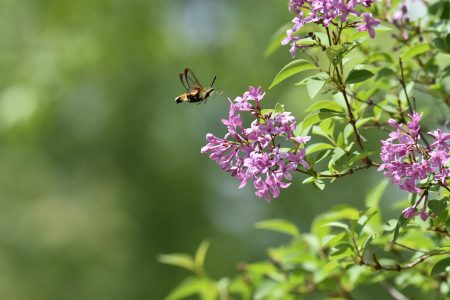
When temperatures soared into the 80s Monday and Tuesday, it seemed to trigger the lilacs at Six Mile Lake to burst into full bloom, drawing in all manner of nectar-loving insects.
One of the more unusual is the snowberry clearwing moth. Though a variety of sphinx moth, the snowberry clearwing at first glance appears to be a hummingbird, hovering from flower to flower. But these are significantly smaller than even our most diminutive of birds.
As with hummingbirds, they have adapted a body and feeding style suited to tapping for nectar, down to the rapidly beating wings and fan "tail" for maneuvering. It allows them to probe for nectar in roughly the same fashion as hummingbirds, though they use a long, coiled proboscis like a straw to sip deep inside a flower. Interestingly, researchers in 2018 published a study that fossil records showed the proboscis on moths and butterflies predated the emergence of flowering plants.
The snowberry clearwing is among four varieties of "hummingbird moths" in North America, though only two are thought to occur in the Upper Peninsula. The other is the hummingbird clearwing. Although color can vary somewhat, the snowberry clearwing can be distinguished from the hummingbird clearwing by the black stripe that runs through the eye down its side and the absence of red, which the hummingbird clearwing has on wings and abdomen. The snowberry also has black legs.
According to the U.S. Fish and Wildlife Service, snowberry clearwings are the more widespread of the hummingbird moths, though more abundant in the west than east, where the hummingbird clearwing is more common. But snowberry clearwings have been recorded in all of the lower 48 states, while hummingbird clearwings have only a few localized areas west of the eastern Great Plains, according to a FWS range map for the two species.
Host plants for their larvae include snowberry, honeysuckle, dogbane and some members of the rose family, such as hawthorn, cherries and plums. The caterpillars are green with a row of small black spots with white borders on each side of the body and a long, black horn on the back end that seems to be for show rather than defense.
The snowberry clearwing can produce two broods in a summer, but the caterpillars that linger into the fall will go down into leaf litter to pupate over the winter. So the ones seen now hatched last summer but didn't emerge as adults until this spring.
They should be easy to see -- and even photograph -- as long as the lilacs last. So watch for these unique little hummingbird lookalikes while they make themselves available.
*****
A few notes about what else seems to be out there as June arrives …
-- This will be peak season for does dropping fawns. A reminder that does will leave their new fawns hidden through the days, returning only a few times to let them nurse. Twins or triplets may even be left at different spots. The fawns instinctively remain motionless when left alone. This is all to avoid detection by predators. So if you stumble across a fawn pressed to the ground, leave it be; it has not been abandoned. The doe likely is not far away but obviously will not return while a human hovers nearby.
-- Painted and snapping turtles will soon begin hauling out on land to lay eggs. So watch for them on the roads. If you come across one that's in the middle of the road and can safely step in, it can help to carry or otherwise assist a turtle in crossing. I watched someone on Memorial Day do just that with what appeared to be a snapping turtle on U.S. 2 near the Bay College West campus in Iron Mountain. Again, emphasis on safety -- don't get hit trying to save the turtle from that fate. And always take the turtle in the direction it was headed, otherwise it probably will turn around and try crossing again.
Betsy Bloom can be reached at 906-774-2772, ext. 240, or bloom@ironmountaindailynews.com.