Smartphones can make us wiser about nature
Northwoods Notebook
-
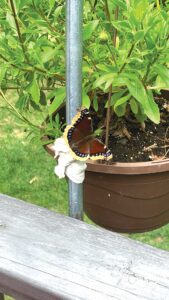
- A mourning cloak butterfly visits a planter at a home in Breitung Township. (Kyle Dorosz photo)
-
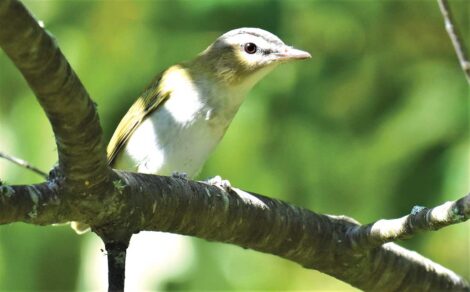
- The red-eyed vireo is legendary for its ability to sing for hours. (Betsy Bloom/Daily News photo)
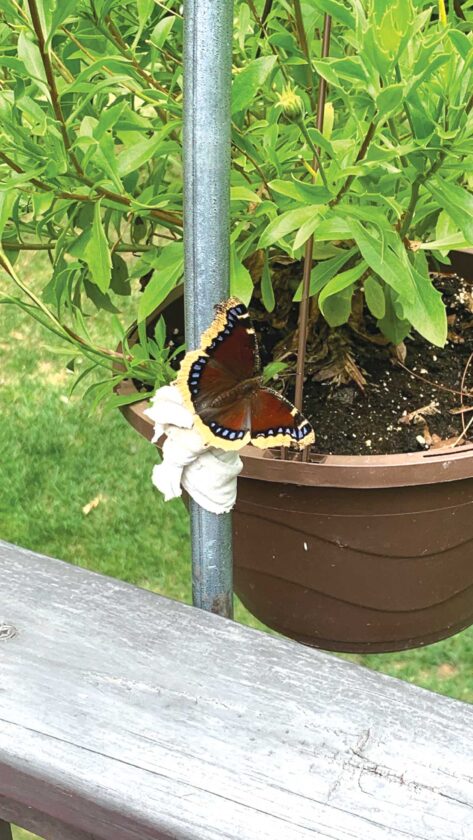
A mourning cloak butterfly visits a planter at a home in Breitung Township. (Kyle Dorosz photo)
A reader, Al Hansen, recently stopped in at the Daily News office with a photo he wanted to share.
It was a lovely butterfly, velvet brown with wings edged in gilded cream and a string of sky-blue spots, that his visiting grandson, Kyle Dorosz, had taken at his home. They did not know what kind it was, so ran it through a phone app that identified it as a mourning cloak.
Grandfather and grandson, a teacher who soon will start classes in the Grand Rapids area, got to share that day in learning what this beautiful creature was in their midst. And then grandpa passed it on at The Daily News.
It made me happy, because they took the time not just to notice a native species but to document it with a photo and, even better, take the extra steps to identify it. Bonus points — they then thought it important enough to pass along so others might learn.
He also described how they hunted to learn what bird was singing in their yard: a red-eyed vireo, legendary for its ability to log long hours in song.
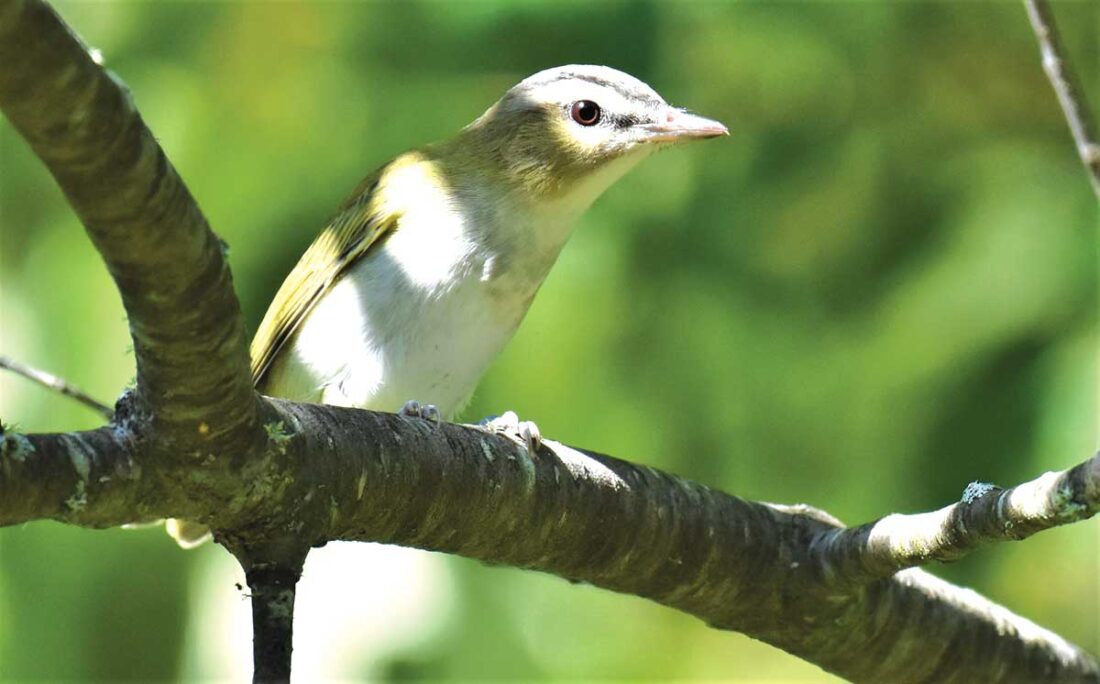
The red-eyed vireo is legendary for its ability to sing for hours. (Betsy Bloom/Daily News photo)
Neither the mourning cloak butterfly nor red-eyed vireo are rare or unusual; quite the opposite, they are common. That doesn’t mean they’re not worth recognizing when seen or heard. They are integral parts of the fabric of the northwoods.
I write this column to try to offer some insights on what can be seen in this area, mostly animals but sometimes plants. Yet I know I am not a true expert on either, especially the plant part.
But we live in an incredible age of the internet and smartphones, that can put so many resources instantly at our fingertips, even when far away from home. Yes, the internet sometimes can be a bad place, with misinformation and divisive takes on, well, almost anything.
Yet on such (hopefully) neutral topics as birds and butterflies, the internet, for all its faults, can be a gateway that allows so many more people to become “citizen scientists.”
In the past, trying to identify an insect, even one as distinctive as a mourning cloak butterfly, or bird might require a visit to the local library to look for a match. That’s not to knock libraries or book sources — we have a host of printed field guides at home, for animals and plants, that I still enjoy reviewing.
But the internet and, in turn, the rise of smartphones can put such information in easy reach while out in the field.
The phones give everyone a camera, video and audio recorder to capture not just photo but sounds and movement. Phone apps can name the best match by look or, if birds, by song.
For those who haven’t connected with such resources, here’s some of the better-rated ones:
— Merlin, https://merlin.allaboutbirds.org/. In this column I’ve long touted the Cornell Lab of Ornithology’s All About Birds website, and this is their phone app that can “identify the birds you see or hear.” According to Merlin, the user is asked to “answer three simple questions about a bird you are trying to identify and Merlin will give you a list of possible matches.” It has options for downloading photos or song recordings as well. Plus, it can allow the user to keep a birding life list. Merlin is free and available on the Apple iPhone App Store as well as Google Play.
— The Audubon Bird Guide App, https://www.audubon.org/app. This gives easy access to the Audubon field guide for North American birds, with more than 3,000 photos, song and call audio clips. It, too, has a format for entering information about the bird seen, then providing possible matches. This app also is free and available at the iPhone App Store or Google Play.
— Leps by Fieldguide, https://leps.fieldguide.ai/figures. The Free Apps for Me site rated this as the top app for butterfly identification, stating, “not only does it provide you with an impressive database but it also gives you a smart UI that is easy and cool to use.” It’s also free of charge and does not carry ads. How it works, according to the website: To identify the insect, open the app, use the camera and take a photo right from the application. It will be automatically uploaded and, if recognized, the app provides a small card with detailed info about the butterfly. The application is available on the App Store, as well as Google Play.
— What’s That Flower?, https://whatsthatflower.com/. This was the top flower recommendation from the Free Apps for Android and iOS site. It not only offers the feature of simply taking a photo for the app to upload and match but also has a search engine to provide characteristics of the flower, such as color or shape, that can help in identifying it as well. As with the others, it can be downloaded at the Apple App Store or Google Play.
The Free Apps for Me site, https://freeappsforme.com, has a host of other categories for animal and plant identification where it ranks and describes what’s out there. So check out its listings and see what best match your needs.
And a final note on that mourning cloak — experts say this probably is our longest-lived butterfly. The ones seen earlier this month emerged as adults in late June and July, fed for a brief period and now have gone dormant until fall. They’ll then come back out and feed again before hibernating, usually tucked away in forest leaf litter or tree bark.
Mourning cloaks are among the few butterfly species to overwinter as adults — most native to the north endure the cold months as eggs or pupae — and likely the first that will be seen back out come spring, sometimes appearing when snow still lingers. Those adults, after surviving eight to 10 months compared with a few weeks as adults for most butterflies, will breed in the spring to bring on the next generation.
A very detailed article on the mourning cloak — and how well-adapted it is for life in a far northern climate — can be read at the University of Wisconsin-Milwaukee’s College of Letters and Science Filed Station website, https://uwm.edu/field-station/mourning-cloak-revisited/.
Betsy Bloom can be reached at 906-774-2772, ext. 240, or bbloom@ironmountaindailynews.com.
Local News
NMU PRSSA to host annual Coffee Crawl
MARQUETTE — The Northern Michigan University chapter of the Public Relations Student Society of America will host ...
Lunchtime Live special edition hints at spring
ESCANABA — Bay College has hosted Lunchtime Live, a midday music-and-food event that takes place weekly on campus ...

Ore Dock Brewery to host Festival of the Angry Bear

Norway third grader in running for ‘America’s Most Artistic Kid’
UP Dark Sky Festival returns to Copper Harbor