Pentoga Park marks 100 years
Lac Vieux Desert speaker honors park’s other legacy as tribal burial grounds
-
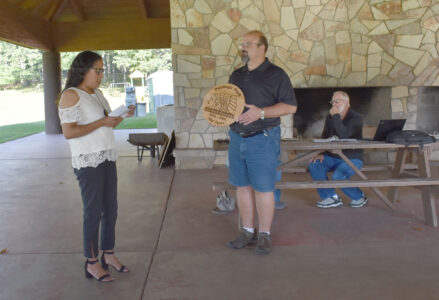
- ALINA SHIVELY, TRIBAL historic preservation officer for the Lac Vieux Desert Band of Lake Superior Chippewa in Watersmeet, speaks Monday about the tribal burial grounds at Pentoga Park during a ceremony marking the 100th anniversary of the park being established on Chicagon Lake. Iron County Board Chair Mark Stauber looks on with a new sign that will be posted in the park noting the centennial; in back is county board member Mike Stafford. (Betsy Bloom/Daily News photo)
-
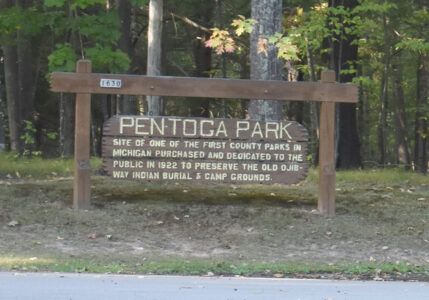
- THE SIGN AT the entrance to Pentoga Park, listing its dedication as a park in 1922 “to preserve the old Ojibway Indian burial & camp grounds.” (Betsy Bloom/Daily News photo)
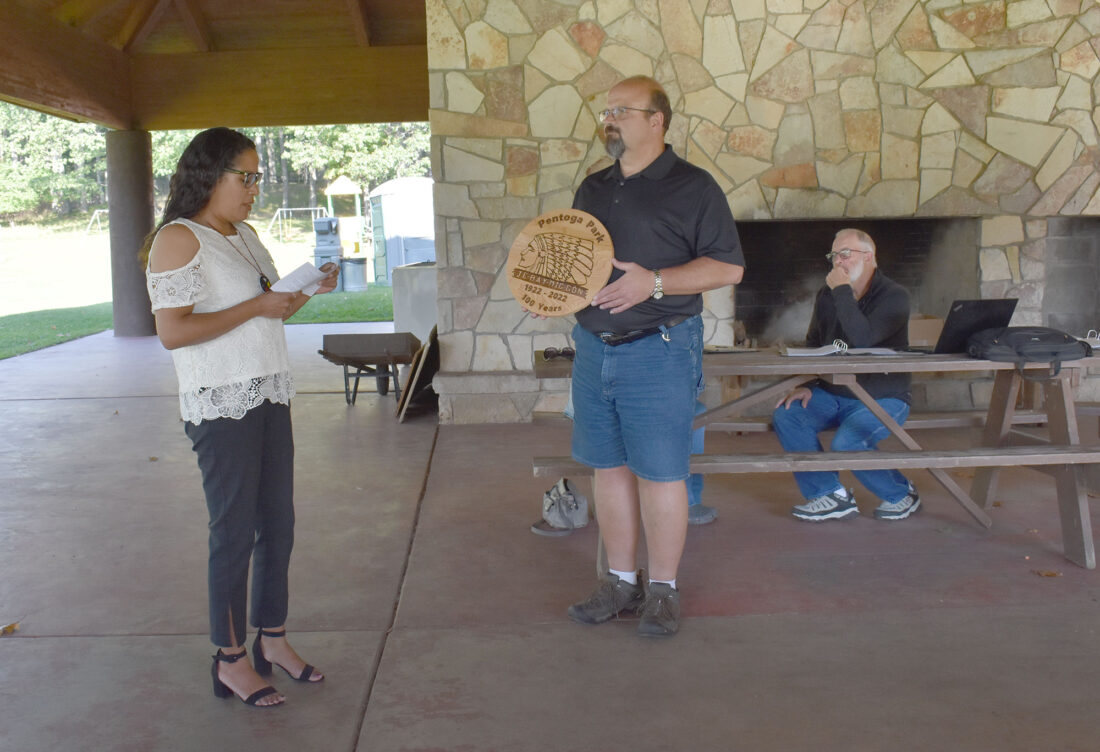
ALINA SHIVELY, TRIBAL historic preservation officer for the Lac Vieux Desert Band of Lake Superior Chippewa in Watersmeet, speaks Monday about the tribal burial grounds at Pentoga Park during a ceremony marking the 100th anniversary of the park being established on Chicagon Lake. Iron County Board Chair Mark Stauber looks on with a new sign that will be posted in the park noting the centennial; in back is county board member Mike Stafford. (Betsy Bloom/Daily News photo)
STAMBAUGH TOWNSHIP — As Pentoga Park celebrates 100 years, those who attended a ceremony Monday to mark the centennial got a powerful reminder that others lived — and died — on the land long before it became an Iron County campground and recreation area.
Alina Shively, tribal historic preservation officer for the Lac Vieux Desert Band of Lake Superior Chippewa in Watersmeet, spoke as the Iron County Board ended its meeting in the park Monday at Chicagon Lake by showing off new signs for the anniversary.
She noted the park’s other signature feature — a hill that is a tribal burial ground.
“Many historical accounts of the Chicagon Lake village reference this sacred place as ‘abandoned.’ The definition of abandoned is ‘having been deserted or cast off,'” Shively said.
But that view is incorrect, she said. Only after being hit hard by imported diseases her ancestors had no immunity to fight did the survivors living on Chicagon Lake join the greater Lac Vieux Desert Community on Lac Vieux Desert Lake.
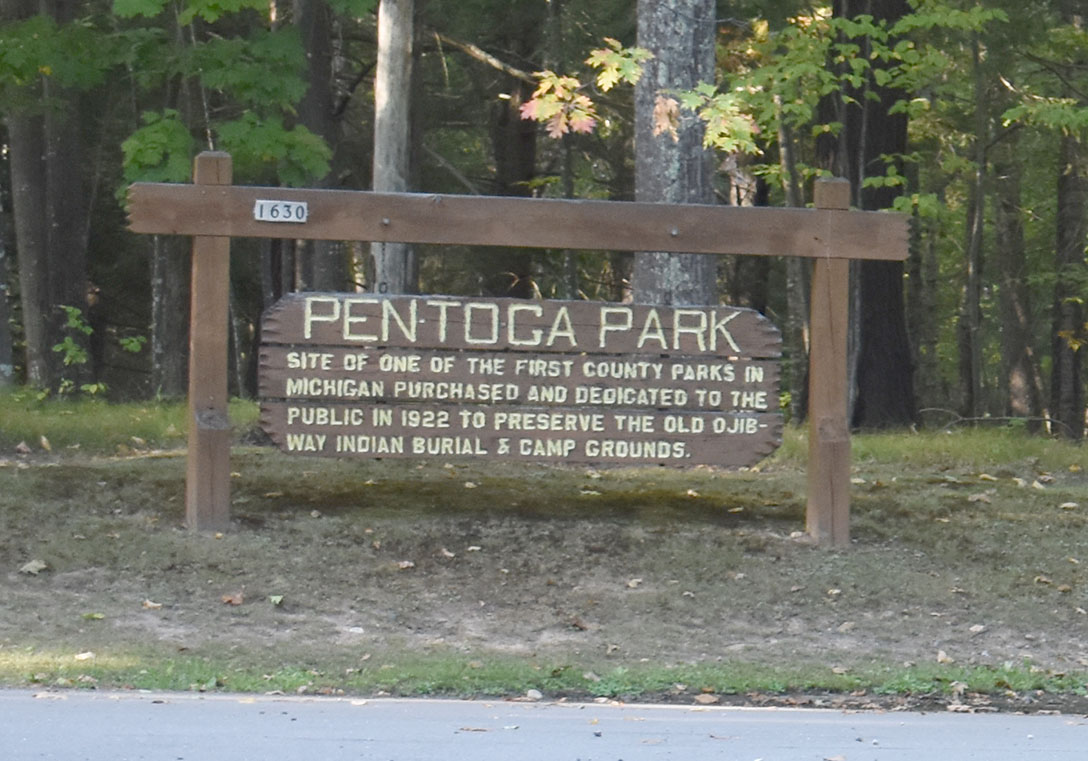
THE SIGN AT the entrance to Pentoga Park, listing its dedication as a park in 1922 “to preserve the old Ojibway Indian burial & camp grounds.” (Betsy Bloom/Daily News photo)
“I tend to imagine what life would be like on this land, had this disease not devastated the happy, thriving, joyful community who lived in this beautiful place,” Shively said, pausing several times to steady her emotions. “I look at the view and I know this is a special place.
“We never chose our homes by mistake. Everything we chose was for a purpose, for the greater good, for survival and for the Creator’s blessing of bountifulness in wildlife, medicine, water, safety and security.”
And while they may have stopped living there, the land was never abandoned — nor the ancestors who still lie there, Shively said.
“They were never deserted or cast off. Burying our ancestors means that we are to ensure that their final resting place is safe and undisturbed,” she said.
“The people buried here are loved and cared for. Their spirits are acknowledged and valued. Their lives mattered. They are family to Anishinaabe people who still live and breathe today. I just want to state that this is a sacred place to the Lac Vieux Desert Tribe. We will always do what is in our power to protect our ancestors who rest here,” she said.
Shively added, “We hope that visitors here will remember that these are spirits who are still very much alive and that our ancestors deserve the same respect as all others.”
Mark Stauber, county board chair, thanked Shively for the history.
He also unveiled the new sign that Rob Olson, a county maintenance employee, created for the park. The larger one will be installed at the entry, while smaller versions will be posted at the office and other locations.
Dedicated in 1922, the park now offers 134 camping spaces, about 65 for seasonal use, all with electricity and water hook-ups. It operates from May 15 until the end of November.
The park usually is full during the summer months, with a waiting list for the seasonal sites, Stauber said. With the seasonal crowd and private residences nearby, “it’s like its own little town here,” Stauber said.
Local News

Northern shoveler, American bittern pause within range for photographs
Forest fuelwood permits now available from DNR
LANSING, Mich. — State forest fuelwood permits are available for Michigan residents interested in collecting ...
Middle school Girls’ Dream Fair on May 14 at MTU
HOUGHTON — Middle school girls from across the western Upper Peninsula will gather at Michigan Technological ...

Iran war sends inflation soaring, consumers’ mood plunging

Documenting the dairies