Tufted titmouse highlights Christmas Bird Count
Northwoods notebook
-
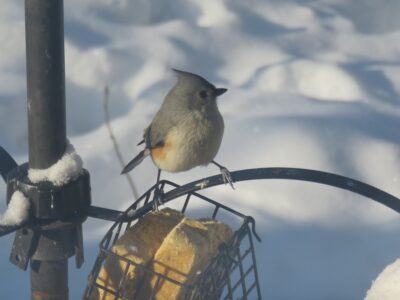
- (Phyllis Carlson photo) A tufted titmouse was a new bird recorded during the annual Christmas Bird Count in the Iron Mountain area Dec. 17. This one has been visiting a backyard feeder in the Norway area for some time, said Phyllis Carlson, count coordinator.
-
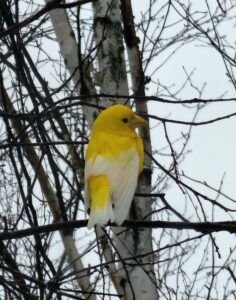
- (Pam Opolsky photo) This unusual, all-yellow evening grosbeak continues to be seen in the Dickinson County area, turning up in Randville; Aurora, Wis.; Felch Township early this week; and then Channing on Thursday.
-
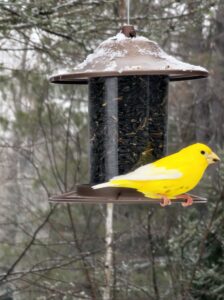
- Pam Opolsky photo
-
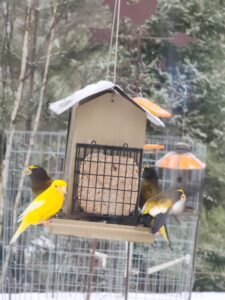
- Pam Opolsky photo
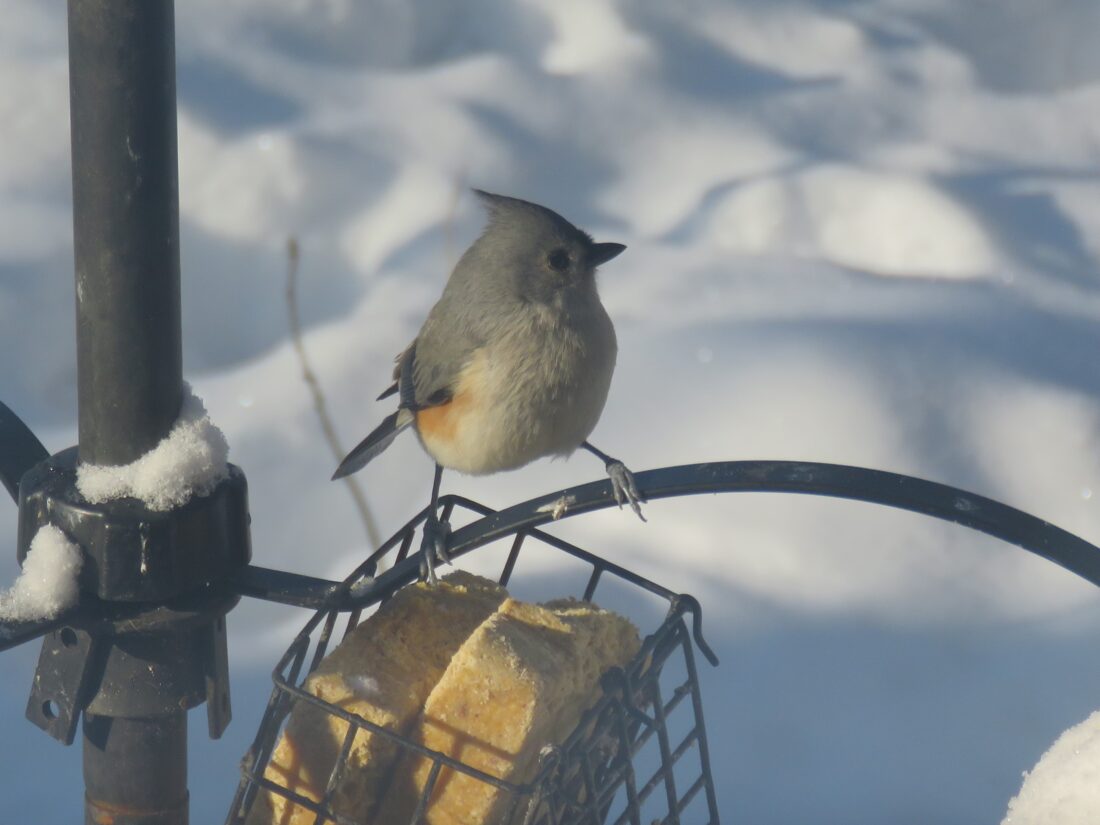
(Phyllis Carlson photo) A tufted titmouse was a new bird recorded during the annual Christmas Bird Count in the Iron Mountain area Dec. 17. This one has been visiting a backyard feeder in the Norway area for some time, said Phyllis Carlson, count coordinator.
For the first two full weekends of January, I want to do a few updates on some of the items I wrote about in 2022.
First, Phyllis Carlson on Wednesday provided the final figures from the 2022 Christmas Bird Count, conducted Dec. 17 in the Iron Mountain area.
To recap, the Christmas Bird Count is part of the National Audubon Society’s 123rd annual 24-hour “bird census” within designated areas in the U.S., Canada, and many countries in the Western Hemisphere. Data gathered from these counts, which groups can do any day from Dec. 14 to Jan. 5, is analyzed to gauge how avian populations might be expanding their numbers and range, or losing ground.
Local volunteers are asked to record the numbers of birds they see of each species, then submit their lists to Carlson, who enters the information online at the Audubon website. For the Iron Mountain count, they cover roughly the lower one-third of Dickinson County, from the Florence County line east to the Menominee County line and from the Menominee River north to Granite Bluff.
The 2022 Christmas Bird Count locally had 26 people — mostly monitoring feeders — who recorded 1,490 individuals and 32 species, up and down, respectively, from 2021, Carlson said. Eight people did venture out into the field for the day, logging 137.5 miles combined.
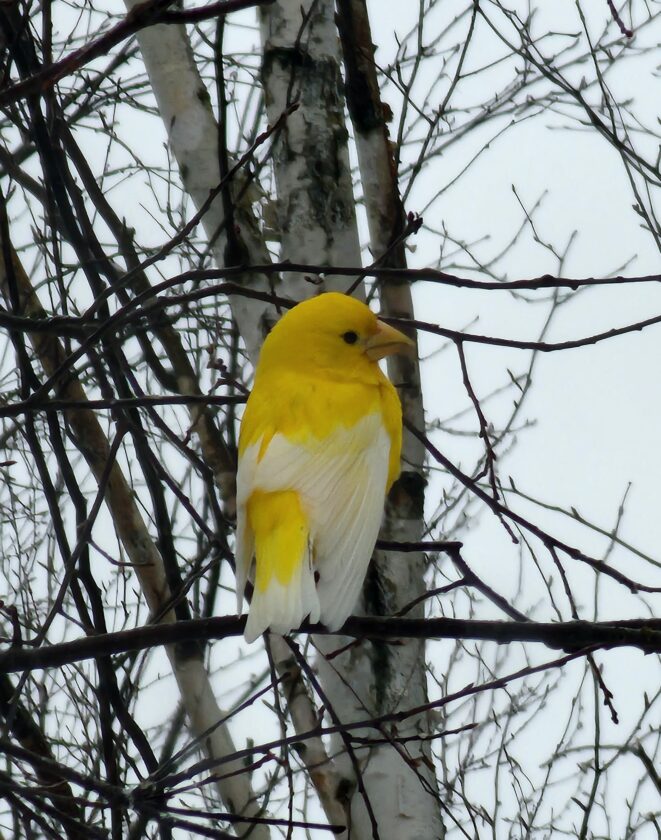
(Pam Opolsky photo) This unusual, all-yellow evening grosbeak continues to be seen in the Dickinson County area, turning up in Randville; Aurora, Wis.; Felch Township early this week; and then Channing on Thursday.
New to the count in 2022 was a tufted titmouse, a more southernly relative of chickadees. This small, gray, crested songbird has been visiting a feeder in the Norway area since last summer but stuck around long enough into winter to be officially recorded — and photographed, Carlson said.
“This species is not a regular in the U.P., although there have been observations over the years during spring and fall migration,” Carlson noted in reporting the count results. “Interestingly, I know of seven observed this year and four of those have stuck around until at least December. There may be others that have not been reported.”
According to the Cornell Lab of Ornithology’s All About Bird website, www.allaboutbirds.org, tufted titmice’s “range has been expanding northward over the last half-century. Possible reasons for range expansion include a warming climate, farmlands reverting to forests, and the growing popularity of backyard bird feeders.” This is similar to what has been seen with red-bellied woodpeckers in the past couple decades.
After 40-plus years in the Upper Peninsula, Carlson said, “I for one welcome them since they were a favorite bird of mine growing up in Virginia.”
Those out in the field Dec. 17 spotted a male American kestrel, very late in the season for this smallest of North American falcons, which normally migrate south before the snows set in. This one was seen catching a vole, so seems to know what he’s doing.
Pam Opolsky photo
Other highs and lows, via Carlson:
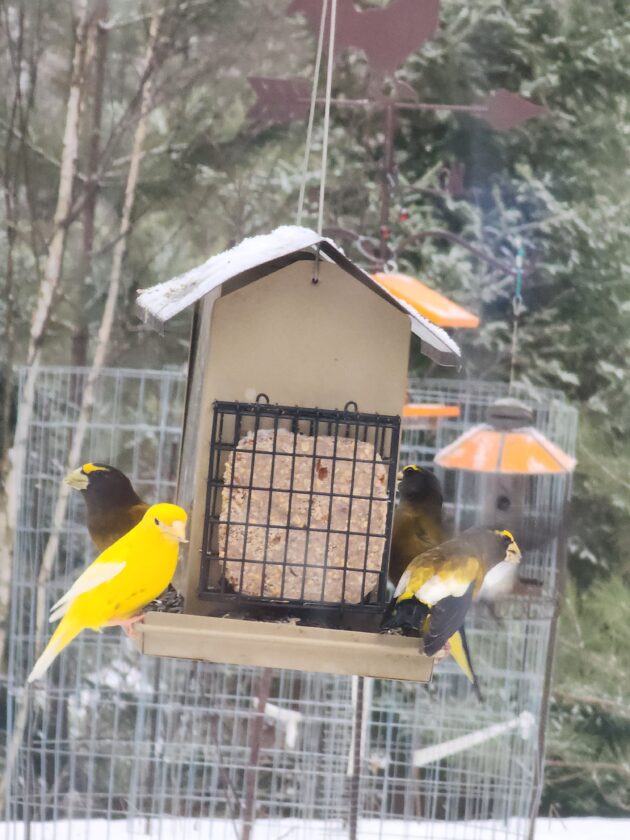
— Evening grosbeaks were seen after being scarce for several years — not surprising, as they arrived in abundance in November.
— Almost absent were two other “winter finches,” with only two pine siskins and no redpolls, common or hoary.
— Four American robins lingered for the count, perhaps reflecting the very good fruit crop on trees in the region.
— A couple of rough-legged hawks made the count, an arctic-nesting species that comes down to spend the winter in the relatively “balmy” Upper Peninsula.
Pam Opolsky photo
— Missing this year were trumpeter swans, often reliably found on the Menominee River, and pine grosbeaks. That’s a bit surprising, as these large winter finches also had appeared in November in the region, although they had been less visible in December. Perversely, they showed up this past week along Six Mile Lake Road.
The next such bird-census effort will be the 26th annual Great Backyard Bird Count set for Feb. 17-20. While the Christmas Bird Count must be filed through a local coordinator like Carlson, the Great Backyard Bird Count can be done by individuals, by entering the information online.
For more information on the 2023 Great Backyard Bird Count, go to www.birdcount.org.
*****
The unique all-yellow evening grosbeak continues to pop up in the region.
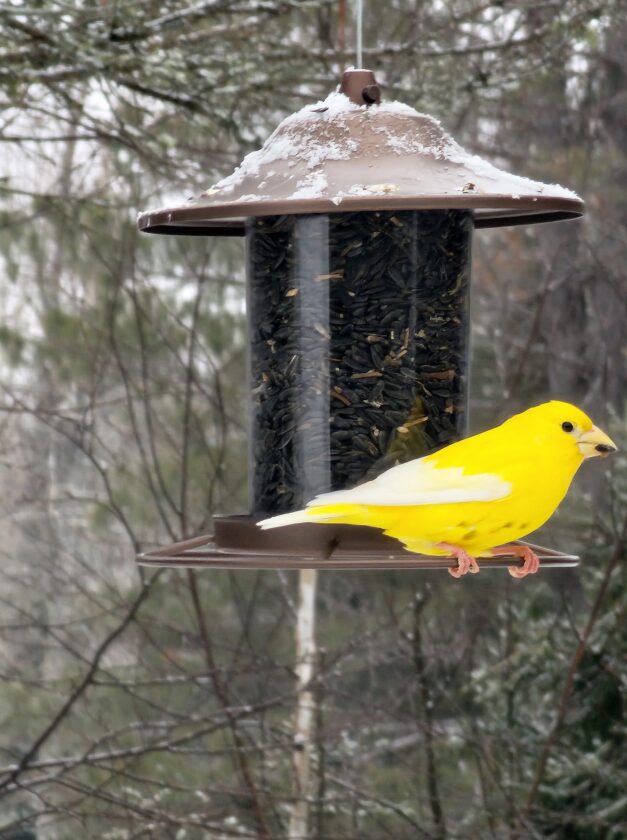
This bird seems to lack all of the black pigmentation that against a yellow background makes the male evening grosbeak so distinctively marked. The only variation to its bright yellow is white wings and tail tip.
Though some speculated this bird exhibits a mutation called leucism, several experts stated this variation — which has turned up elsewhere amid the strong influx of evening grosbeaks this year — is a different mutation, xanthochromism. Animals with this trait have unusually high yellow pigmentation, often due to a lack of red pigmentation or its replacement with yellow, according to several online definitions.
After first being reported at a home in Randville in November, the canary-looking grosbeak next turned up at a feeder in Aurora, Wis., in early December, where it seemed to stay for some time.
Then Jan. 1 and 2, Pam Opolsky was fortunate enough to get several photos of the grosbeak in all its glory while at her “offgrid camp” in Felch Township. It made the trek on snowshoes, pulling a 40-pound bag of seeds on a sled, worth the effort.
On Thursday, Amy Marie Ball Conery posted photos on the Upper Peninsula Birding Facebook page — one well worth joining for those interested in what birds are in the region — of what appears to be the same bird, as it has the same distinctive darker spots on its underside as the one that came to Opolsky’s cabin.
Given the relatively short distance between the locations — and the rarity of this type of mutation — it is likely these reports are all the same bird, said Ryan Brady, Natural Heritage Conservation biologist with the Wisconsin Department of Natural Resources. The additional detail of the spots on the underside should make it easier to identify and track this particular all-yellow grosbeak if it appears elsewhere, he added.
Betsy Bloom can be reached at 906-774-2772, ext. 240, or bbloom@ironmountaindailynews.com.
Local News
Northern shoveler, American bittern pause within range for photographs
Forest fuelwood permits now available from DNR
LANSING, Mich. — State forest fuelwood permits are available for Michigan residents interested in collecting ...
Middle school Girls’ Dream Fair on May 14 at MTU
HOUGHTON — Middle school girls from across the western Upper Peninsula will gather at Michigan Technological ...

Iran war sends inflation soaring, consumers’ mood plunging

Documenting the dairies