
Progress on new Menominee Range museum
Our Town Iron Mountain
-
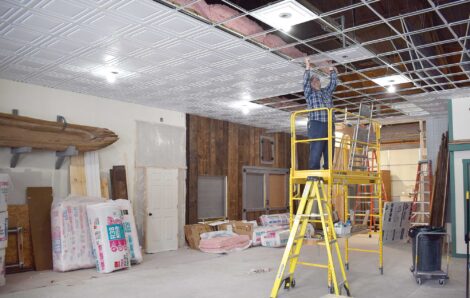
- MENOMINEE RANGE HISTORICAL FOUNDATION Treasurer Guy Forstrom installs ceiling tiles in the large area of the new Menominee Range Historical Museum at the Chapin Mine “C” Ludington Shaft Dry building at 300 Kent St. in Iron Mountain. (Terri Castelaz/Daily News photo)
-
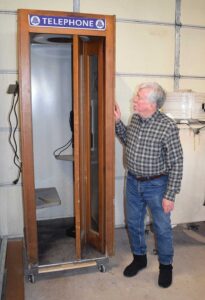
- MENOMINEE RANGE HISTORICAL FOUNDATION President and Historian Bill Cummings displays a recently acquired 1950s telephone booth. This will be kept on wheels to move in different locations in the main area of the new museum. (Terri Castelaz/Daily News photo)
-
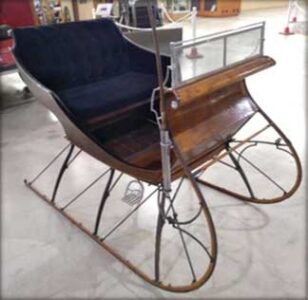
- EDIE GAZZA donated this one-horse open sleigh that had been restored by her late husband, Roland Gazza. It will be featured with other horse-drawn vehicles in the livery stable area of the new museum. (Terri Castelaz/Daily News photo)
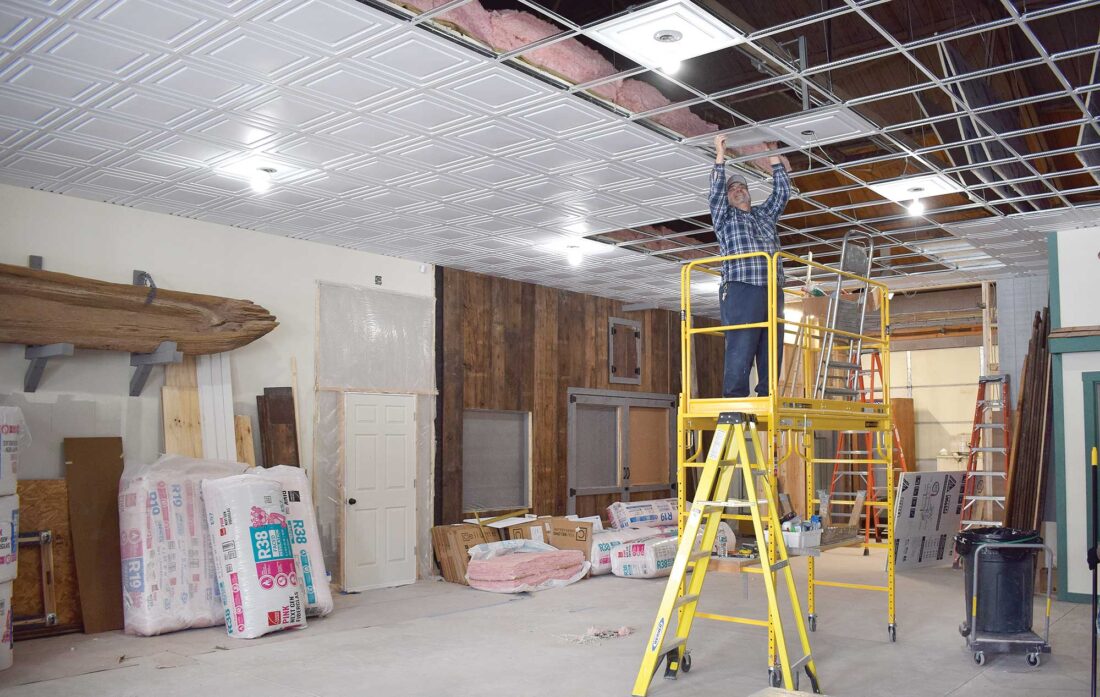
MENOMINEE RANGE HISTORICAL FOUNDATION Treasurer Guy Forstrom installs ceiling tiles in the large area of the new Menominee Range Historical Museum at the Chapin Mine “C” Ludington Shaft Dry building at 300 Kent St. in Iron Mountain. (Terri Castelaz/Daily News photo)
IRON MOUNTAIN — The new Menominee Range Historical Museum is one step closer to welcoming its first visitors.
In 2018, the Menominee Range Historical Foundation decided to incorporate the former Chapin Mine “C” Ludington Shaft Dry at 300 Kent St. in Iron Mountain into its historical museum.
This move allows for all three facilities to be on just one campus.
In June 2022, the MRHF turned the old Carnegie Public Library building on Ludington Street over to the Iron Mountain School District, officially terminating the foundation’s 51-year occupancy.
With donors’ generous support, the foundation has been able to move at a steady pace with each phase of the renovation on the 1910 sandstone dry.
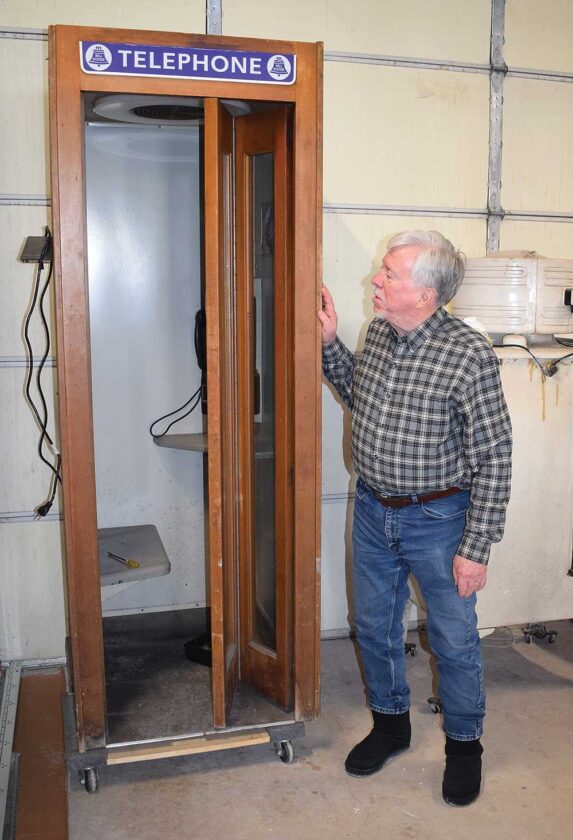
MENOMINEE RANGE HISTORICAL FOUNDATION President and Historian Bill Cummings displays a recently acquired 1950s telephone booth. This will be kept on wheels to move in different locations in the main area of the new museum. (Terri Castelaz/Daily News photo)
“The community has been great — we have been very fortunate,” said Bill Cummings, foundation president and historian.
With a recent substantial donation, they were able to finance the entire ceiling project in the museum’s main area, Cummings said.
Gridwork for the suspended ceiling was installed in December, with the insulation and ceiling tiles recently completed by Guy Forstrom and Jim Hartwell.
“With this phase complete, we will now be able to heat this area, allowing us to finish the exhibits in this space,” Cummings said.
In addition to the general store, the large main area will house recreations of a school room, livery stable, firearms collection and special rotating exhibits from the foundation collections that aren’t on permanent display.
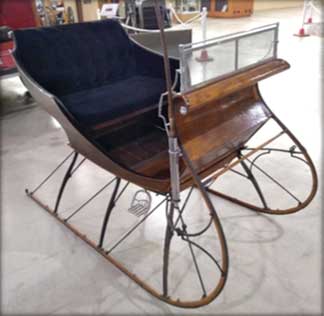
EDIE GAZZA donated this one-horse open sleigh that had been restored by her late husband, Roland Gazza. It will be featured with other horse-drawn vehicles in the livery stable area of the new museum. (Terri Castelaz/Daily News photo)
“Guy (Forstrom) recently restored a C.E. Parent’s store sign dating from 1888 that was found in the old livery stable,” Cummings said.
The dugout canoe has already been placed on the wall in the main display area. “This is a real rarity,” he said. “The birchbark canoe will also be mounted on the opposite wall.”
“We are excited to have these two important pieces properly displayed,” Cummings said.
Some of the other larger features include a horse-drawn sleigh and a carriage.
“We will be adding another sleigh — a cutter — that was donated by Edie Gazza about a year ago,” Cummings said.
They also acquired a phone booth last year from the 1950s. “This is a fun addition to the space,” he said.
Substantial progress has been made in the exhibition area of the new museum, finishing 22 rooms.
“We recently completed the parlor room, as well as hung the large Izzo sign in front of the shoe shop,” he said.
All the framing and glass installation for these individual rooms has also been done over the winter months.
They now are working on the display that will honor the ski jumping history at Pine Mountain. The area will include skis and photos of how the sport has evolved over the years, he said.
They are also in the process of finishing their large household appliance space.
Additional displays in this portion will include a Native American collection and the interior of an Ojibwe wigwam. Local Native American researcher Walt Summers will assist with these displays.
“This is going to be different from what we had before,” Cummings said. “This will be one of the last displays to be completed.”
The new historical museum will feature more than 50 exhibits when it’s all completed.
One of the next projects will be staining the concrete floors, Cummings said.
Foundation Vice President Hartwell continues to construct the 4-by-4-feet glass display cases that will be installed on the outside walls to house hundreds of artifacts.
“We have two larger versions of these cases already hung in the large main area,” Cummings said.
He also added that he is doing work on signage that will provide information about the displays.
Cummings credits Hartwell and foundation Treasurer Forstrom with the progress. “We definitely wouldn’t be this close,” Cummings said. “We are getting to be in pretty good shape.”
The foundation board is unsure if they will be able to open the new historical museum this summer but do hope host a few special events.
Volunteers are crucial to the museum’s daily operations. “This is another building that needs to be manned,” he said. “We can’t afford to staff three locations.”
Anyone interested in volunteering for a four-hour shift this summer can contact museum manager Dianne Castelaz-Chapusio at 906-828-1822.
“I think it’s fun. I encourage everyone — young and old — to come and give it a try,” Cummings said.
The Foundation will also host the 72nd annual Upper Peninsula History Conference set for June 23-25.
At this time, they will have an open house for its attendees as well as conduct several walking tours, including downtown Iron Mountain and Kingsford.
“We are also trying to get Norway and Hermansville involved,” Cummings said.
They continue to seek funding, as it is essential to the museum’s future success.
“Each major new display costs about $1,000 to build and decorate,” he noted. “Any donation is very much appreciated.”
The Menominee Range Historical Foundation is funded only through admission fees, gift shop sales, memberships, donations, bequests and occasional grants. No tax dollars from city, county, state or national sources are received.
Donations can be made payable to the Menominee Range Historical Foundation, at P.O. Box 237, Iron Mountain, MI 49801.
Local News
Migration hits the brakes in icy weather

Evers vetoes GOP bills for no tax on overtime and tips
Trump administration plans closure of 4 Michigan forestry research centers
The Archives seeks township information
FELCH TOWNSHIP — The Archives — representing Breen, Felch and West Branch townships — is updating its files ...
Northwood Beekeepers to host apiary inspector
FLORENCE, Wis. — Northwoods Beekeepers will host Patrick Sizemore, apiary inspector for the state of Wisconsin, ...
Registration open for ‘Raise the Roof’ golf outing
KINGSFORD — Registration is open for the 2026 "Raise the Roof" golf outing, a major fundraiser for Habitat for ...