
Invasive species get their goat
KISMA, ecological restoration company team up on buckthorn control
Trending
Glossy buckthorn, a woody invasive species and its relatives known for their tendency to spread in large swaths, have become a focus of invasive species management.
They are also a snack for the omnivorous goat.
Regenerative Ruminants, an ecological restoration service powered by goats and sheep, and Keweenaw Invasive Species Management Area have joined forces to study glossy buckthorn management.
Dr. Sigrid Resh, coordinator of KISMA and a research assistant professor at Michigan Technological University, has experimented with several types of buckthorn management, including a method that utilized a native fungus to stymie the buckthorn's growth.
She's excited about having goats in the project, noting the use of browsing livestock has become more popular in managing invasive species.
The Swedetown project will measure the effectiveness of the goats and how they compare to other management methods on plots within the Swedetown trails.
A team of nine undergraduate students also are testing novel approaches and technologies such as moth, insect and bird surveys that can help quantify the impact of the goats as well as understand the role of biodiversity in the area.
The team had embraced incorporating the animals and outside-the-box thinking, which Resh said was important to finding solutions to ecological problems, such as invasive species control.
Jake Williams of Poplar, Wis., is co-owner of Regenerative Ruminants with his partner Brigid Reina Williams.
Over the past several years the company has partnered with the Wisconsin Department of Natural Resources and private landowners in northern Wisconsin using their mixed "flerd" of sheep and goats to manage invasive species, such as buckthorn.
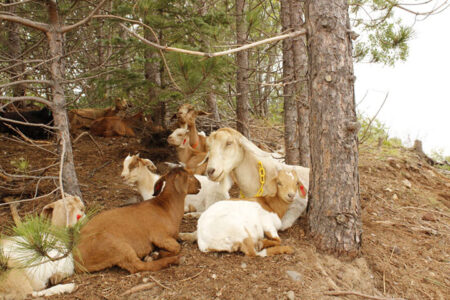
Williams and a team of 35 goats set up the weekend of July 8 at the trailheads across from the Swedetown chalet.
Having cordoned off a half-acre with an electric fence, the goats were off to work, biting leaves from the trees.
The team are set to browse through 8 acres over the next two weeks.
For the next four years, the goats will return seasonally while Resh and her team maintain surveys of the area to track the goats' effect.
Everyone is welcome to visit with the goats and learn more about the project at a "Greet the goats" event today from 10 a.m. to noon and again from 2 to 4 p.m. Eastern time, when Williams and members of the research team will be on hand.