
Trending
IRON MOUNTAIN -- "Forever chemicals" are present in groundwater at the closed Central Landfill east of Hydraulic Falls Road, but no community water supplies have levels of contamination that require immediate action other than continued sampling, according to the Michigan Department of Environment, Great Lakes and Energy.
Iron Mountain City Manager Jordan Stanchina, who participated in a teleconference last month with Michigan's PFAS Action Response Team, updated the city council on the findings Tuesday.
"There is nothing that needs to be done by the Central Landfill at this time and MPART will conduct additional testing to gather more information on the extent of the contamination," Stanchina said. He described the situation as "something they have to keep an eye on and monitor."
In recent years, experts have become increasingly concerned about the potential effects of high concentrations of per- and polyfluoroalkyl substances, or PFAS, on human health. In sampling conducted at Central Landfill in April, two of the three test wells had PFAS well above Michigan standards.
Groundwater at the landfill flows to the southeast, an area mostly served by Breitung Township municipal water, according to the MPART report. This supply is on annual compliance monitoring and results to date have been "non-detect" for all tested PFAS, the report states.
White Birch Village mobile home park is north of the landfill, and its water supply is also on annual monitoring. Results to date have been below maximum contaminant levels or no PFAS detected, the report stated.
EGLE, meanwhile, is contacting four nearby residents to obtain permission to sample their residential wells. Based on results from these downgradient residential sites, the Michigan Department of Health and Human Services will help gauge the need for drinking water filters.
Reverse osmosis filters, which utilize high-pressure membranes, can be more than 90% effective at removing a wide range of PFAS, according to the U.S. Environmental Protection Agency.
MPART is a multi-agency team that is coordinating state resources to address per- and polyfluoroalkyl substances, or PFAS, contamination. PFAS are a large group of man-made chemicals that include perfluorooctanoic acid, or PFOA, and perfluorooctanesulfonic acid, or PFOS.
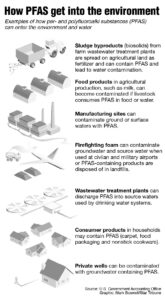
PFAS have been used globally during the past century in manufacturing, firefighting and thousands of common household and other consumer products. The chemicals are persistent in the environment and in the human body -- meaning they don't break down and can accumulate over time.
One well at Central Landfill showed PFOS at a level of 67 parts per trillion -- more than four times the Michigan groundwater cleanup standard of 16 ppt. PFOA was detected in that same well at 20 ppt, which is more than twice the state's standard of 8 ppt.
Another well showed PFOS at 41 ppt and PFOA at 18 ppt. A third well showed much lower levels -- 5.3 ppt for PFOS and 4 ppt for PFOA.
Central Landfill is mostly within Breitung Township and includes a northern section crossing into Iron Mountain. According to MPART, it began operation in 1966 and accepted municipal waste from the cities of Iron Mountain, Kingsford and Norway as well as Breitung Township.
MPART says it likely received waste from manufacturing and factories as well. The landfill was closed and capped under a state consent order in 1990, aided by grant funds. The landfill had been operating unlicensed and a 1985 study showed effects to groundwater, according to MPART.
In addition to Central Landfill, MPART lists two other PFAS sites in Dickinson County -- Ford Airport, 400 Riverhills Road, Kingsford; and Grede Landfill, 801 S. Carpenter Ave., Kingsford.
Groundwater monitoring wells at the airport have shown four of eight samples above state standards. The contamination is believed to stem from a former firefighter training area and a plane crash in 1980.
Eleven residents near the airport have had their wells sampled for PFAS, with four having detections below criteria and seven having no PFAS detected, according to MPART.
The Grede site is a 3-acre landfill that accepted foundry sands and associated wastes. It was capped and closed in 1993. The most recent sampling in June 2022 showed a concentration of 8.2 ppt for PFOA.
Public water supplies covered under the Michigan Safe Drinking Water Act are regularly sampled for the presence of PFAS compounds. For private wells, EGLE works with local units of government and MPART agencies to evaluate which homes need to be sampled. Residents are contacted by phone or mail requesting permission to sample drinking water from their well.
People who are interested in testing their own drinking water can find more information at https://www.michigan.gov/pfasresponse/drinking-water/sampling.
EPA in March proposed the first federal drinking water limits on six forms of PFAS, which are linked to a broad range of health issues, including low birthweight and kidney cancer.
A final decision is expected later this year or in 2024. The proposed EPA limits for PFOS and PFOA are 4 ppt each, much stricter than the Michigan's maximum contaminant levels of 16 ppt for PFOS and 8 ppt for PFOA. The standard of 4 ppt has been described as the lowest level that can be reliably measured for PFOS and PFOA.
Water flowing from nearly half of U.S. faucets likely contains "forever chemicals," according to a U.S. Geological Survey study released in July.