
IM couple reflects on visit to Sassoferrato
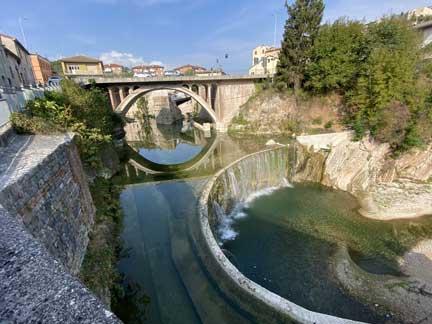
The Sentino River runs through the city of Sassoferrato, Italy, which is Iron Mountain’s sister city.
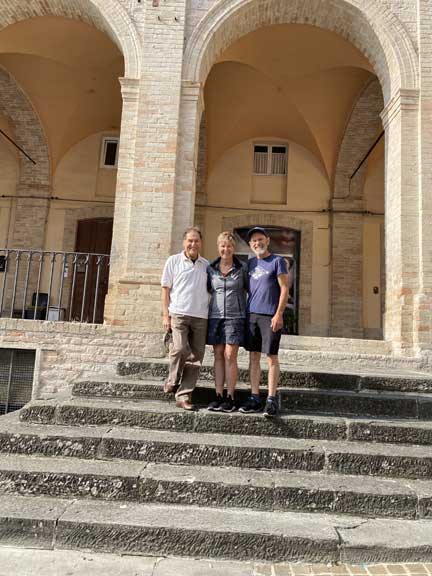
Belagio Satarrini, left, greets Glady Van Harpen and John Nienstaedt of Iron Mountain at Sassoferrato’s City Center. Sassoferrato, Italy, is nearly 5,000 miles from Iron Mountain, but the sister cities have much in common, including natural beauty and histories rooted in mining.
The Sentino River runs through the city of Sassoferrato, Italy, which is Iron Mountain’s sister city.
Belagio Satarrini, left, greets Glady Van Harpen and John Nienstaedt of Iron Mountain at Sassoferrato’s City Center. Sassoferrato, Italy, is nearly 5,000 miles from Iron Mountain, but the sister cities have much in common, including natural beauty and histories rooted in mining.
Trending
[Editor's note: This article was written by Iron Mountain residents Glady Van Harpen and John Nienstaedt, who have lived here since 1986. They suggest that others who venture to Sassoferrato, Italy, should announce themselves in advance. Biagio Marini can be reached at giogio4@gmail.com. Rita Sacco Ballanti can be reached at ritasacco@alice.it.]
We are writing this to fulfill a promise we made to two wonderful Italians, Biagio Marini and Rita Sacco Ballanti, whom we met by chance in Sassoferrato, Italy.
Biagio and Rita are members of a committee that worked with local architect Albert Santoni, City Manager Jordan Stanchina, Mayor Dale Alessandrini and the Iron Mountain City Council to establish Sassoferrato and Iron Mountain as sister cities. Sassoferrato and Iron Mountain have similar populations of about 8,000.
Our promise to the Sassoferrato officials was to pass on greetings and to welcome all to visit our wonderful and beautiful sister city. But we're getting ahead of ourselves -- here is the rest of the story.
During recent years, we have been inspired by many local friends and acquaintances from the Iron Mountain-Kingsford area who have recently traveled to Italy: Dan and Kelly Bianco; Sarah and Gino Venditti; Mike and Pat Nicometo; Scott and Shawn Lewellyn; Frank and Cece Smith; Dan and Nanette Sjoquist; Nancy Bommarito Finch; and others. Needless to say, we were not the first out of the starting blocks to visit Italy.
Glady had visited Italy in 2013 with a university group. So, despite the fact that John's idea of a major travel adventure is to go to a Brewers game in Milwaukee, Glady eventually prevailed in a decade-long argument and we found ourselves headed to Italy on SAS Airlines this past Oct. 1 to celebrate our 40th wedding anniversary.
Truth be told, we initially did not plan to visit Sassoferrato. Our rough itinerary included, visiting Rome (Vatican City and many ancient sites), Assisi (St. Francis' home, vineyards, olive groves), Cinque Terre (a five ancient village hike on the west coast); and Florence (lots more ancient stuff).
Also, John, ever the snow chaser, wanted to go north almost to Switzerland, to see Lake Como, Sondrio and Bomio, the area of the 2026 Winter Olympics in Italy. Needless to say, we are really good at biting off way more than can possibly be chewed.
But somewhere around the third day of our trip, we went to bed thinking, "Heck, we're going to be within 90 minutes of Sassofer-whatever, the sister city. It would be shameful to skip it. How about we drive there for breakfast?" We figured we'd be in and out of there in an hour and off to Florence in a flash.
Early the next morning, there was one small problem. How would we find Sassoferrato? It was not on the highway map we had with us. We only knew we needed to drive through a low mountain range toward the east coast of Italy. Luckily, always the thinker, Glady had downloaded satellite maps, which allowed us to see Sassoferrato was about 70 miles to the northeast.
Our 90-minute drive took us through some beautiful yet twisty, county type highways. Interestingly, Sassoferrato, like Iron Mountain, is surrounded mostly by woods and farm fields. As you approach from the west, you see large hills or low mountains, and it appears that you are entering a very rural area. At one point, John offered, "Geez, do ya think this is some kind of glorified cow town?"
We soon learned it's much more than that. In fact, it's really cool. We later learned, Sassoferrato is one of the top 100 archaeological cities in Italy. As we approached, Glady said, "Wow, I think I just saw some Roman columns." That was our first U-turn.
We parked and self-toured through the ancient Roman town of Sentinum, located on the western edge of Sassoferrato. This archaeological area includes Roman columns, a section of Roman road constructed of large flat stones, and the ruins of a substantial Roman bath.
As we studied the ruins and Italian/English plaques, we learned that Sentinum and Sassoferrato were the site of a many decisive battles between 295 B.C. and 40 B.C. that allowed the Roman Empire to capture central Italy and open a land route to the Adriatic Sea.
All this and we hadn't even had breakfast!
We backtracked to the city limits and took a selfie at the welcome sign that we now understood: "SASSOFERRATO Gemellato con Iron Mountain, USA -- Benvenuti Nell'antica Citta Di Sentinum."
Continuing on, we entered Sassoferrato, where we made a second U-turn to see a very historic-looking building that caught our eye. We learned that it was an old abbey, called Santa Croce, built in the late 12th century.
Driving further, John said excitedly, "Hey, this is that circular spillway waterfall, which we saw on the internet pictures!" We parked, and walked again. It turns out three separate rivers join in the center of the city. It is really picturesque.
But what also caught our attention was a collapsed pedestrian bridge at the junction of the rivers. We later learned that Sassoferrato had a major flood in the fall of 2022. Both the pedestrian bridge and a section of railroad track were washed away. Like most small cities, Sassoferrato has infrastructure challenges, too.
OK, now we were really getting hungry. At this point we asked a local woman where we could get breakfast. Not surprisingly, she did not speak English. We had entered rural Italy and the chances meeting older people who could only speak Italian had increased. But Glady used her best international pantomime, and the woman graciously guided us to a cafe. "Grazie!" we told her.
Once inside we were greeted by the proprietor, "Buongiorno!" We attempted to order, but, again, our Italian is hopeless. Not surprisingly, a kind-looking man behind us said, with perfect English, "May I help you order?" We thanked him, and he asked where we were from.
When we said, "Iron Mountain, Michigan," he grinned broadly, threw his hands up in the air and said, "Iron Mountain!!?" He shook our hands vigorously, embraced us with an Italian hug and kissed Glady on both cheeks. He introduced himself, Biagio Marini, gave us his business card, and explained his involvement with the committee and formation or the sister city relationship. Also, he immediately told the cafe owner that he had our bill covered.
We were somewhat stunned by this turn of events. We realized that our one-hour jog in and out of Sassoferrato might be toast! Quickly, we explained to this gentleman, Biagio Marini, that although we were from Iron Mountain, we were not people of any importance, just normal tourists from the U.S. We explained further that we are not even Italian -- actually Danish and Dutch. Biagio would not hear of it. He just kept smiling and patting us on the back as though were superstars.
We sat down at the nearest table with our pastries and cappuccino, and then to our amazement he called the mayor of Sassoferrato. Within moments of walking into the cafe, we were talking to the mayor of our sister city. The mayor was out of town, but on the phone he welcomed us with great warmth and enthusiasm. He explained their strong feelings for Iron Mountain, and we did our best to express the same feelings for Sassoferrato, and to relay greetings from Iron Mountain.
When the phone call ended, Biagio asked how long we would be visiting. We were embarrassed to say we were planning for an hour but we were already at two hours. His reply was, "One hour! No! You stay two more hours!" We realized that it was time to let go and go with the flow.
The next few hours became a really pleasant blur. Biagio took us to his cafe, where we met his friends. We had more espresso and photos, and then headed out for a walking tour of the city center and a driving tour the surrounding Sassoferrato area.
He continued to introduce us to many new friends who greeted him by name. We gathered that Biagio Marini knows every other person in Sassoferrato.
He showed us a 200-year-old family pharmacy business and introduced the owner -- more photos. He showed us the "old gate" arched entrance to the city. We toured a many-hundred-year-old Catholic church and walked by the house where Biagio was born.
Ultimately, we walked back to the river junction. Biagio explained the flood of Sept. 15, 2022. He told us that the pedestrian bridge would be re-constructed, and he described how he and his dad swam in the river years ago. Then, after Biagio made another phone call, and after we adjusted our luggage, we piled into our Fiat-Mini rental car and drove out into the countryside.
We drove to a very nice apartment complex where Rita Sacco Ballanti lives. Rita greeted us with open arms. She, and her late husband also had served on the committee that formed the sister-city alliance. We understood that she is the secretary of the Sister City Committee.
Rita was a very gracious host. We sat and talked quietly about Iron Mountain and Sassoferrato for nearly an hour. We looked at many photos and articles from her files. She talked enthusiastically about working with Albert Santoni and Jordan Stanchina. She specifically expressed interest in initiating a possible exchange student relationship.
After we thanked Rita, and took a photo in her garden, she concluded our visit by giving us a new copy of the high-quality glossy magazine their group publishes each year, "Sassoferrato Mia." As we headed off in the rental car to see more sites in Sassoferrato, we reflected on the very genteel lady we had just met.
We then drove with Biagio to the "Old City," which sits high on top of a hill above modern Sassoferrato. The "Old City" dates back to the 11th century. After parking, we walked to the historic "Old City" center, which is the site of the mayor's office.
Everywhere we looked were stone or brick structures with climbing vines and pocket gardens. Sassoferrato is a really beautiful place.
Finally, we continued our walk with Biagio to a very high overlook, probably similar to Giant Pine Mountain. At the overlook, we viewed the Albornoz Fortress, built in 1365. This was a really impressive location. The views of the Sassoferrato countryside were absolutely gorgeous
By this time, it was almost 1:30 in the afternoon. Our excellent host and guide, Biagio Marini, needed to get back to his originally planned day. He had spent three hours with us. We cannot say enough about what a fine gentleman he is. We drove back to the new city center, said our good-byes and had another round of hugs.
As we hit the road to Florence, we noticed a food stand on one corner with a sign that said "Porchetta." We immediately doubled back and bought the two largest porchetta sandwiches we have ever seen. The smell of garlic and roasted pork was intoxicating.
Our intention was to eat the porchettas in the car, but as we passed by the site of ancient Roman town of Sentinum, we stopped, got out, sat, ate and reflected on the truly wonderful and amazing experience we had just had.
When we started driving again, we were quiet for a while. We knew we had just had one on the finest experiences of our life. Finally, one of us broke the silence and we decided to begin another round of our new Italian car game -- trying to see who could spot the next Iron Mountain name on street signs, factories and businesses.
During our two weeks in Italy, we saw many names identical or nearly identical to those we know here: Angeli, Constantini, Bacco, Alessandrino, Romagnolo, Santi, Santini, and more.
We hope that this article appropriately honors the work of the people and committees, Italian and American, who had the vision and did the work to make Iron Mountain; and Sassoferrato sister cities.
Thank you to all involved. It was a great privilege to travel to such an inspiring, culturally diverse and welcoming city and country. We are proud to consider ourselves "adopted" Italian Americans.
(A second story, to be published at a later date, focuses on similarities and differences in the Italian and American cultures.)