
Michigan’s minimum wage is going up in 2026
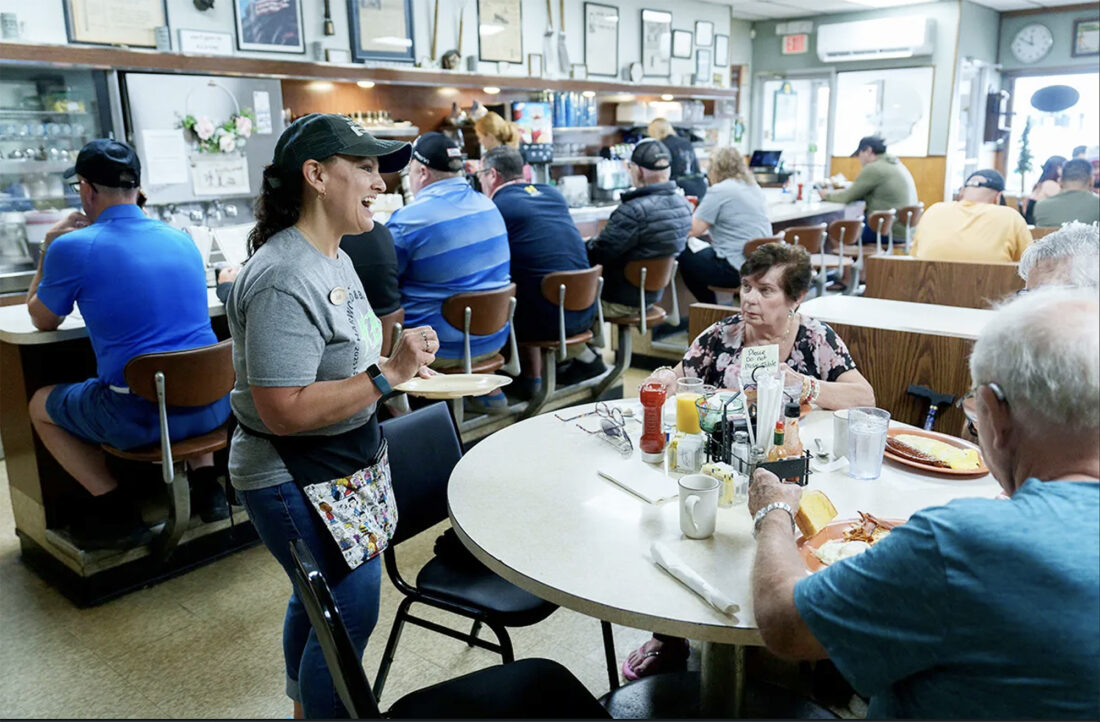
Michigan’s minimum and sub-minimum wages will increase on Jan. 1. That’ll be good news for some workers, but some in the restaurant industry believe the move will hurt businesses already bearing the brunt of inflation. (Josh Boland for Bridge Michigan)
(This story was originally published by Bridge Michigan, a nonprofit and nonpartisan news organization. Visit the newsroom online: bridgemi.com.)
LANSING — Michigan’s minimum wage will jump by $1.25 an hour on Thursday under a new state law that sped up planned base rate increases but scaled back a bigger bump for tipped workers.
The minimum wage will climb from $12.48 to $13.73 an hour on Jan. 1.
The sub-minimum wage for tipped workers will increase from $4.74 to $5.49, down from $7.97 that had been planned under a court-ordered schedule that the Legislature and Gov. Gretchen Whitmer agreed to weaken as part of a February deal.
The minimum pay for minors, who make 85% of the state’s standard minimum wage rate, will increase from $10.61 an hour to $11.67 an hour.
Wage increases are scheduled to continue in future years, with the standard minimum wage hitting $15 in 2027 and then being tied to inflation. The tipped wage will reach 50% of that rate by 2031.
The raises are good news for Michigan’s lowest-paid workers but are already causing some concern for businesses, especially restaurant owners, many of whom successfully fought a full phase out of the lower tipped wage.
“The reality of the situation is hitting them now, and they’re just in a difficult place … They’re trying to find ways to shrink the total labor force to make the numbers work,” said Justin Winslow, president and CEO of the Michigan Restaurant and Lodging Association.
Restaurants are already struggling with decreased foot traffic, he said, as consumers closed their wallets in the face of rising menu prices.
But Steven Dyme, co-founder and CEO of the midwestern floral arrangement business Flowers for Dreams, argues that “it’s about time” for the minimum and sub-minimum wage to increase.
“It’s been so frustrating to see such resistance to raising the minimum wage, even with the cost of living” on the rise, he told Bridge Michigan, joking that he wished minimum wage would actually “go up faster” to help address the affordability gap.
Dyme’s flower business operates in Chicago, Detroit and Milwaukee, with the first of those three cities already mandating a $16.60 an hour minimum wage and $12.62 per hour sub-minimum, or tipped, wage.
“Profits can’t be continuing to increase … without workers getting a larger share,” Dyme told Bridge in early December. “That’s not feasible, sustainable, or right in my view.”
Legal, legislative fight
While the increase may seem small, the fight to get there was anything but.
The effort to change Michigan’s minimum and sub-minimum wages started in 2018 as a citizen-led petition initiative to increase the standard minimum wage to $15 an hour and phase out tipped wages altogether.
Organizers collected enough signatures to make the ballot that year, but lawmakers weakened the measure by adopting it and then quickly amending it before it took effect, triggering a years-long court fight.
In 2024, the Michigan Supreme Court ruled the Legislature had violated the state constitution by amending the initiated legislation in the same two-year term. Justices ordered wage and sick leave increases as a result.
From there, it was all hands on deck for the Michigan restaurant lobbying group, which argued that the court-ordered wage increases would be a “catastrophe” for the industry.
Michigan lawmakers did not change the court ordered rules by the end of 2024, prompting House Republicans — at that time the minority, but led by current House Speaker Matt Hall of Richland Township — to walk out on the final days of Democrats’ legislative trifecta.
Whitmer and lawmakers ultimately struck a bipartisan compromise in February 2025. As part of the agreement, the state will speed up planned minimum wage increases but will not phase out its subminimum wage for tipped workers, as ordered by the Michigan Supreme Court.
One week later, lawmakers also approved new sick leave policies that reduced court-ordered mandates for small businesses. For many Michigan firms, those rules took effect earlier this year.
Under the agreement, small businesses with fewer than 10 workers must provide five days paid leave, and larger firms must provide nine days.

Local News
Michigan AmeriCorps programs relaunch after funding restored
Advocates are applauding the return of federal taxpayer funding for AmeriCorps programs in Michigan. This comes ...
Report warns Michigan’s teacher shortage goes beyond staffing
As Michigan grapples with an ongoing teacher shortage, a new report says the state is also falling short when it ...

Grant for ambulance service

Niagara to be site of Toilet Bowl Trauma Trot
Niagara Library offers programs for all ages
NIAGARA, Wis. — Winter programs are offered at Niagara Library, 1029 Roosevelt Road, including card games, book ...
Courthouse closed today, Thursday
IRON MOUNTAIN — Dickinson County Courthouse will be closed today and Thursday for the New Year’s ...