Army Corps releases final report on Line 5 tunnel plan
-
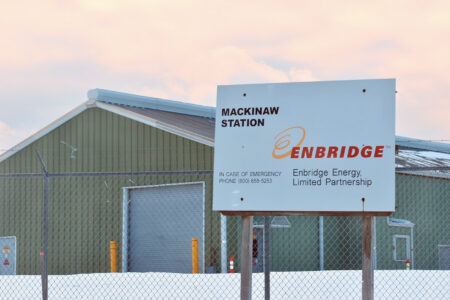
- An Enbridge Inc. pumping station for Line 5 in Mackinaw City. (Laina G. Stebbins/Michigan Advance, file)
-
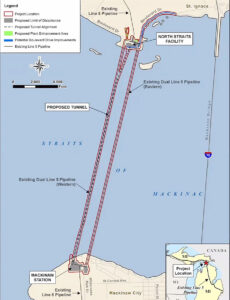
- A diagram of Enbridge Inc.’s proposed Line 5 tunnel project under the Straits of Mackinac. (U.S. Army Corps of Engineers)
-

- Nichole Keway Biber, the Mid-Michigan campaign organizer for Clean Water Action and a Tribal citizen of the Little Traverse Bay Bands of Odawa Indians, voices concerns over Enbridge’s Line 5 tunnel project plan at a demonstration Aug. 26. (Kyle Davidson/Michigan Advance)
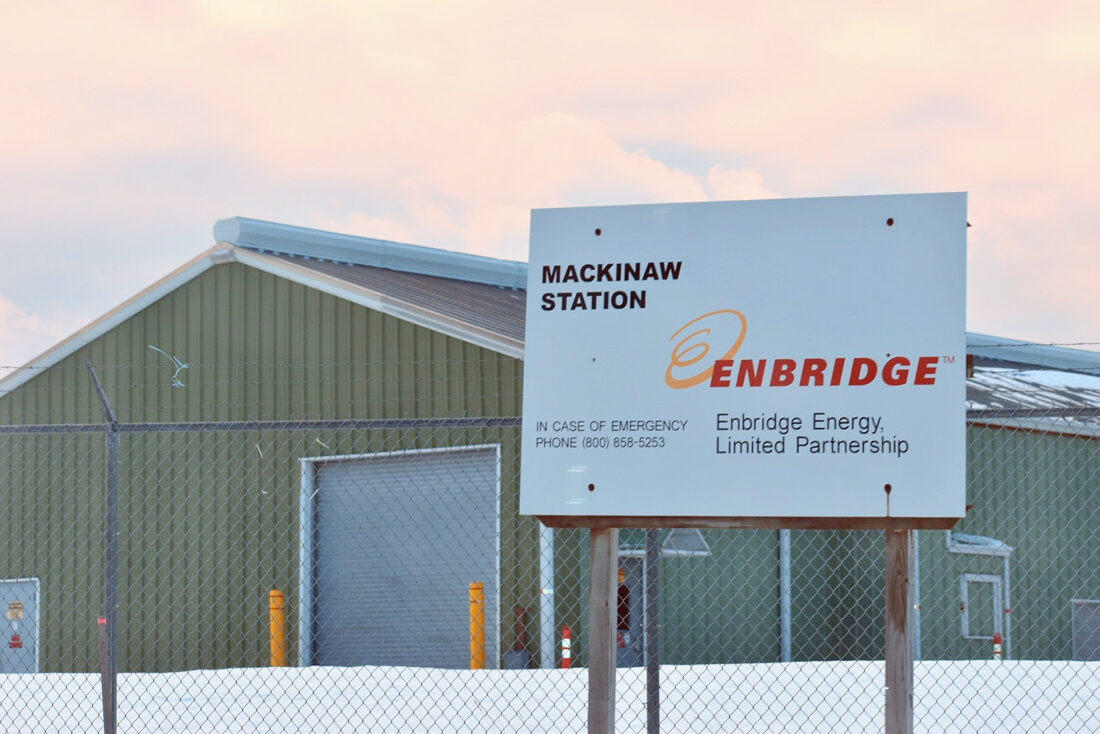
An Enbridge Inc. pumping station for Line 5 in Mackinaw City. (Laina G. Stebbins/Michigan Advance, file)
The U.S. Army Corps of Engineers on Friday released the final version of its Environmental Impact Statement on Enbridge’s proposed Line 5 tunnel project, starting a 30-day waiting period before making its final decision on whether to grant the pipeline company a permit to move forward with the proposal.
Canada-based Enbridge celebrated the release of the statement as a true milestone, with spokesperson Ryan Duffy praising the six-year review as “thorough, transparent and science driven.”
However, Line 5 opponents argue the final document fails to address several key concerns, including the project’s impacts on Indigenous treaty rights and alternatives for transporting oil outside of the Great Lakes.
The Line 5 tunnel project would replace the segment of dual pipelines operating in the Straits of Mackinac – where Lake Michigan and Lake Huron meet – with a new, single segment housed in a tunnel in the bedrock beneath the lakes.
The 645-mile long pipeline runs from northwestern Wisconsin into the Upper Peninsula — including Dickinson and Iron counties — and through downstate Michigan, where it ends in Sarnia, Ontario. It carries up to 22.68 million gallons of crude oil and natural gas liquids through the Straits of Mackinac each day.
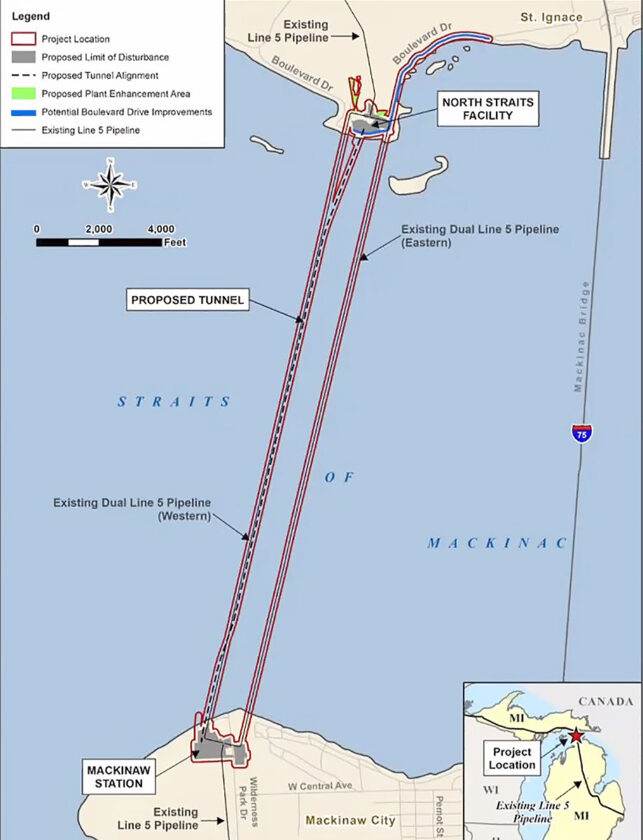
A diagram of Enbridge Inc.'s proposed Line 5 tunnel project under the Straits of Mackinac. (U.S. Army Corps of Engineers)
Julie Goodwin, a senior attorney for Earthjustice, which is supporting the Bay Mills Indian Community in its fight against the pipeline, said the final environmental impact statement sets up a predetermined decision to approve the tunnel by failing to consider scenarios where oil is not flowing through the straits.
In its review, the corps looked at four main scenarios: taking no action and allowing the dual pipelines to continue operating, constructing a tunnel beneath the lakebed as Enbridge would prefer, placing a gravel/rock protective cover over the dual pipelines, and replacing the dual pipelines with a new segment installed using horizontal directional drilling under the lakebed.
“The corps had the opportunity, of course, during this environmental review process to look at alternatives that transport oil outside of the Great Lakes region or in different ways. And they just, they never took that opportunity,” Goodwin said.
A 2016 study from the University of Michigan determined more than 700 miles of shoreline in lakes Huron and Michigan would be vulnerable to pollution should Line 5 rupture. A 2018 study published by Michigan State University determined that the economic damage from a Great Lakes oil spill would amount to $5.6 billion dollars.
While the environmental impact statement acknowledges the straits are a profoundly sacred place in the culture, history and spirituality of Anishinaabe Tribal Nations, it does not address the tunnel project’s impact on treaty rights, which grant tribal nations the right to hunt, fish and gather on lands ceded to the federal government.

Nichole Keway Biber, the Mid-Michigan campaign organizer for Clean Water Action and a Tribal citizen of the Little Traverse Bay Bands of Odawa Indians, voices concerns over Enbridge’s Line 5 tunnel project plan at a demonstration Aug. 26. (Kyle Davidson/Michigan Advance)
The corps writes that its review of treaty rights is separate from its review of the project under the National Environmental Policy Act and that it is consulting on a government-to-government basis with federally recognized Tribes to determine if the tunnel project would infringe upon treaty rights. The final finding will be included in its record of decision.
On March 21, 2025, Bay Mills Indian Community alongside the Little River Band of Ottawa Indians, Sault Ste. Marie Tribe of Chippewa Indians, Grand Traverse Band of Ottawa and Chippewa Indians, Match-E-Be-Nash-She-Wish Band of Pottawatomi, and Nottawaseppi Huron Band of the Potawatomi sent a letter to the Army of Corps of Engineers withdrawing their participation as cooperating agencies in drafting the environmental impact statement, due to President Donald Trump’s Administration’s plan to expedite review of the tunnel project.
The Little Traverse Bay Bands of Odawa Indians similarly withdrew from talks with the corps on March 26.
Whitney Gravelle, president of the Bay Mills Indian Community, said it has been frustrating to watch the corps move forward with the environmental impact statement without completing surveys and research on cultural resources and treaty rights.
“That’s one of the reasons we left as a cooperating agency,” Gravelle said. “The corps has disregarded tribes. They’ve disregarded tribal treaty rights, they’ve disregarded cultural resources, and it has just been one of the most dehumanizing processes I have ever participated in.”
The tunnel itself will bore through several cultural sites, archaeological resources and what Anishinaabe consider to be the site of creation, Gravelle said and there are hundreds if not thousands of archaeological sites on the north and south ends of the straits.
“Those burial places are how we understand our history, how we understand our culture, how we understand our trade movements, or where we’re meant to be harvesting, hunting and gathering,” Gravelle said. “To then be told that all of these places can be destroyed and that it doesn’t really matter, what you’re really saying is that our Indigenous lifeways then don’t matter.”
Gravelle emphasized that the impacts from the tunnels construction are not abstract or theoretical, telling Michigan Advance that these places are where parents go to teach their children ceremony on the water, uncles teach their families how to hunt and put food on the table and elders share stories so their community can understand who they are as a people.
“To have those rights limited or overlooked or misunderstood is really undermining the impact that will be felt by generations,” Gravelle said. “Not only by myself, but by my niece, you know, by my children, by the generations that will exist long after I’m gone from this earth.”
In a statement, Sean McBrearty, the campaign coordinator for anti-Line 5 Oil & Water Don’t Mix coalition pointed to several of the environmental impacts included within the assessment.
“The EIS confirms that the tunnel would result in permanent wetland loss and require excavation and removal of roughly 665,000 cubic yards of bedrock from beneath the Straits of Mackinac, the ecological heart of the Great Lakes system,” McBrearty said. “These impacts are not temporary, and they cannot be undone.”
While much of the focus on Line 5 has centered around the Straits of Mackinac, Gravelle noted that concerns about an oil spill stretch the length of the pipeline, which has leaked more than 30 times over its lifespan, spilling more than 1 million gallons of oil.
However, Gravelle and several other pipeline opponents emphasized that a permitting decision from the Army Corps of Engineers does not give Enbridge a green light to move forward with the project, as the Michigan Department of Environment, Great Lakes and Energy has yet to decide on a Clean Water Act permit for the project. The Sierra Club and Oil and Water Don’t Mix have already called on Gov. Gretchen Whitmer to block the project from moving forward.
“All eyes are really turning to Governor Whitmer,” Goodwin said. “She has two choices to either cave to the Trump administration’s agenda and their friends in the oil industry, or stand up for Michigan and protect the Great Lakes.”
———
Michigan Advance is part of States Newsroom, a national 501(c)(3) nonprofit. For more, go to https://michiganadvance.com.
Local News

Northwoods Notebook: ‘Backyard’ count starts Friday
Michigan bill would allow bow hunters to carry a pistol
LANSING — Legislation proposed by an Upper Peninsula lawmaker to allow Michigan archery hunters to carry a ...
Michigan NRC meetings to be live-streamed
LANSING — Beginning with the Wednesday meeting of the Michigan Natural Resources Commission, the Michigan ...

New memorial scholarship for Church at Kingsford High School

New elevator takes shape at Giant Pine Mountain jump