Dickinson CD’s tree sale a way to appeal to wildlife
Northwoods Notebook
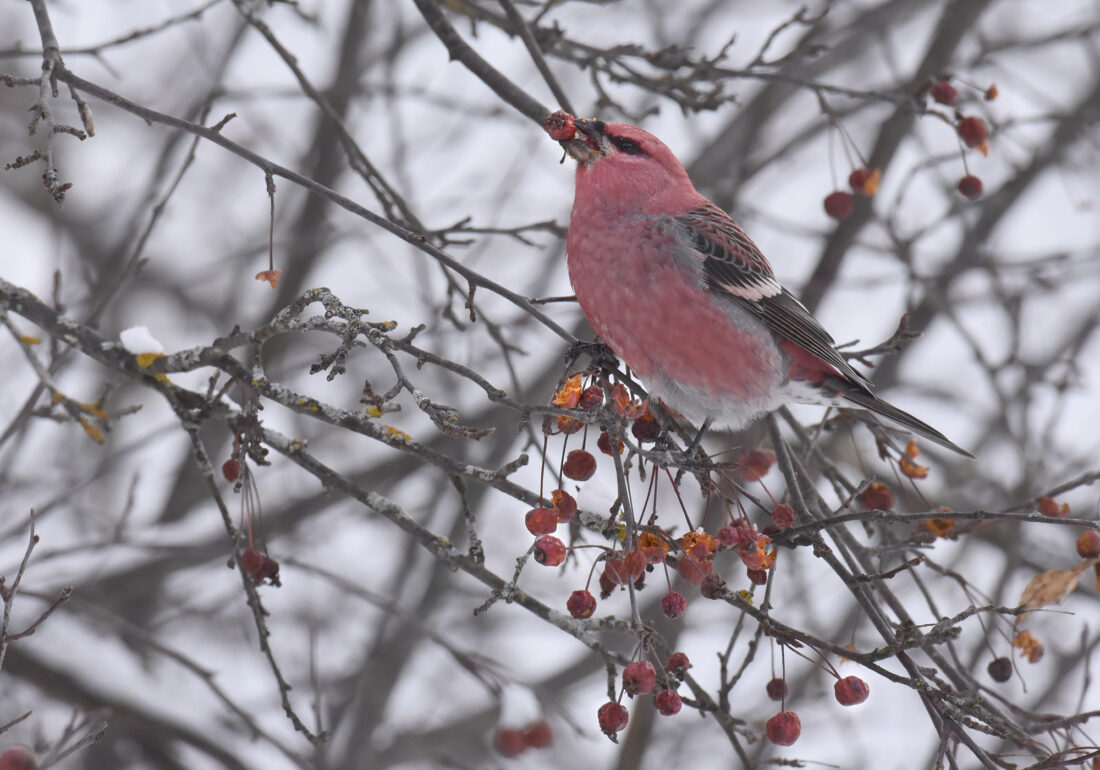
This male pine grosbeak was enjoying a neighbor's crabapples in early December at Six Mile Lake. The Dickinson Conservation District’s annual tree sale has crabapples along with many native species that produce small fruit or berries to attract birds. (Betsy Bloom/Daily News)
The Dickinson Conservation District is now taking orders for its annual tree sale.
This sale offers the chance to plant species on your property that can provide natural feeding opportunities — trees and shrubs that bear fruit, berries or nuts for winter forage.
This is known as mast, the food items native vegetation produces that may convince visiting birds conditions are good enough to stick around at least part of the winter.
While some of these mast producers can occur naturally depending on where you live, it certainly can help to nurture a few of these trees or shrubs within sight of the home to get full enjoyment of what might come along to feed.
The convenience of all this being brought in locally makes the annual tree sale well worth supporting. But if another reason is needed, it is the main fundraiser for Dickinson Conservation District and all the services it provides.
With that in mind, I went back to a column from 2022 in which Ryan Brady, Natural Heritage Conservation biologist with the Wisconsin Department of Natural Resources, gave some guidance on what might be best to appeal to wildlife.
He endorsed much of what the district is offering in the sale, especially the native species that may otherwise be difficult to find at other outlets.
Among the list of large trees, he singled out the oaks as being the “single-best kind of wildlife tree in our area.” Not just because it produces acorns, but it can play host to 530 Lepidoptera — butterflies and moths — species, he explained.
Of the top five Lepidoptera host species, three — the oaks, cherry/plum and birch — are available in the DCD sale.
Birch are a good seed source, he said. The conifers — the sale offers plug seedlings for fir, spruce, pine, cedar, hemlock and tamarack — provide shelter and roosting sites as well as seed-laden cones.
Among the small trees and shrubs, Brady gave virtually the entire list a thumbs up, further recommending choosing several to extend the fruit-bearing season.
Serviceberry also is known as “juneberry” because it has fruit in the early summer. Elderberries ripen in late summer.
Dogwoods provide great low cover, Brady said, and white berries that “are a big hit with the birds.”
Mountain ash is a top food source for what are known as the “winter finches” that sometimes visit the region in winter when the berry crop is poor to the north. The Upper Peninsula in December into this year has seen a solid influx of pine grosbeaks that heavily rely on mountain ash, which had an average to poor crop from Lake Superior across the boreal forest into eastern Quebec, according to the 2025-26 Winter Finch Forecast.
Even the American plum, not considered that attractive to birds as a food source, “smell wonderful; they’re tremendous to pollinators,” Brady said.
As someone who has long advocated planting native species, “this sort of thing,” Brady said, “is a fantastic opportunity, close to home, to ‘feed the birds.'”
His last bit of advice: check the best soils for the species you choose, plant a number and diversity with the idea that some might not thrive, and devise a way to protect the young plants from being munched by deer or rabbits.
Along with the native species, the sale has some of the most popular apples now on the market — such as Honeycrisp and Zestar — along with some long-time favorites like McIntosh and Wolf River.
Crabapples definitely have been a consistent place in winter to see birds such as the pine grosbeaks and Bohemian waxwings; the DCD has several types on their list. Pears, plums and cherries can be ordered as well.
The sale offers other treasures, too — asparagus, raspberries, blackberries, grapes, strawberries, blueberries and rhubarb.
To see what’s available, along with prices, go online to https://www.dickinsoncd.org/shop. More information can be obtained by calling 906-774-1550, ext. 103.
Orders can be placed online, in-person by stopping at the DCD office at 420 N. Hooper St. in Kingsford or over the phone at the above number. Deadline for ordering is April 3, but supplies of some varieties are limited and might not last that long. The DCD advises calling on availability or possible discounts for larger quantities of a single species.
Pickup days will be April 24-25 at Dickinson County Fairgrounds in Norway and 10 a.m. to noon April 25 at Coleman High School in Coleman, Wis.
—
Betsy Bloom can be reached at 906-774-2772, ext. 85240, or bbloom@ironmountaindailynews.com.
Local News
Dickinson CD’s tree sale a way to appeal to wildlife

Substitute teacher accused of criminal sexual conduct
Library’s Prom Dress Swap lets teens get decked out for free

Tourism agencies adjust marketing as more Canadians dial back on visiting Michigan
Seasonal road limits likely to start soon
IRON MOUNTAIN — Seasonal road restrictions will likely be implemented soon as the Dickinson County Road ...