Niagara students get tour of city’s often-invisible past
-
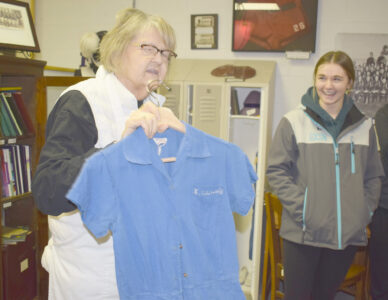
- Niagara High School freshman Carly Sanicki laughs as museum volunteer Darleen Kadulski shows off a uniform girls had to wear for gym class during a special tour of the Niagara Historical Museum. The students also were taken on a bus past several sites that in the past had historic significance in the city. (Marguerite Lanthier/Daily News)
-
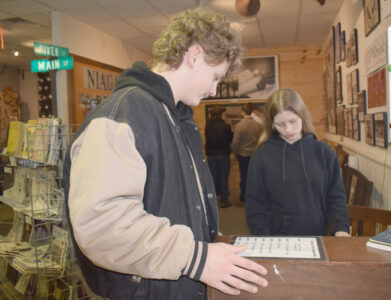
- Niagara High School freshmen Landen Micoley and Jaycie Marchetti look at a display at the Niagara Historical Museum during a special tour the freshmen class took last week. The students also traveled on a bus past several sites in the city. (Marguerite Lanthier/Daily News)
-
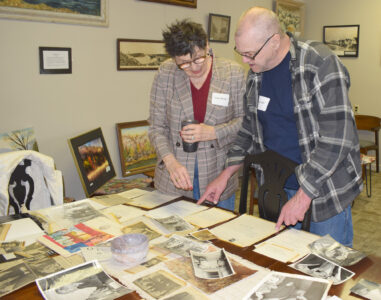
- Judy Sanicki and Ray Kuder of the Niagara Area Historical Society look at information Kuder has about his father, Charles, who was a Niagara village president, during a tour by local freshmen students of the Niagara Historical Museum. (Marguerite Lanthier/Daily News)
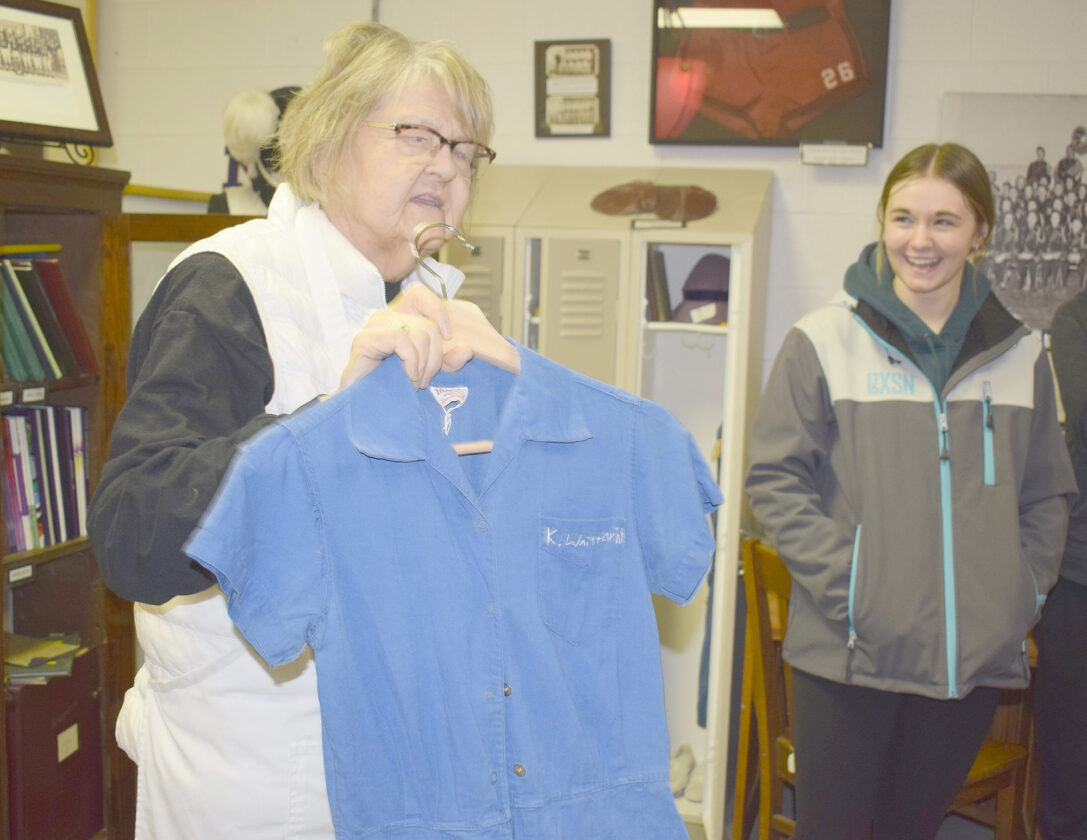
Niagara High School freshman Carly Sanicki laughs as museum volunteer Darleen Kadulski shows off a uniform girls had to wear for gym class during a special tour of the Niagara Historical Museum. The students also were taken on a bus past several sites that in the past had historic significance in the city. (Marguerite Lanthier/Daily News)
NIAGARA, Wis. — The freshmen class at Niagara High School recently was taken on a bus tour of the city, past sites that are mostly only visible in people’s memories.
“I think it’s really cool to learn who lived here and what was here before us. Now it’s just houses, but before it was so cool,” student Jaycie Marchetti said.
The event Wednesday was organized by Karen Klenke and other members of the Niagara Area Historical Society as a way for Niagara students to learn about their city.
Rick Wagner, a volunteer for the tour, thought the kids seemed to be interested.
“If you don’t pass this down, it just gets lost. They don’t know anything about the past,” he said.
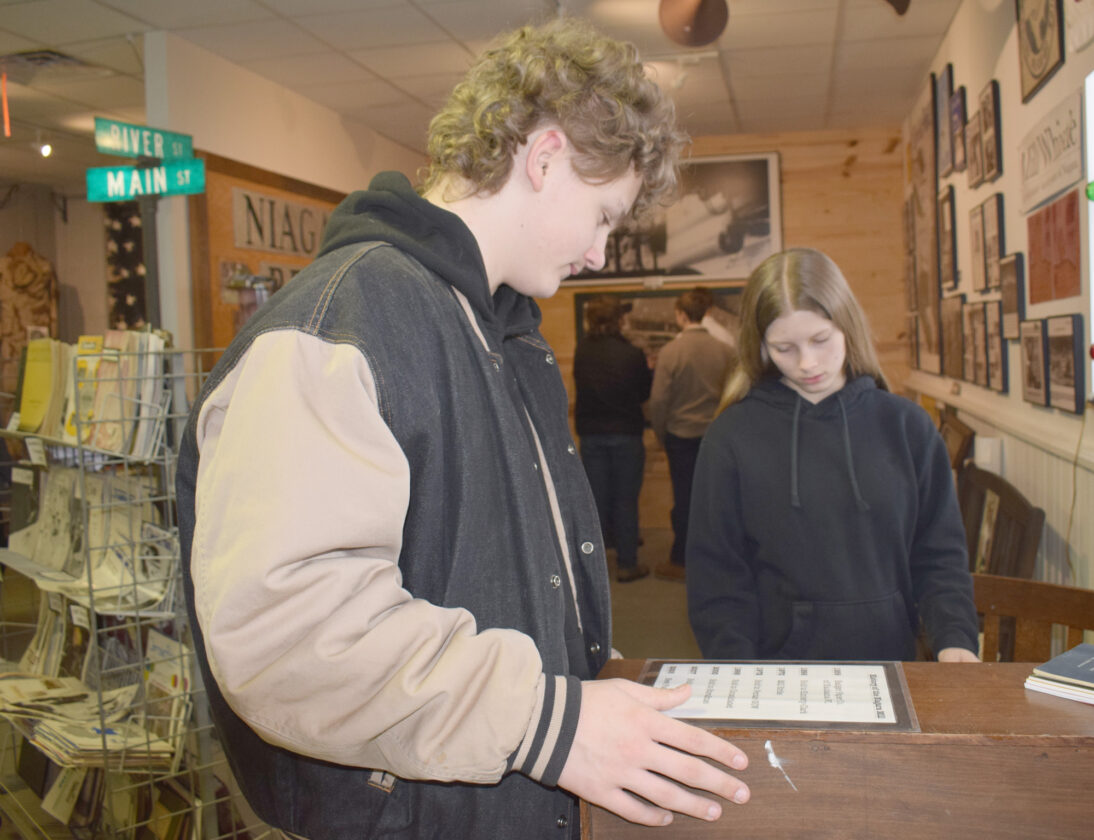
Niagara High School freshmen Landen Micoley and Jaycie Marchetti look at a display at the Niagara Historical Museum during a special tour the freshmen class took last week. The students also traveled on a bus past several sites in the city. (Marguerite Lanthier/Daily News)
He served as the main guide on the bus and first relayed information about the ski hill, which was along Tyler Road. Tyler Road also served as the main road until U.S. 141 was constructed in the 1930s. Residents would travel down Tyler Road to get to the old iron bridge across the Menominee River, which was build between 1904-06.
Behind Main Street, at the other end of Tyler Road, they learned about a coal and ice operation owned by Henry Schintgen.
John Stoveken built a sawmill and pulp house near the falls. Kimberly Clark purchased the property in the late 1880s and built the mill. At one time 52 families lived behind the former mill, Wagner said, including his grandparents. There were several businesses as well, including the Grandview Hotel, some taverns and a grocery store.
After the hotel burned, Kimberly Clark built the Kim-Lark Inn, which served as housing for mill workers and is now the site of the Brick Restaurant.
The hill across from downtown was clear cut to create space for houses built by the mill to house workers.
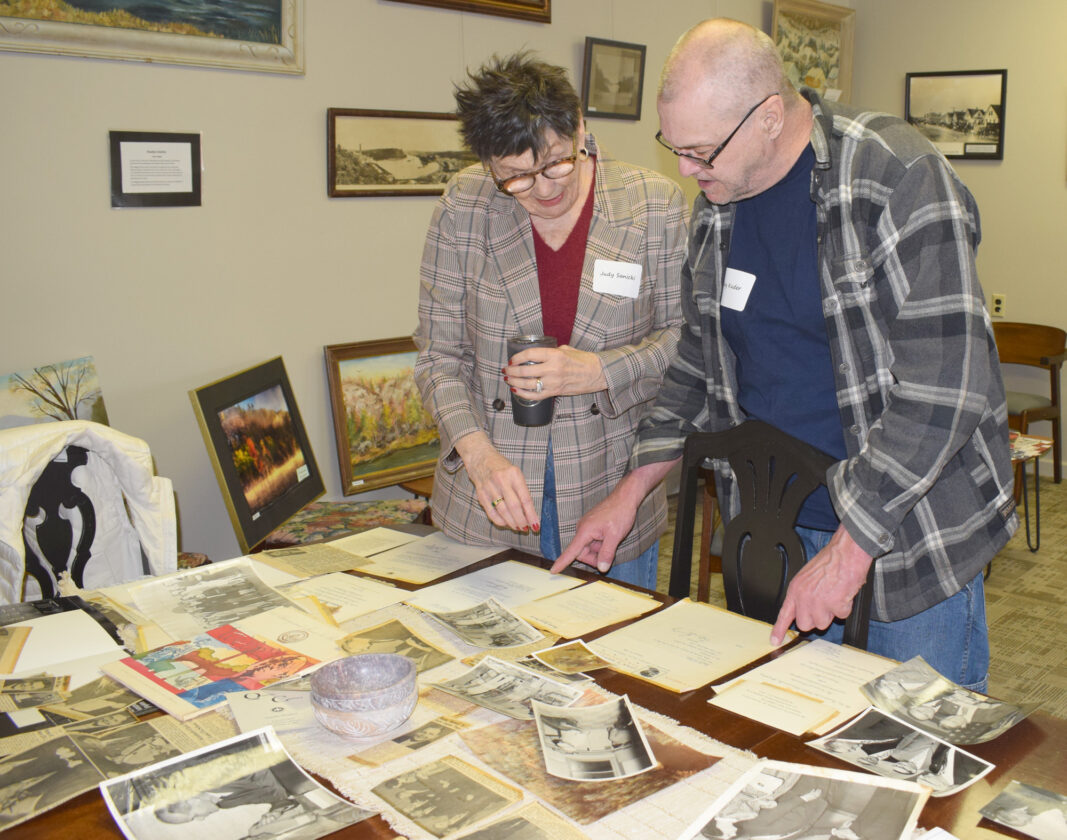
Judy Sanicki and Ray Kuder of the Niagara Area Historical Society look at information Kuder has about his father, Charles, who was a Niagara village president, during a tour by local freshmen students of the Niagara Historical Museum. (Marguerite Lanthier/Daily News)
Off Hill Street, the bus traveled to the former Van Ginkel farm. The family, at one time owned 100 acres. On Van Ginkel Road, students were able to see where the ski hill had been located. They also learned about Saler Summit, where parents would send their children out to pick blueberries. Students also viewed the baseball field at the end of Forest Avenue, which was home to the former football field as well. Children who attended the old school had to climb the hill behind the school for outdoor gym classes.
The bus then traveled to the Niagara Historical Museum, where volunteers — including Wagner, Darleen Kadulski, Judy Sanicki and Ray Kuder — explained various topics to small groups of students.
Kadulski, whose family operated a grocery store near where the Alibi Bar now is, discussed early families and her family’s store. She stumped the kids when she showed them a chamber pot and asked them what it was used for. She also drew a laugh when she showed off a one-piece uniform girls had to wear for gym class.
Wagner, a former mill worker, talked about the history of the mill and explained that some of the men who worked there in early years went barefoot because it was so wet it would ruin their shoes and shoes were expensive.
Kuder spoke about his father, Charles Kuder, who was a former village president. His father met President John F. Kennedy and was invited to three inaugurations.
Back on the bus, students were able to see the former clubhouse, which served as a community center for the city. It’s still standing but not accessible to the public.
At the site of the former high school is a gas station. The school had an Olympic-size pool built off the end in the 1960s, funded by the mill, after an outdoor pool was eliminated due to mill expansion. The outdoor pool was built after children drowned trying to swim in the river.
On the way back to the school, Wagner also detailed the different businesses that used to line Main Street, including a Gamble store, bank, theater, hardware store and liquor store.
Superintendent Nate Burklund thought it was good for the students to see the roots of the community, go to the museum and then share at home what they learned with their parents. Hopefully the parents would be able to give them more information.
“Our kids need that. They need to know the history of the town where they go to school, what actually happened. Sometimes all those towns were bigger then,” Burklund said.
Museum volunteers hope more students get interested in the museum, perhaps even want to volunteer there.
“This is something that’s been a push for the historical society, to get more kids involved so they understand the history of Niagara,” Kadulski said. “That’s why we started the Last Saturday’ events. The last Saturday of every month, we have an activity here from noon until 2 p.m. We cover all ages of kids, to give them an understanding of what’s here, and hopefully develop things for middle school and high school programs.”
———
Marguerite Lanthier can be reached at 906-774-3500, ext. 85242, or mlanthier@ironmountaindailynews.com.
Local News
Michigan ranks high for foreign-owned farmland
A new U.S. Department of Agriculture report found that foreign investors own nearly 10% of Michigan’s ...
US 141 to see improvements in 2027
A U.S. 141 resurfacing and culvert replacement project is scheduled to begin in 2027 in Marinette County, the ...
Fair board votes against saving 1939 exhibition hall
Niagara students get tour of city’s often-invisible past
Line 5 case to come before US Supreme Court today