Tribe wants court to halt Line 5 reroute in Wisconsin
-
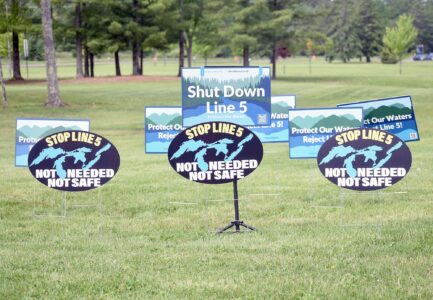
- Signs read “Shut Down Line 5” and “Stop Line 5” outside the site of a public hearing in June 2024 in Ashland, Wis., on a draft environmental assessment of Enbridge’s proposal to reroute the pipeline. (Danielle Kaeding/Wisconsin Public Radio)
-
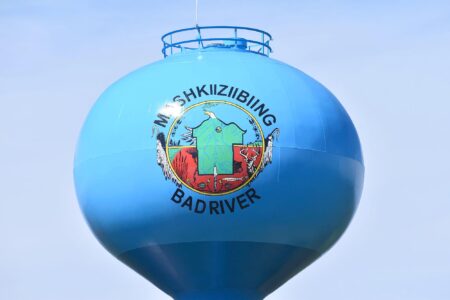
- The Bad River tribe’s reservation spans more than 124,000 acres. The tribe’s reservation includes lands in two counties and six townships in Wisconsin. (Danielle Kaeding/Wisconsin Public Radio)
-
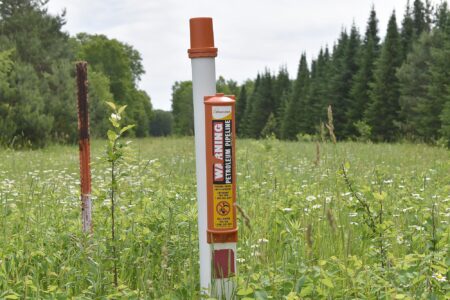
- A post marks where Enbridge’s Line 5 crosses the Wisconsin reservation of the Bad River Band of Lake Superior Chippewa in June 2022. (Danielle Kaeding/Wisconsin Public Radio)
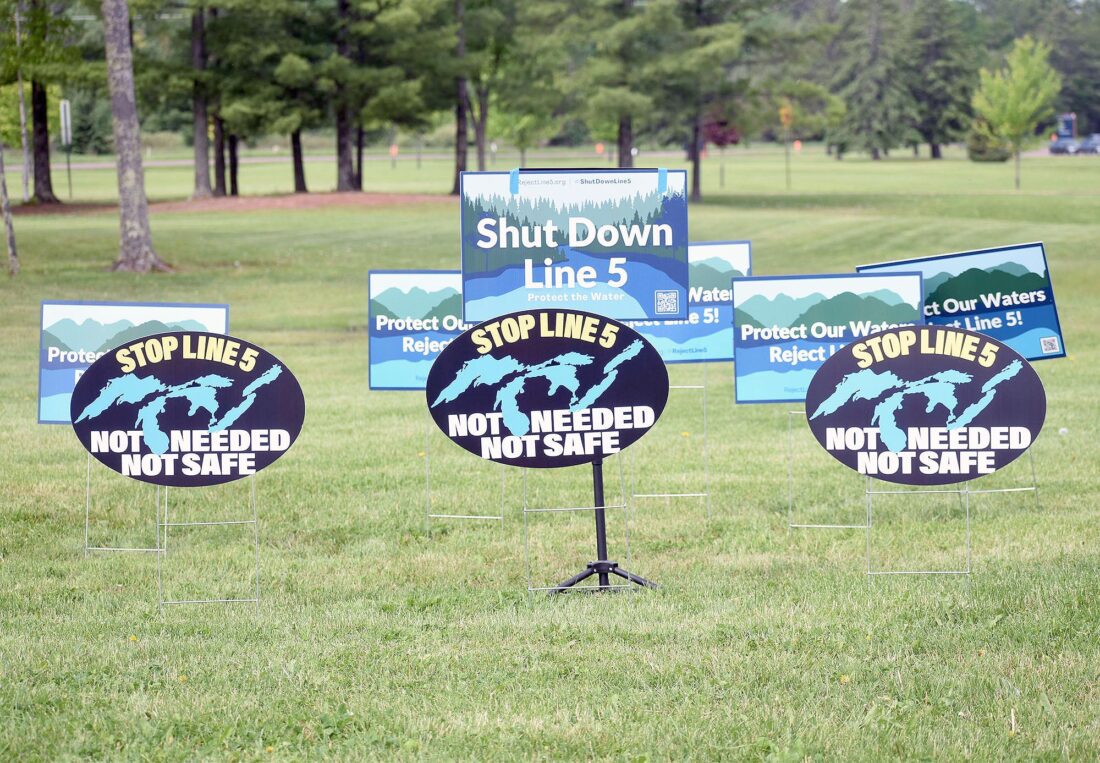
Signs read “Shut Down Line 5” and “Stop Line 5” outside the site of a public hearing in June 2024 in Ashland, Wis., on a draft environmental assessment of Enbridge’s proposal to reroute the pipeline. (Danielle Kaeding/Wisconsin Public Radio)
A northern Wisconsin tribe wants a court to halt construction of Enbridge’s $450 million reroute of an oil and gas pipeline around its reservation after an administrative law judge upheld state permits for the project.
The Bad River Band of Lake Superior Chippewa filed a petition Thursday in Iron County Circuit Court that challenged the recent decision, as well as a motion to halt construction.
“For generations, the Bad River — Mashkiiziibii — and the waters that flow into Lake Superior have nurtured our healthy walleye, sustained our wild rice beds, and kept our community vibrant and strong,” Bad River Chairwoman Elizabeth Arbuckle wrote in a statement.
“The Band River watershed is not an oil pipeline corridor that exists to serve Enbridge’s profits,” she continued. “It is our homeland. We must protect it.”
On Feb. 13, Administrative Law Judge Angela Chaput Foy found the tribe and environmental groups failed to show that approvals granted for the project didn’t meet state permitting or water quality standards. John Petoskey, an Earthjustice attorney representing the tribe, called it a flawed decision and said the project could destroy the tribe’s waters and trample its treaty rights.
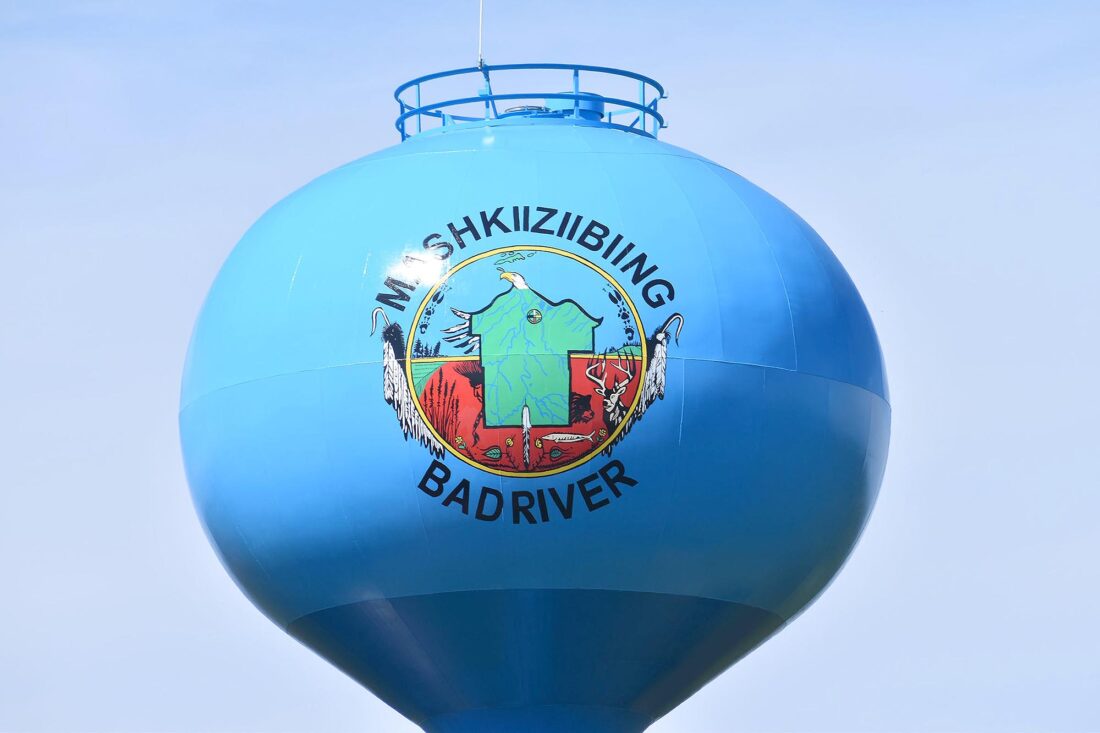
The Bad River tribe’s reservation spans more than 124,000 acres. The tribe’s reservation includes lands in two counties and six townships in Wisconsin. (Danielle Kaeding/Wisconsin Public Radio)
“This permit was granted and then upheld without baseline information about the project’s immediate and long-term impacts. We hope the Court will agree that more investigation is needed,” Petoskey wrote in a statement.
The judge’s ruling came after the tribe and environmental groups challenged permits granted to Canadian energy firm Enbridge.
Enbridge first proposed building a 41-mile segment of Line 5 around the Bad River reservation after the tribe sued in 2019 to shut down the pipeline on its lands due to expired easements on roughly a dozen miles on the reservation.
Juli Kellner, an Enbridge spokesperson, said in a statement that it would be unreasonable to halt construction of the project.
“Project opponents failed to make their case before the Administrative Law Judge who recently upheld state permits issued by the Wisconsin Department of Natural Resources after an extensive and thorough four-plus year review concluded that construction impacts would be temporary and isolated, with no significant adverse effects to water quality or wetlands,” Kellner wrote.
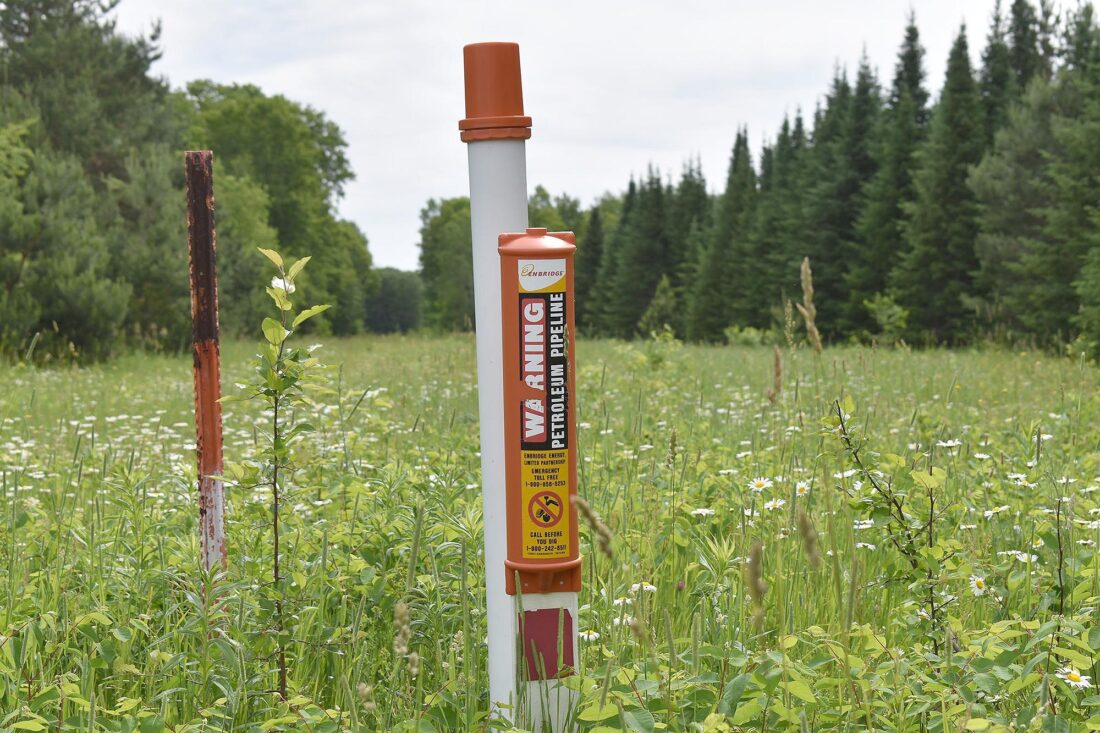
A post marks where Enbridge’s Line 5 crosses the Wisconsin reservation of the Bad River Band of Lake Superior Chippewa in June 2022. (Danielle Kaeding/Wisconsin Public Radio)
Enbridge’s proposed reroute of its pipeline has been subject to years of controversy and scrutiny. Line 5 carries up to 23 million gallons of oil and natural gas liquids daily from Superior, Wis., to Sarnia, Ontario. The route extends through the Upper Peninsula, including Dickinson and Iron counties.
Tribal leaders have said their way of life could be devastated by a potential oil spill into the headwaters of the Bad River, threatening the tribe’s water quality and its internationally recognized wild rice beds.
The project would cross close to 200 waterways and affect about 101 acres of wetlands in Wisconsin’s Ashland and Iron counties. Construction would include blasting bedrock and drilling in waterways and wetlands, which could take multiple decades to restore.
The tribe has argued the project would increase water temperatures, runoff and contamination. Enbridge experts contended the project wouldn’t result in water quality violations or measurable impacts.
Environmental experts testified that blasting could have lasting effects on groundwater flow in areas of fractured bedrock, influencing flows that feed wetlands and springs. Enbridge experts said impacts to groundwater flow and risk of an aquifer breach “are essentially nil.”
A DNR attorney has said the project is the most studied in the agency’s history, undergoing years of review. The agency received more than 32,000 public comments on the proposed reroute, and the DNR has maintained it properly applied the state’s permitting standards.
Enbridge has said state permits were subject to extensive environmental protections and restoration plans. The project would create 700 union jobs during construction.
The company secured an early version of a federal permit from the U.S. Army Corps of Engineers in October. In December, the tribe sued to overturn the permit, alleging violations of federal environmental laws. Kellner said that permit is being finalized to allow construction to begin.
GOP lawmakers, farm groups, industry and labor unions have touted the project’s roughly $135 million economic impact and voiced concerns about the potential for fuel price hikes and a propane shortage if the reroute doesn’t move forward.
Opponents say Enbridge has a track record of spills on Line 5 and other pipelines, including a 2010 spill that released more than 1.2 million gallons of oil into Michigan’s Kalamazoo River. Enbridge has also paid millions tied to aquifer breaches on the Line 3 replacement in Minnesota that released hundreds of millions of gallons of groundwater.
In 2023, a federal judge ordered Enbridge to pay the tribe $5.15 million for trespassing on tribal lands where easements expired and reroute or shut down its Line 5 pipeline on the reservation by June. Both the tribe and the company are appealing that decision in the 7th U.S. Circuit Court of Appeals.
Local News
City, township meetings scheduled
Iron Mountain Planning Commission will meet at 3:30 p.m. today at Iron Mountain City Hall. The panel will establish ...

Manistique’s drive-in theater announces 2026 schedule
Tribe wants court to halt Line 5 reroute in Wisconsin

Iron River to welcome Olympian Baumgartner on Wednesday

Grounded due to weather