US Supreme Court weighs if Line 5 case should stay in state court
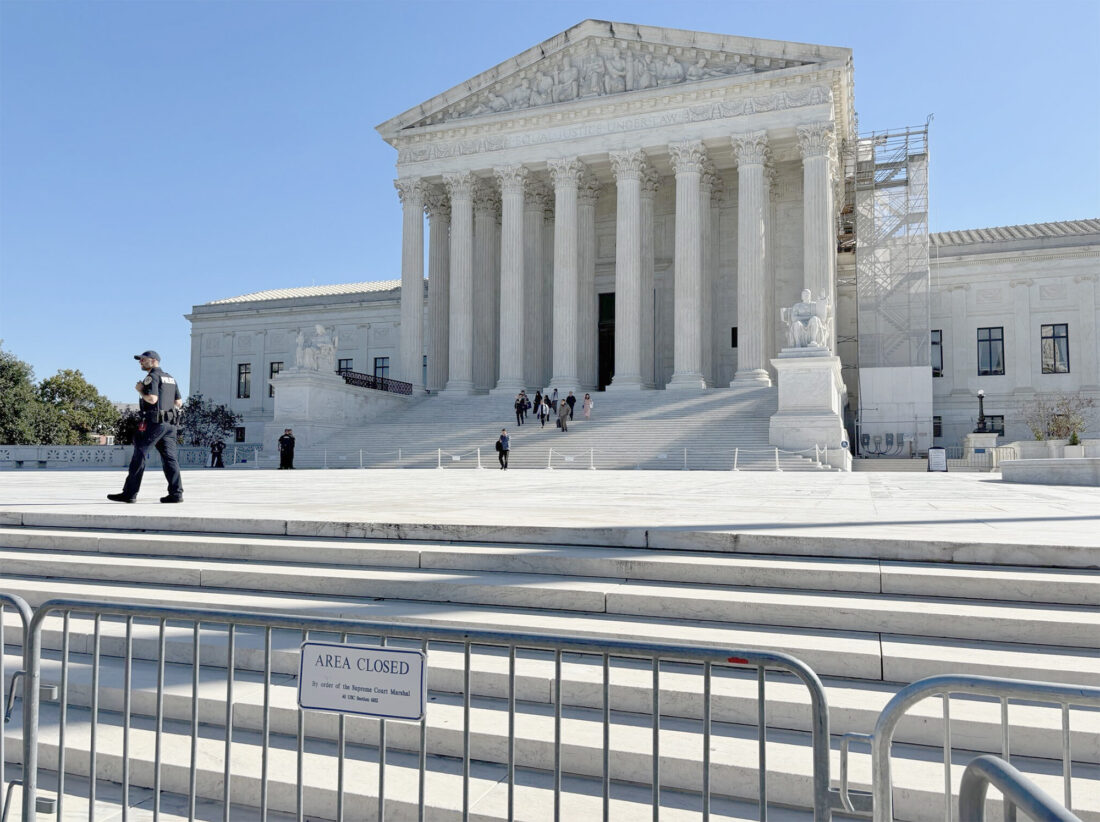
The U.S. Supreme Court building in October 2024 in Washington. (Jane Norman/States Newsroom)
The U.S. Supreme Court heard arguments Tuesday on behalf of Michigan Attorney General Dana Nessel and Enbridge Energy on whether the state’s case to shut down the Line 5 pipeline should be heard in state or federal court.
At issue? Whether there are exceptions to the 30-day time limit to have a matter removed from state court to be heard in federal court.
Nessel first filed suit against the Canadian Pipeline company in 2019, though the case has yet to be resolved as years of legal maneuvering have moved the matter from state court to federal court and back.
In 2024, Nessel successfully argued that Enbridge had exceeded its 30-day time limit to have the case removed to federal court, with the company filing its request after more than a year of litigation. However, Enbridge maintains that U.S. district courts can excuse the time limit, leaving the Court to determine whether they hold this authority.
After arguments from Enbridge attorney John Bursch, Justice Clarence Thomas questioned why this case wasn’t removed to federal court like a similar suit filed by Gov. Gretchen Whitmer, who voluntarily dismissed the case.
Bursch explained that while the cases were similar, the Canadian government invoked a 1977 treaty concerning international pipelines in Whitmer’s case while a federal judge was weighing whether the matter should be heard in state or federal court.
While it wasn’t clear whether Nessel’s initial case was within federal jurisdiction at the outset, the governor’s decision to terminate Enbridge’s right to operate Line 5 on the bottomlands of the Great Lakes and Canada’s treaty invocation changed the lay of the land.
After Whitmer’s case was dismissed and Nessel announced she would move forward with her case at the state level, Bursch said the company filed its notice to remove the case to federal court within 15 days.
Justice Sonia Sotomayor asked what rights Enbridge is losing by having the matter heard in state court as opposed to federal court.
“You have a right to have recovery for a loss or a potential loss, and the forum where that right is adjudicated is not lost,” Sotomayor said. “You have a forum, you have the state court. None of your remedies, like in some of our other cases, would be lost forever. None of your claims or defenses would be lost forever.”
In response, Bursch pointed to two other Supreme Court cases where parties had lost the right to a particular legal mechanism to enforce their argument, arguing that they were losing their right to have the case removed under similar conditions.
Later in the hearing, Justice Neil Gorsuch asked Bursch why Enbridge wanted to have the matter heard in federal court.
There are four reasons, Bursch explained. First, he argued there is value in having a case heard in a forum that respects federal authority. Second, Bursch said federal courts are uniquely qualified to decide matters of federal common law and foreign affairs.
Enbridge would also like to have the option for the Supreme Court to be able to weigh in if an order to shut down the pipeline is upheld, and it has a separate case against the governor in federal court, Bursch said.
Gorsuch probed further, asking whether Enbridge felt it could receive a fair trial in state court.
While Bursch said state courts likely hadn’t dealt much with federal common law in the jurisdiction of foreign affairs, Gorsuch said the issue doesn’t often come up in federal district court, either.
Gorsuch posed a similar question to Michigan Solicitor General Ann Sherman, asking if there’s a reason why the plaintiff would prefer to have the matter resolved in state court.
Sherman noted the case was brought by a state official, addressing concerns of state law as to whether or not Enbridge had violated the state’s public trust doctrine, which determines that the state has a duty to manage natural resources for the benefit of the public.
Congress has given legal parties a choice of forum, with Nessel, the plaintiff, given the first choice of forum, Sherman said. Congress has also given the defense an opportunity to select a federal forum, Sherman said, arguing that if Enbridge thought the matter should have been heard in federal court, it should have responded in a timely manner.
She also argued that Congress had not given federal courts exclusive authority over matters of foreign affairs, and that even if the scope of the case goes beyond state law and into treaty matters, the state court can be trusted to handle it with the Supreme Court as a backdrop.
Sotomayor noted that a federal court had recently ruled in Enbridge’s favor, determining that federal law bars the state from ending Enbridge’s Line 5 easement. If the Supreme Court affirms the Sixth Circuit Court’s decision, leaving Nessel’s case in state court, there would be lawsuits relating to Line 5 in both state and federal court, she noted.
“If you were to win here, are you willing to commit that you will ask the state court to continue its stay pending resolution of the federal action?” Sotomayor asked.
While it was not something she’d discussed with Nessel, Sherman said it was certainly a strategic decision they could discuss.
Line 5 is a 645-mile-long pipeline stretching from Superior, Wis., to Sarnia, Ontario, transporting up to 23 million gallons of crude oil and natural gas liquids every day. It extends through the Upper Peninsula, including Dickinson and Iron counties, and includes a
4-mile segment of dual pipelines that runs underwater in the Straits of Mackinac, where Lake Michigan and Lake Huron meet.
Michigan’s 12 federally recognized Tribal Nations and a number of environmental advocacy groups have called for the more than 70-year-old pipeline to be decommissioned, raising concerns of an oil spill that deepened when Line 5 was struck by an anchor in 2018 and 2020.
In a statement Friday morning, Enbridge spokesperson Michael Barnes said the company was encouraged that the Supreme Court had agreed to review the case. He argued that the federal government holds the sole authority to regulate the pipeline, and that the case holds significant concerns for both energy security and foreign affairs.
Sean McBrearty, campaign coordinator for the anti-Line 5 Oil and Water Don’t Mix Coalition, said he was encouraged by Tuesday’s hearing.
“I think that the justices really ran both lawyers through their paces on this, but just like what we saw in the Sixth Circuit Court of Appeals, Enbridge had no answer as to why they blew past a clear legal deadline by 29 months,” McBrearty said.
While the justices addressed an array of issues related to the case, Whitney Gravelle, president of the Bay Mills Indian Community, said that ultimately, the case centers on one procedural issue.
“If you stay hyper-focused on the procedural issue at hand, Enbridge messed up,” Gravelle said. “They waited two years to file for removal. That is an erroneous and technically unallowable amount of time for something like that to occur.”
The Bay Mills Indian Community, alongside the Grand Traverse Band of Ottawa and Chippewa Indians, Hannahville Indian Community, Keweenaw Bay Indian Community, Lac Vieux Desert Band of Lake Superior Chippewa Indians, Little River Band of Ottawa Indians, Little Traverse Bay Bands of Odawa Indians, Nottawaseppi Huron Band of the Potawatomi, Pokagon Band of Potawatomi and the Sault Ste. Marie Tribe of Chippewa Indians, filed an amicus brief in support of keeping the case in state court.
While questions around whether the state court should hear matters tied to international treaties were raised in court, Gravelle pointed to People v. LeBlanc as an example of a case originating in Michigan, noting that the case ultimately reaffirmed the Bay Mills Indian Community’s rights under the 1836 Treaty of Washington.
“I think it’s unfair to say that only federal courts can interpret federal questions,” Gravelle said, noting that states also have treaty obligations and have historically been a part of that discussion.
In addition to Nessel’s case, the Whitmer administration has also asked the high court to determine whether the state is immune from the suit Enbridge filed against Whitmer and the director of the Michigan Department of Natural Resources for revoking its easement to operate Line 5 in the Straits of Mackinac.
———
Michigan Advance is part of States Newsroom, a national 501(c)(3) nonprofit. For more, go to https://michiganadvance.com.
Local News
Fair Board meeting day corrected
Dickinson County Fair Board typically meets at 6 p.m. the first Tuesday of the month at the fairgrounds in Norway. ...

Ready to root for ‘Some Pig’

Breitung awaits recommendations on office staffing
US Supreme Court weighs if Line 5 case should stay in state court
Seasonal road restrictions expected to start soon
IRON MOUNTAIN — Businesses that involve truck deliveries and services are being advised to adjust their schedules ...