Whitmer pitches $88B budget; GOP signals it wants cuts
-
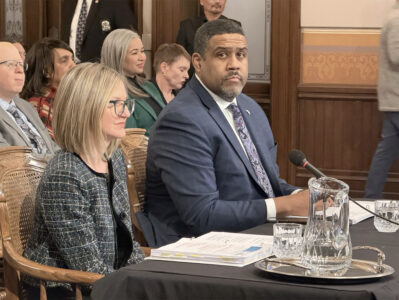
- State Budget Director Jen Flood, left, and Michigan Department of Technology, Management and Budget Acting Director Kyle Guerrant provided an overview Wednesday of Gov. Gretchen Whitmer’s final budget proposal of her term, totaling roughly $88 billion. (Jordyn Hermani/Bridge Michigan)
-
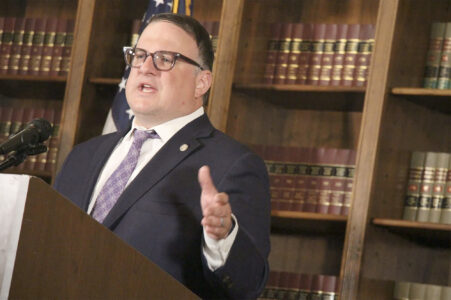
- Michigan House Speaker Matt Hall, R-Richland Township, said he will not take up new “sin” taxes called for in Gov. Gretchen Whitmer’s proposed budget on Wednesday, arguing that raising taxes was “something we’re not going to do.” (Jordyn Hermani/Bridge Michigan)
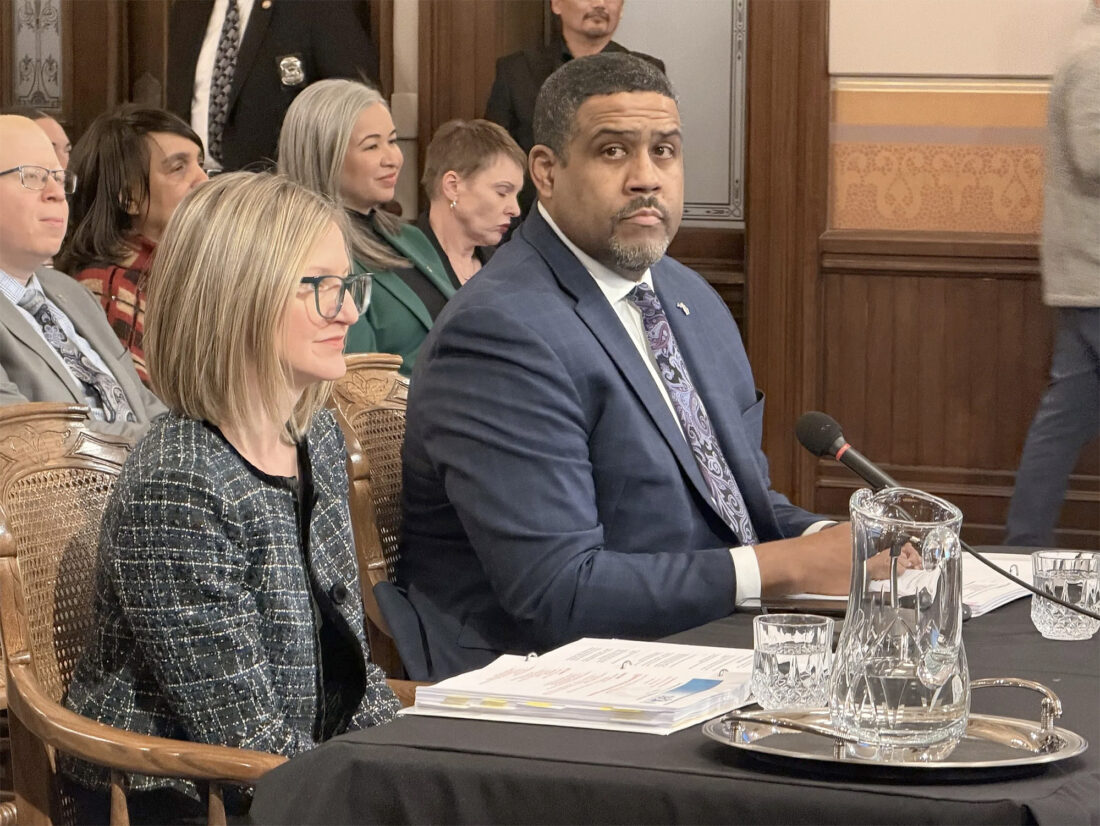
State Budget Director Jen Flood, left, and Michigan Department of Technology, Management and Budget Acting Director Kyle Guerrant provided an overview Wednesday of Gov. Gretchen Whitmer’s final budget proposal of her term, totaling roughly $88 billion. (Jordyn Hermani/Bridge Michigan)
(This story was originally published by Bridge Michigan, a nonprofit and nonpartisan news organization. Visit the newsroom online: bridgemi.com.)
LANSING — Michigan Gov. Gretchen Whitmer on Wednesday unveiled a record-setting $88 billion state budget plan, proposing to tap the state’s “rainy day” fund and raise “sin” taxes to fund key initiatives next fiscal year.
The executive budget proposal, Whitmer’s last before term limits force her out of office, is significantly larger than the roughly $81 billion law she signed in October, and would be a 54% jump from the $57 billion budget signed the year before she took office, without adjusting for inflation.
Beyond the new spending, Whitmer is also proposing a pair of targeted tax cuts: A 10% property tax reduction for seniors, and a sales tax “holiday” to help families purchase school supplies.
“This is a budget that helps Michiganders save money, improve student literacy, protects access to health care and sets Michigan up for long-term success,” State Budget Director Jen Flood told House and Senate lawmakers Wednesday, as part of the administration’s budget presentation.
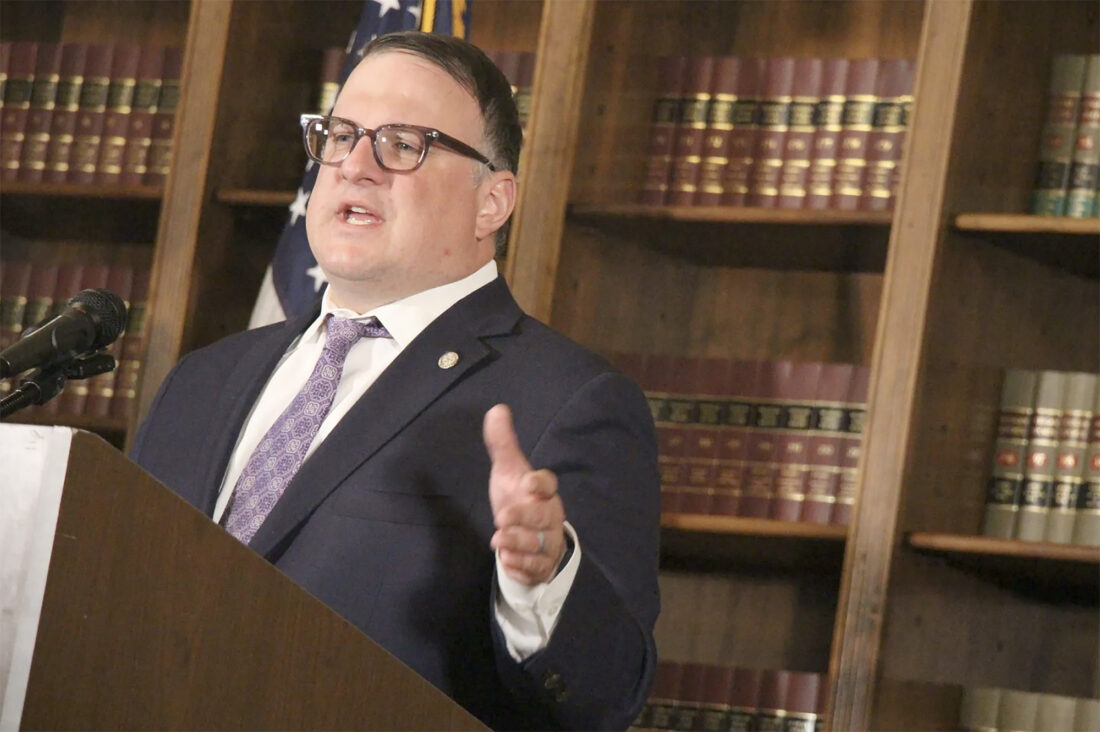
Michigan House Speaker Matt Hall, R-Richland Township, said he will not take up new “sin” taxes called for in Gov. Gretchen Whitmer’s proposed budget on Wednesday, arguing that raising taxes was “something we’re not going to do.” (Jordyn Hermani/Bridge Michigan)
The governor’s proposal is the opening salvo in what will be a months-long process. The Republican-led House and Democratic-led Senate will propose their own budgets later this year, and the three camps will attempt to negotiate a final deal by summer — or the Oct. 1 constitutional deadline.
The final budget will likely be significantly smaller than the $88 billion version pitched by Whitmer, who is proposing to use $400 million from the state’s so-called rainy day fund and about $800 million in new taxes on vapes, tobacco, digital advertising and more to cover rising Medicaid costs.
Economists last month told state officials to expect about $1 billion less to work with as they build budgets over the next two years, primarily because of federal tax law changes and the state’s new road funding law.
Republicans control the state House, and quickly made clear they will not support some of the Democratic governor’s proposals.
“No responsible budget proposal should pull from a rainy day fund. We purposefully put ourselves in this situation,” House Speaker Matt Hall, R-Richland Township, said earlier Wednesday.
Revenue projections suggest the state must reduce spending, Hall added, saying he was “shocked” the administration’s proposed solution is “raiding the rainy day fund and raising taxes — something we’re not going to do.”
In her final budget proposal, Whitmer is seeking millions in one-time payments for operations at Michigan’s 15 public universities and more spending on K-12 classrooms, with an emphasis on literacy and improving the state’s low student performance on standardized tests.
Here’s what to know:
Literacy push
Reading proficiency scores for Michigan’s third-graders are at record lows, prompting bipartisan concern from lawmakers and the governor, who has vowed that addressing the state’s literacy crisis will be her “No. 1 priority” during her final year in office.
Among Whitmer’s new budget proposals —
— $100 million for “high impact tutoring,” and $100 million in grants for school districts to purchase and implement curricula;
— $50 million for teacher training on the “science of reading”;
— $30 million for “early learning partnerships”;
— $10.5 million for more literacy coaches at intermediate districts;
— $6 million to continue “literacy essentials programs” to improve instruction and facilitate a statewide network of literacy coaches.
New taxes to support Medicaid
With Medicaid costs projected to continue to climb but federal resources expected to decline because of President Donald Trump’s “big, beautiful” law, Whitmer is proposing a slew of new taxes to support the health care program for lower-income residents.
Among them: Raising cigarette taxes from $2 to $3 a pack, a new vape tax, higher taxes on casinos and sports betting, and a new tax on digital advertising. Read more about the proposal at https://bridgemi.com/michigan-government/gretchen-whitmer-raise-800m-taxing-nicotine-gambling-and-ads-for-medicaid/.
Hall, the Republican House speaker, made clear he is not going to support the proposed tax increases: “We’re not going to do any of that,” Hall said in a press conference before the governor’s proposal was formally unveiled.
While not a tax, per se, the administration is also renewing calls to raise Michigan’s landfill dumping fees. Michigan has more trash in landfills per resident than anywhere else in the country, according to a 2025 study, due in part to the low rates it charges to take waste: Just $0.36 cents per ton.
‘Big, beautiful’ bill costs
The “big, beautiful” law could also have other big impacts on the Michigan budget. New cost-sharing rules are projected to cost the state nearly $100 million next fiscal year.
Whitmer is proposing at least $223 million in related spending, including —
— $94 million to offset increased cost sharing requirements for the Supplemental Nutrition Assistance Program, or SNAP.
— $80 million for additional 589 full-time employees to cover what the Whitmer administration calls “workload increases resulting from new requirements” in the federal law. That would include new assistance payment workers, Office of Inspector General agents, departmental analysts, supervisors and more.
— $16.7 million to increase access to benefit help-line services and educate recipients on the federal changes.
— $30 million to help Medicaid and SNAP recipients to meet federal work requirements and “maintain access to their benefits.” That would include $25 million for workforce development and training, along with $5 million for registered apprenticeships.
More student funding, free lunches
Whitmer’s budget proposal includes $325 million to raise the K-12 school funding foundation allowance from $10,050 to $10,300 per pupil. Cyber schools should get less — $8,240 per pupil — because of “lower fixed costs,” she suggested, an argument lawmakers have previously rejected.
The proposal also includes $200 million to continue a universal free school meal program launched under Whitmer, and $143 million to continue universal free pre-K, also launched under Whitmer.
“The foundation for long-term success begins before kindergarten,” said Deputy State Budget Director Kyle Guerrant.
The governor also continues to push for more “weighted” funding for schools with more rural or economically disadvantaged students, English language learners, pre-K and vocational students. Her proposal includes an additional $128 million for those schools, a 6% increase.
She’s also proposing another $125 million for districts with declining enrollment, and $125 million to help schools pay for transportation.
Higher ed scholarships
The Whitmer administration is calling for $52.3 million in new one-time payments to boost operations funding for Michigan’s 15 public universities.
That comes as part of an overall 11% increase in the higher education budget. Much of that new spending would be focused on expanding scholarship programs, including —
— $232 million in extra funding for the Michigan Achievement Scholarship, which offers students up to $5,500 a year for four-year colleges and is part of the state’s free community college program started under Whitmer;
— $26.5 million more for the Tuition Incentive Program, which helps lower-income students get associate degrees;
— $25 million more for Michigan Reconnect, which would allow the state to permanently lower the eligibility age to 21 for the program, which currently provides scholarships to residents 25 years or older who do not have a degree.
Tapping rainy day, School Aid funds
Whitmer is proposing to increase spending, in part, by using $400 million from the Budget Stabilization Fund, the rainy day savings account that she has grown during much of her tenure.
As of January, the fund had about $2.2 billion, up from about $1.1 billion when Whitmer took office in 2019.
Hall, the Republican House speaker, made clear he does not support the proposed rainy day withdrawal.
Officials should instead cut state spending, Hall argued, saying officials knew that was a possibility when they passed new laws last year to exempt tips and overtime pay from taxation for three years and devote other tax revenue to road repairs as part of a $2 billion plan.
The governor is also proposing to spend more School Aid Fund money on community colleges and universities, continuing what critics call a K-12 diversion that began nearly two decades ago under then-Gov. Jennifer Granholm, a Democrat, and continued under former Gov. Rick Snyder, a Republican.
Whitmer’s executive budget proposes spending $525 million in School Aid Fund revenue on community colleges, and nearly $1.3 billion on universities. The combined total of $1.8 billion would top the $1.3 billion in the current year budget.
Property tax break for seniors
One of the handful of policies to leak ahead of Wednesday’s budget presentation: Property tax relief for seniors. Whitmer’s budget calls for allowing seniors 65 and older to apply for a property tax refund of up to 10%. It’s estimated to cost the state $90 million next year.
“At its core, this proposal is about helping seniors remain in their homes, maintain independence and manage rising costs with greater certainty,” said Guerrant, the acting director of the state Department of Technology, Management and Budget.
Because this is a credit paid by the state, local governments that rely on property tax revenue are expected to be held harmless.
Hall called Whitmer’s proposal a “positive step” but called it “very limited,” noting House Republicans are preparing a more expansive property tax relief proposal.
“Our plan, people are going to feel it,” he said. “Homeowners across the state, they’re going to feel it, our renters are going to feel it — it’s going to be significant property tax relief.”
School supply tax holiday
Another previously reported piece of tax relief proposed by Whitmer: A tax “holiday” on school supplies, estimated to cost the state $13.6 million next fiscal year.
The proposed tax relief would last for three years and apply to school supplies bought both online and in-person. Items included in the targeted tax cut include clothes, classroom items, and computers.
“Household budgets are stretched, and this provides direct, tangible relief when families need it most,” Guerrant said.

Local News
Comments sought on Kimberly-Clark Marinette Green Tier contract
MADISON, Wis. — The Wisconsin Department of Natural Resources is seeking public comment on a proposed Green Tier ...
Booster Club makes donation
Maple syrup program Tuesday in Florence
FLORENCE, Wis. — A program on maple syrup techniques will take place at 6 p.m. Tuesday at the Florence Natural ...
DIDHD board elects officers, lists schedule
KINGSFORD – Mark Stauber, Iron County commissioner, was elected chair and Joseph Stevens, Dickinson County ...
Whitmer pitches $88B budget; GOP signals it wants cuts