Despite decades of efforts, Michigan still without statewide septic code
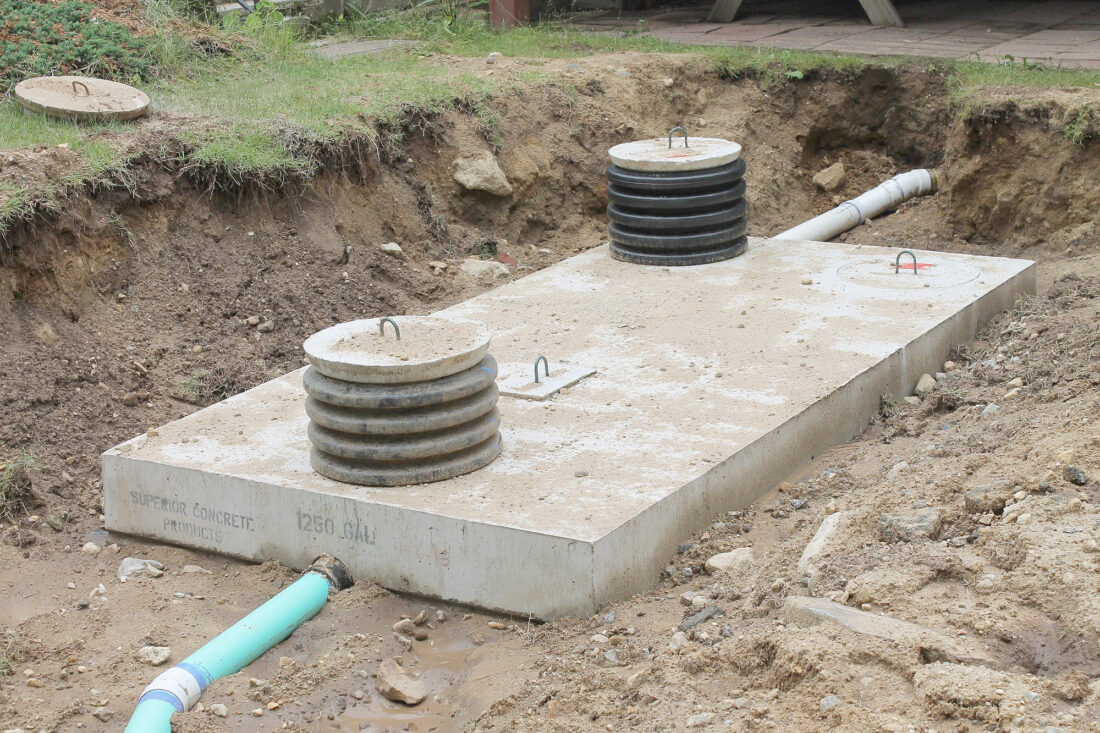
A two-compartment concrete septic tank. (Environmental Protection Agency photo)
For many residents and visitors alike, the State of Michigan conjures images of abundant fresh water and sprawling Great Lakes summed up by the state’s two-word tagline: Pure Michigan. While environmental advocates have long fought to preserve the health and quality of those issues, one particular issue has evaded progress for decades: establishing a statewide code on septic systems.
On Friday, Flow Water Advocates hosted a panel to discuss the lack of uniform regulation on septic fields within the state, and how failing to monitor these systems could bring harm to both Michigan residents and the environment.
Skip Pruss, senior advisor for Flow and the moderator of Friday’s panel, said the state is gifted to be surrounded by 21% of the world’s freshwater, alongside 11,000 inland lakes and countless rivers and streams. However, when those bodies of water are tested, results often show evidence of contamination with human feces, Pruss said.
“It’s just astounding that Michigan is the only state of all 50 states that doesn’t have a statewide septic code, and it’s not for want of trying,” Pruss said. “We’ve been at this for almost 40 years, trying to get legislation passed, and we haven’t been able to do it.”
During the 2023-2024 Legislative session, state Sen. Sam Singh, D-East Lansing, led the introduction on a set of bills to set a statewide code, with state Reps. Phil Skaggs, D-East Grand Rapids, and Carrie Rheingans, D-Ann Arbor, leading the effort in the House. While the bills failed to reach the governor’s desk, Singh reintroduced legislation at the end of January 2026 to allow local health departments to inspect and enforce new regulations on on-site wastewater treatment systems.
“I think we sometimes don’t acknowledge the size and scope of the issue,” Singh told attendees of Friday’s webinar. “There is over 1.3 million on site septic systems throughout the state. And obviously, the way we’ve been regulating it since we don’t have a statewide code has been at the local level.”
Dan Thorell, a health officer with the Benzie-Leelanau District Health Department, noted that there are 45 local health departments throughout the state, and that each department has its own set of regulations on the permitting and siting of new septic systems, with only a handful of departments performing evaluations of existing systems.
“A statewide code is something that local health departments have supported,” Thorell said. “The concept of a statewide code is just a matter of the details, right? Of getting something that, you know, we can all live with and that is going to do what we need to do.”
Singh’s Senate Bill 771 would create a technical advisory committee, which would work with the Michigan Department of Environment, Great Lakes and Energy to make recommendations for rules on a statewide septic code, laying out a three-year timeline to adopt rules on onsite water treatments systems, with inspections beginning as early as 45 days after the rules are putting in place, he explained.
Local agencies would have 10 years after the rules are put in place to evaluate systems based on certain risk factors, including environmental criteria, age and any changes in use. Any system older than 20 years within 500 feet or surface water, or that lacks a construction permit must be evaluated. Systems 30 years or older must also be evaluated.
Singh acknowledged that with 1.3 million systems in the state, local health departments would be facing a significant increase in their workload, so inspections in the first 10 years would focus on systems at the highest risk of failure, with reevaluations every 10 years. Over time, every system in the state would eventually be inspected due to its age, Singh said.
“We have had studies that have shown that anywhere between 20 to 30% of septic systems are in some level of failure,” Singh said. “And we want to ensure that, you know, that these evaluations are done in an appropriate way.”
The bill also creates a public education and training fund, to provide public education and outreach on septic systems as well as training to local health departments, evaluators and EGLE. The fund would be supported by a $5 fee on services associated with permitting and applications for an onsite water treatment system.
Additionally, the bill allows public health departments to charge a $50 fee for inspections, and would create an electronic database on the locations of septic systems within the state and the results of their evaluations.
While the system would not be accessible to the general public under the current iteration of the bill, Singh said access to the system has been part of an ongoing conversation.
“I think that’s still being debated at the stakeholder level, but we want to make sure that there’s at least enough public understanding that if there is a crisis or an issue, people would be well aware of it,” Singh said.
As for the threat failing septic systems can pose to the environment, Megan Tinsley, the water policy director for the Michigan Environmental Council, explained that these systems can deposit nutrients into nearby water bodies, leading to algal blooms.
“We know they close beaches, but they also do have an environmental impact,” Tinsley said. “They change the ecosystem, because basically the algae sucks and uses up all the oxygen in the water column, and so you’re left with areas that fish and other aquatic life just can’t live.”
Some of these algae also release toxins, which can damage the liver, harming both humans and their pets, Tinsley explained.
Failing septic systems can also contaminate bodies of water with E. coli, a type of bacteria found in mammals’ digestive tracts. The bacteria can infect humans through ingestion or contact with skin, leading to health issues such as diarrhea, giardia, hepatitis or cholera.
There are more than 9,000 miles of streams in the state that are out of compliance for safe human contact, Tinsley said. Additional monitoring activity could bring that number up to 37,000 miles, meaning more than half of streams in the state would not be safe for swimming, Tinsley explained.
When asked what the major holdups have been in establishing a statewide septic code, Singh said the cost of a failing system has been the biggest concern.
“Out of sight, out of mind, I think, is, you know, how some people want to view this issue,” Singh said. “And they know, once you have a statewide septic code, there’s evaluations that are being done that, you know, your residents are going to find out ‘Hey, I’ve got a failing system. And guess what? Now I’ve got a $15,000 bill, $10,000 bill,’ Some even higher, if you’ve got even a larger septic system.”
Managing that cost, alongside concerns about how the will impact the transfer of property and how health departments who don’t have the capacity and finances to meet additional demands have been the basic components of this conversation for the past 40 years, Singh explained.
———
Michigan Advance is part of States Newsroom, a national 501(c)(3) nonprofit. For more, go to https://michiganadvance.com.
Local News
Township, county, school meetings for the week
Iron Mountain Tree Board will meet at 4 p.m. today at Iron Mountain City Hall. Florence County Board of Education ...

IAHF awards mini-grant
Despite decades of efforts, Michigan still without statewide septic code
Crude oil prices top $100 a barrel amid ongoing Iran war

Effort on to extend law for veterans’ burial benefits