
Proposed Michigan public notice changes spark newspaper industry fears
-
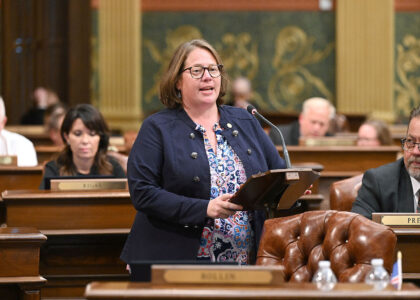
- State Rep. Sarah Lightner, R-Springport, speaks in the Michigan House in Lansing. Listening to the right is state Rep. Dave Prestin, R-Cedar River, of the 108th District in the Upper Peninsula. Lightner told Michigan Advance last week that she has been looking into the possibility of amending the state’s public notice requirements that now rely on postings in local newspapers. (Contributed photo)
-

- From left, state Sens. Ed McBroom, R-Waucedah Township, and Jeremy Moss, D-Bloomfield Township, take questions from reporters Jan. 29, 2025, after the Michigan Senate passed legislation to expand the state’s Freedom of Information Act. It has stalled in the state House. (Kyle Davidson/Michigan Advance)
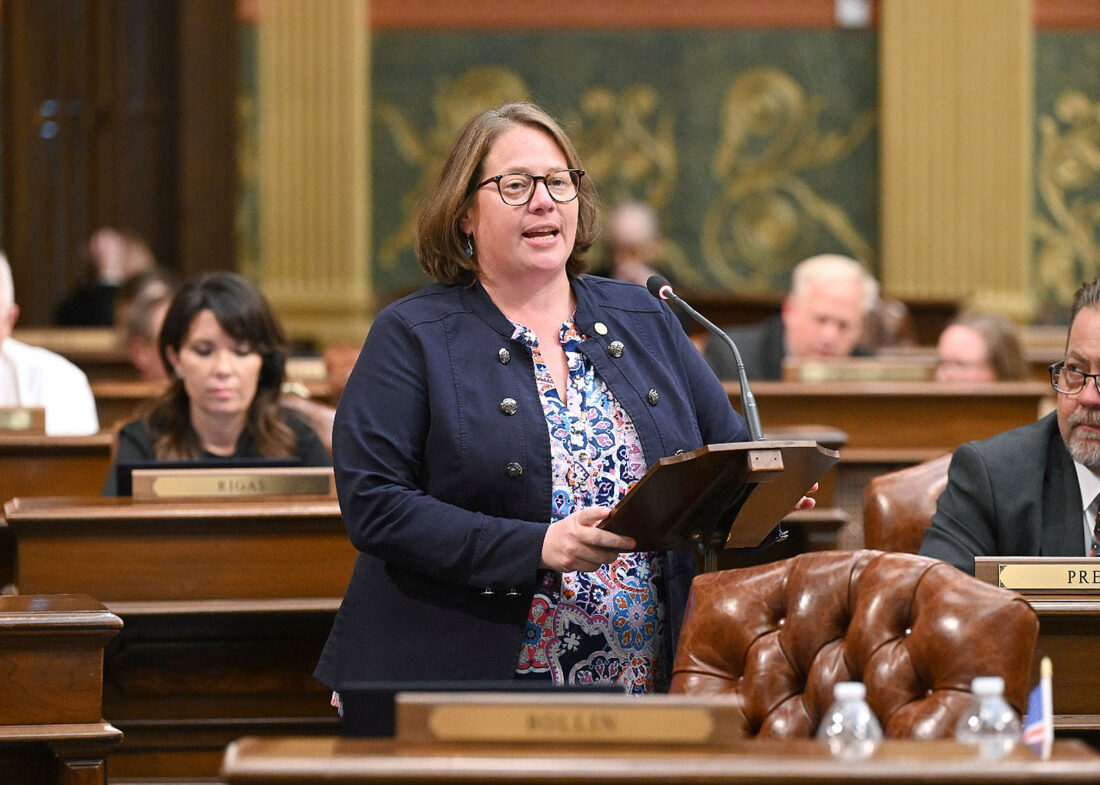
State Rep. Sarah Lightner, R-Springport, speaks in the Michigan House in Lansing. Listening to the right is state Rep. Dave Prestin, R-Cedar River, of the 108th District in the Upper Peninsula. Lightner told Michigan Advance last week that she has been looking into the possibility of amending the state’s public notice requirements that now rely on postings in local newspapers. (Contributed photo)
A leader in the House Republican caucus is in the early stages of researching ways to amend the state’s public notice requirements that presently rely on postings in local newspapers to keep the public informed about important local meetings or other legal notices.
Although the work is in its earliest stages, and no bills have been drafted or introduced in the House, the move has sparked concern among leaders in Michigan’s newspaper industry, which relies on public notice posting fees as a key driver of revenue. Those same news leaders have also raised alarms over what a change to the state’s notice requirements could mean for the public’s right to know about the inner workings of local and county government.
State Rep. Sarah Lightner, R-Springport, told Michigan Advance last week that she has been looking into the possibility of modernizing the public notice process but confirmed that the work was still in its infancy.
Lightner told the Advance that the intention was not to do away with the state’s public notice requirement. That’s good news for transparency and open government advocates, who say eliminating the requirement could leave residents unaware of key local decisions.
The representative does, however, think changes to the process were worth considering, including updates to the types of spaces where notice could be provided aside from print or online newspapers.

From left, state Sens. Ed McBroom, R-Waucedah Township, and Jeremy Moss, D-Bloomfield Township, take questions from reporters Jan. 29, 2025, after the Michigan Senate passed legislation to expand the state’s Freedom of Information Act. It has stalled in the state House. (Kyle Davidson/Michigan Advance)
“It’s an area I’m looking into, but I’m just starting to do some research,” Lightner said. “It’s not something that is a priority for me this year.”
The Michigan Press Association, the state’s primary coalition of news industry leaders and the outlets that serve public interest, has also noted that the law requiring public notices to be published in newspapers was recently amended to bring those notices out from behind subscription paywalls and onto a website run by the MPA — which further maximizes the chances of the public being notified in a timely manner.
“We also mandate that all of our members who publish public notices in their paper publish them on their website ahead of a paywall,” said Lisa McGraw, public policy manager with the MPA. “So, people who read the paper digitally can see the notices easily, too. I don’t know how much more modern we can get without the government being in control of it, which is not a good thing. That’s just the fox watching the henhouse.”
In a news release issued in the days leading up to Sunshine Week, the association made it a point to note two major affronts to the public’s right to know what’s going on in all realms of state and local government: The lack of action on changes to the Michigan Freedom of Information Act, and the pending potential changes to public notice requirements being explored by Lightner.
Newsleaders rally against changes to notice laws
The Michigan Press Association specifically called on lawmakers to halt any effort to remove the requirements for governments and other public bodies to publish important information on local decision making in newspapers.
A mobilization effort was also in the works, the association said, to raise awareness about the dangers of removing those requirements.
“These measures play an essential role in a healthy democracy where elected officials act on behalf of their constituents and the public, rather than for personal or political gain,” Brad Thompson, co-chair of the Michigan Press Association Public Policy Committee and president of Detroit Legal News Publishing, said in a statement.
The association noted that transparency advocates have long argued that Michigan open government laws lag behind the other states in the nation. Much of that has to do with the sorry state of FOIA in Michigan, which currently exempts the executive office of the governor and the chambers of the state Legislature from disclosure requirements.
Despite attempts from state Sens. Jeremy Moss, D-Bloomfield Township, and Ed McBroom, R-Waucedah Township, to make those changes in state law, the bills that would do so are stuck sitting in the House Government Operations Committee, known as the committee where bills go to die.
Although the upper chamber passed Senate Bill 1 and Senate Bill 2 on a 33-2 margin in January 2025, they have languished in the House committee without a hearing since then.
While changes to FOIA remain a major priority for the Michigan Press Association, protecting the public notice requirement has risen in the association’s collective consciousness.
“Transparency should never be optional,” Jim Schaefer of the Detroit Free Press, co-chair of the MPA Public Policy Committee, said in a statement. “Michigan residents deserve leaders who actively champion the public’s right to know. Unfortunately, that leadership has been absent over the past year.”
McGraw said another concern that has flown under the radar is the security of the digital archives that hold the record of those public notices if they are left to be published on government websites.
If a government website is hacked and hijacked, and the data on that website is lost, McGraw said the record of key public notices could also be lost.
Potential changes in the law remain unclear
It is unclear how Lightner plans to proceed, especially considering that her look into public notice changes remains in the development stage.
The state House has, at the very least, been aware of the association’s concerns, as well as other concerns from local leaders who might be affected by the changes.
Some local government officials have communicated to the House that they were supportive of at least the concept of shifting the burden away from having to post in local newspapers’ print editions or websites. The prevailing argument is that it is expensive to do so, and more so if that local government is actively holding many meetings of high public interest.
There has also long been an argument that the requirement to have legal or local decision-making notices posted in newspapers was archaic, given that some communities no longer have local newspapers, and the fact that print readership continues to dwindle.
McGraw was skeptical about the cost for locals to meet the letter of the law, and said the rates locals pay to do so were far from a budget buster.
“It is de minimis,” McGraw said.
The other side of that coin is the potential heavy lift state lawmakers and local leaders would have to engage in to rewrite state laws and city or township charters that reference those laws.
From a purely legal or bill drafting standpoint, there are nearly a dozen different ways Lightner could potentially go about making those changes, a House leadership spokesperson told the Advance. However, any change would likely require updates across numerous state laws that reference public notice requirements.
It’s also unclear if the Senate, currently controlled by the chamber’s Democrats, would entertain such a bill. A message seeking comment on whether Senate Majority Leader Winnie Brinks, D-Grand Rapids, was not returned at the time of publication.
Moss said the issue has come up for several sessions during his time in the Legislature.
“This is not an entirely new concept,” Moss said. “If we responded to all the things that the House Republicans intimated that they’re going to do, we’ll find ourselves living in a rabbit hole. Who knows what they’ll even get out of their chamber and what it looks like?”
Would the changes come to the Open Meetings Act?
Another area of uncertainty is what would actually be amended in state law to accommodate those potential changes.
The Michigan Open Meetings Act requires notice of regular meetings to be posted in a conspicuous place within 10 days after the first meeting in each calendar or fiscal year, and that any notice of special meeting be posted at least 18 hours in advance of that meeting. That can include a public website that a municipality or county government maintains if the website is regularly updated, or in a conspicuous place in key government buildings.
But the Open Meetings Act generally covers regular meetings of public bodies, and is practically silent on whether those notices need to be published in newspapers for a true and good-faith effort to keep the public informed.
The statute that governs publication of important legal notices in newspapers, or notices for other types of meetings that might fall under the radar, is spelled out in what is known as Act 247 of 1963.
The law generally requires newspapers to publish notices for a range of local government hearings and legal actions.
If a special meeting cannot be held in a public or government space freely and available to residents, Act 247 says it can be held in a private residence under law. If that were to occur, the advertisement for that must be published in a local newspaper at least two days before the meeting occurs.
The publication of legal and judicial notices is similarly governed by Act 247. That includes notices for mortgage foreclosures, probate hearings and surplus land sales.
The Administrative Procedures Act also has a newspaper publishing requirement, which mandates publication of hearing notices in at least three newspapers with general circulation across the state between 10 to 60 days before a hearing.
If Lightner’s approach ends up being new additions to those Act 247 requirements, allowing publication on government websites could prevent newspapers from being the primary place where people access that information.
Some modernizations have already passed
The Legislature in 2022 amended Act 247 when it passed Senate Bills 258 and 259 in the 2021-22 session. The bills were sponsored by then Sen. Curt VanderWall, R-Ludington, who is now a state representative, and Sen. Sylvia Santana, D-Detroit, respectively. Gov. Gretchen Whitmer signed the bills into law as Public Acts 74 and 76 of 2022.
VanderWall’s bill modified the definition of a newspaper in the act, and required a person that operates a newspaper in which notice is published to provide access to that notice within 72 hours of receiving a request for publication. That notice must be published on a newspaper’s website with no additional cost to the reader.
PA 76 of 2022 also requires publication of that notice to a statewide repository managed by the Michigan Press Association.
Santana’s bill amended the Revised Judicature Act to redefine newspapers, as well, as stated in VanderWall’s act.
Each bill took effect May 12, 2022, the legislative record shows.
“We now have two complete digital access places for this,” McGraw said.
With those changes already in place, Moss said his brethren in the House’s time on transparency and the public’s right to open access government would be better spent passing his and McBroom’s FOIA legislation.
“I’m just going to keep beating the drum. If the House of Representatives was really upholding what our residents need from our government, it would pass the FOIA reforms to open up the legislature and the governor’s office to basic scrutiny,” he said. “So time and time again, House Republicans have demonstrated that they’re heading in the wrong direction on transparency and holding up Michigan becoming the 49th state in the country that allows its residents to vet, view and understand all the documents that are produced in state government.”
———
Michigan Advance is part of States Newsroom, a national 501(c)(3) nonprofit. For more, go to https://michiganadvance.com.
Local News

DDA seeks vendors, support for IM Farmers & Artisans Market

Michigan Natural Resources Trust Fund marks 50 years

Culvert replacements planned on Hwy 180 in Marinette County

Push on in Michigan for bird habitat protection, expansion

Wisconsin public lands program likely to expire without action