State Police director pushes for more money to recruit, train
-

- Michigan State Police Director Col. James Grady speaks to reporters in July after a joint meeting of the Michigan House Oversight Committee and the House Appropriations Subcommittee on Michigan State Police. (Ben Solis/Michigan Advance)
-

- Michigan State Police Director Col. James F. Grady II testifies Tuesday to the state Senate Appropriations Subcommittee on Military, Veterans, State Police on the executive budget recommendation for Fiscal Year 2027. (Katherine Dailey/Michigan Advance)
-

- Michigan State Police data on the total enlisted strength of the department over time. (Screenshot via Michigan Advance)
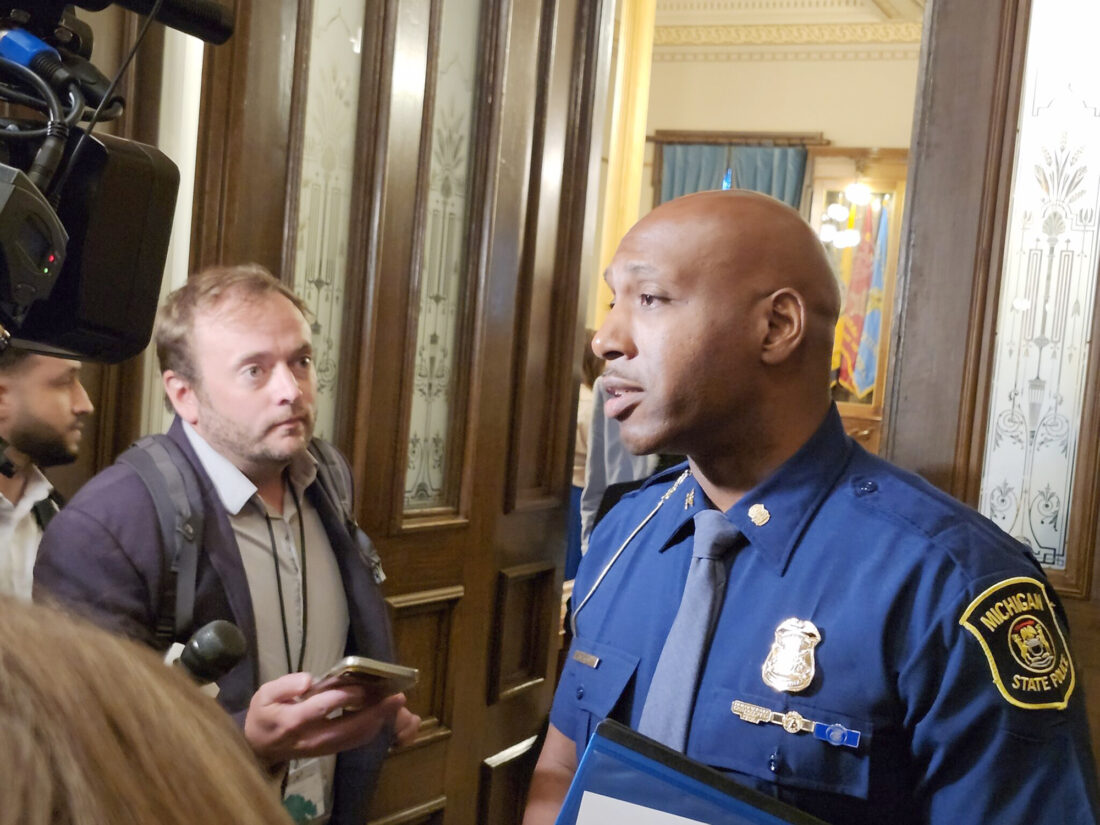
Michigan State Police Director Col. James Grady speaks to reporters in July after a joint meeting of the Michigan House Oversight Committee and the House Appropriations Subcommittee on Michigan State Police. (Ben Solis/Michigan Advance)
Testifying to the Senate Appropriations Subcommittee on Military, Veterans, State Police, Michigan State Police Director Col. James F. Grady II emphasized the importance of recruiting and hiring more staff to the state police, as the number of staff eligible to retire increases.
Grady showed statistics about the total enlisted strength of the department, which peaked in fiscal year 2019 at 1,935 and has decreased each year since, sitting at 1,784 in fiscal year 2026. Full staffing for the department would be 2,000 enlisted members, he said.
Fiscal Year 2027, he continued, will have a significant increase in the number of members who are available for retirement.
“We are still far from fully staffed, and all efforts to diversify our enlisted ranks are wholly dependent on our ability to continue to hire new troopers,” he said to the committee. “This presents us with a unique opportunity for a net increase in the number of troopers, should the funding be available to continue to run schools. This slide demonstrates how quickly our list of ranks will fall without the ability to run schools. Our top priority is to run school to fiscal year ’27, and beyond.”
As for how to combat that, Grady called the department’s academies the most effective way to increase staffing numbers.
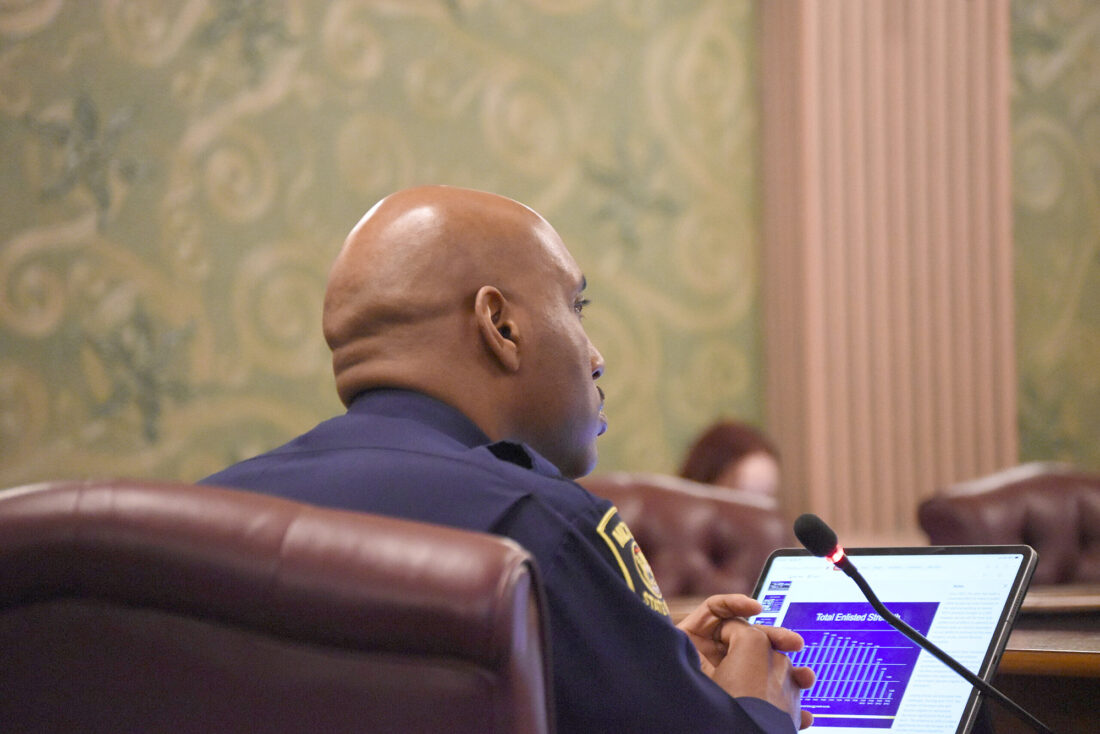
Michigan State Police Director Col. James F. Grady II testifies Tuesday to the state Senate Appropriations Subcommittee on Military, Veterans, State Police on the executive budget recommendation for Fiscal Year 2027. (Katherine Dailey/Michigan Advance)
“You need funding to run our state police academies,” he told reporters after the committee hearing. “We have a great training program, but at the end of the day, you need the money to hire people.”
Grady was complimentary of Gov. Gretchen Whitmer’s executive budget recommendation, which would allocate just over $4.6 million less to the general fund but overall increase the state police gross budget by nearly $5.5 million.
“It supports essential appropriations across our local, county and state law enforcement agencies, and maintains critical systems like the Michigan Public Safety Communications System, which connects over 2630 agencies statewide,” Grady said.
State police laboratories were also a key point of discussion in the committee hearing, especially given that Whitmer’s budget recommendation would eliminate two labs. Committee Chair Sen. Kevin Hertel, D-St. Clair Shores, specifically asked about the potential closure of a lab in Northville.
Grady told the committee that the lab in question was in need of significant improvements, and reminded the senators that there is also a state police lab in Detroit that covers a similar area. The impacts to the department and the state if that lab closed, he said, would be “very minimal.”

Michigan State Police data on the total enlisted strength of the department over time. (Screenshot via Michigan Advance)
“I understand the challenges you’re facing, and I think there’s no doubt that, given the state of the budget overall in the state, we’re all looking to find efficiencies where we can,” Hertel said. “We want to make sure those efficiencies aren’t going to negatively impact the work that happens every single day.”
State Sen. Lana Theis, R-Brighton, however, pushed back, saying she has heard significant concerns that labs take too long to get things done.
“How is it when we create more of a bottleneck that we’re not going to create more of a problem?” she asked in reference to the potential closures.
Grady noted that he had not heard those same concerns about timeliness but added that lab workers would be largely relocated as opposed to having lab positions eliminated altogether.
———
Michigan Advance is part of States Newsroom, a national 501(c)(3) nonprofit. For more, go to https://michiganadvance.com.
Local News
St. Norbert College and NWTC create new transfer agreements
GREEN BAY, Wis. — St. Norbert College and Northeast Wisconsin Technical College have announced new transfer ...

IAHF awards mini-grant
Clarification
NIAGARA, Wis. — The Ford Transit van that the School District of Niagara purchased was a 2022 model. It will be ...
State Police director pushes for more money to recruit, train

Popular craft show returns to Kingsford on Saturday