Documenting the dairies
Carlson has book, program on region’s dairy history
-
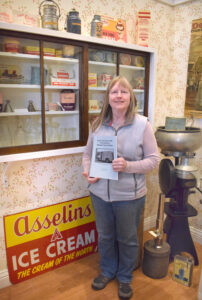
- Phyllis Carlson of Quinnesec will give two presentations on area dairies Friday at the Jake Menghini Historical Museum in Norway. The public is invited to attend the free program at 1 or 6:30 p.m. Carlson will share stories of past dairies that she learned while writing her book “Dairies that Delivered Milk to Residents of Dickinson County.” She’s shown with her book in the Asselin Creamery room at the Jake Menghini Historical Museum Museum. (Terri Castelaz/Daily News photo)
-
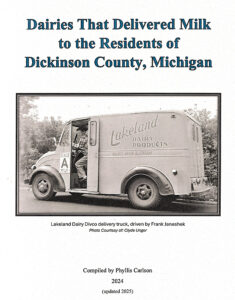
- Book cover of “Dairies that Delivered Milk to Residents of Dickinson County” features Frank Janeshek driving a Lakeland Dairy Divco delivery truck. The cover photo was courtesy of Clyde Unger. (Terri Castelaz/Daily News photo)
-
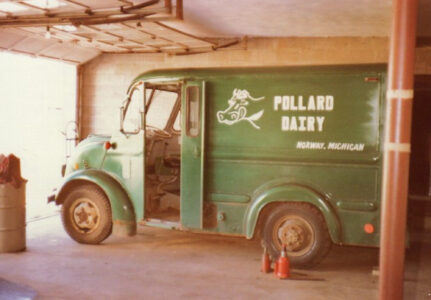
- A photograph of a Pollard Dairy milk truck. (Contributed photo)
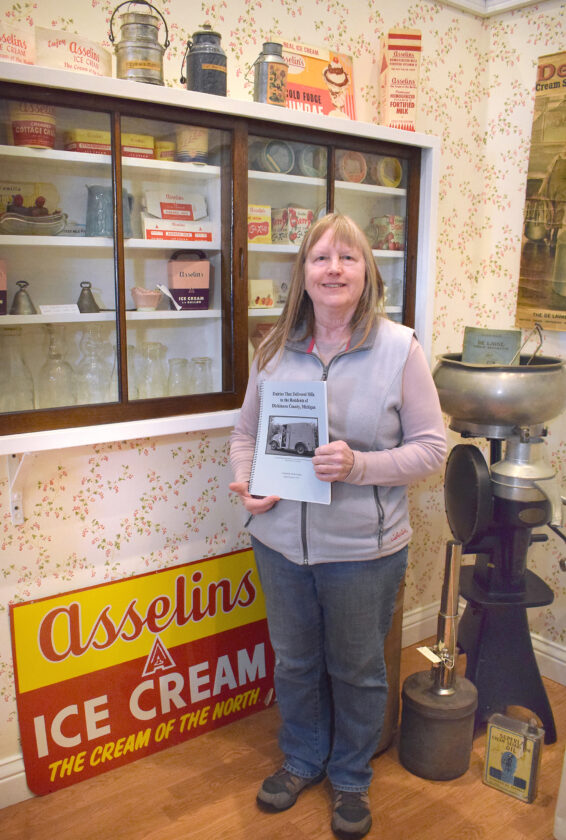
Phyllis Carlson of Quinnesec will give two presentations on area dairies Friday at the Jake Menghini Historical Museum in Norway. The public is invited to attend the free program at 1 or 6:30 p.m. Carlson will share stories of past dairies that she learned while writing her book “Dairies that Delivered Milk to Residents of Dickinson County.” She’s shown with her book in the Asselin Creamery room at the Jake Menghini Historical Museum Museum. (Terri Castelaz/Daily News photo)
IRON MOUNTAIN — Local history isn’t just written in ink — it’s been poured into bottles and left at the doors of customers. Before supermarkets and big brands, local dairies were a part of daily life.
Phyllis Carlson will present two programs on the history of area dairies Friday at the Jake Menghini Historical Museum in Norway.
The Quinnesec resident will share her discoveries at 1 p.m. and 6:30 p.m., drawing from her book “Dairies that Delivered Milk to Residents of Dickinson County.”
Carlson compiled the first book in 2024, and published an updated version last year.
Many locals know Carlson for her work with wildlife rehabilitation, educational programs with Journey the great-horned owl and wildflower walks.
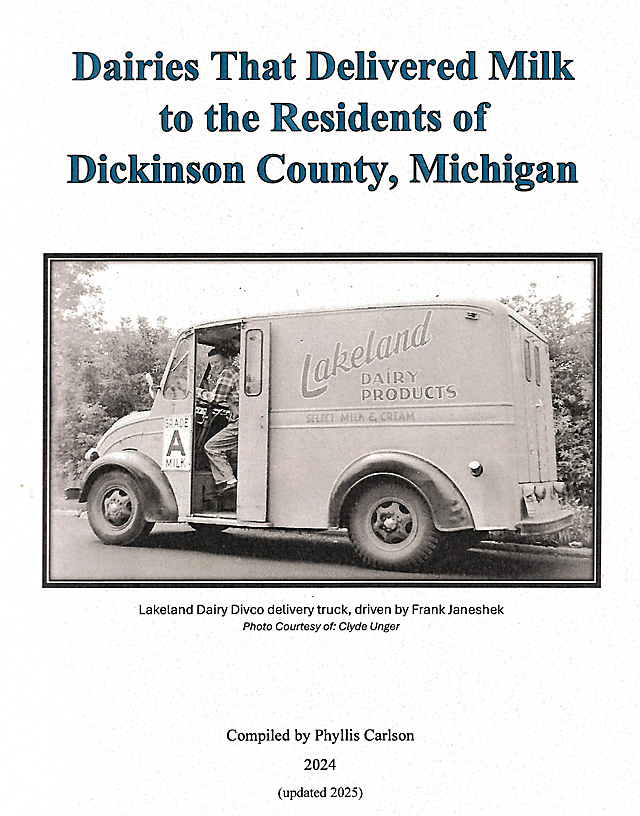
Book cover of “Dairies that Delivered Milk to Residents of Dickinson County” features Frank Janeshek driving a Lakeland Dairy Divco delivery truck. The cover photo was courtesy of Clyde Unger. (Terri Castelaz/Daily News photo)
But few realize she has a “quirky hobby”: collecting local dairy memorabilia.
“When I moved here in the ’70s, I would say I was a hippy — I liked to make my own stuff,” Carlson said. “You never saw a tub of Cool Whip in my house.”
She would visit Miller Dairy in Aurora, Wis., especially around the holidays, to buy half-pint bottles of heavy cream, which she used to make her own cream and sometimes butter.
During a visit, a special half-pint bottle caught her eye. “It had a cute little picture on it and thought it would make the perfect flower vase,” Carlson said.
She noted that during that time, many dairies would accumulate bottles from other operations, especially the ones that had closed.
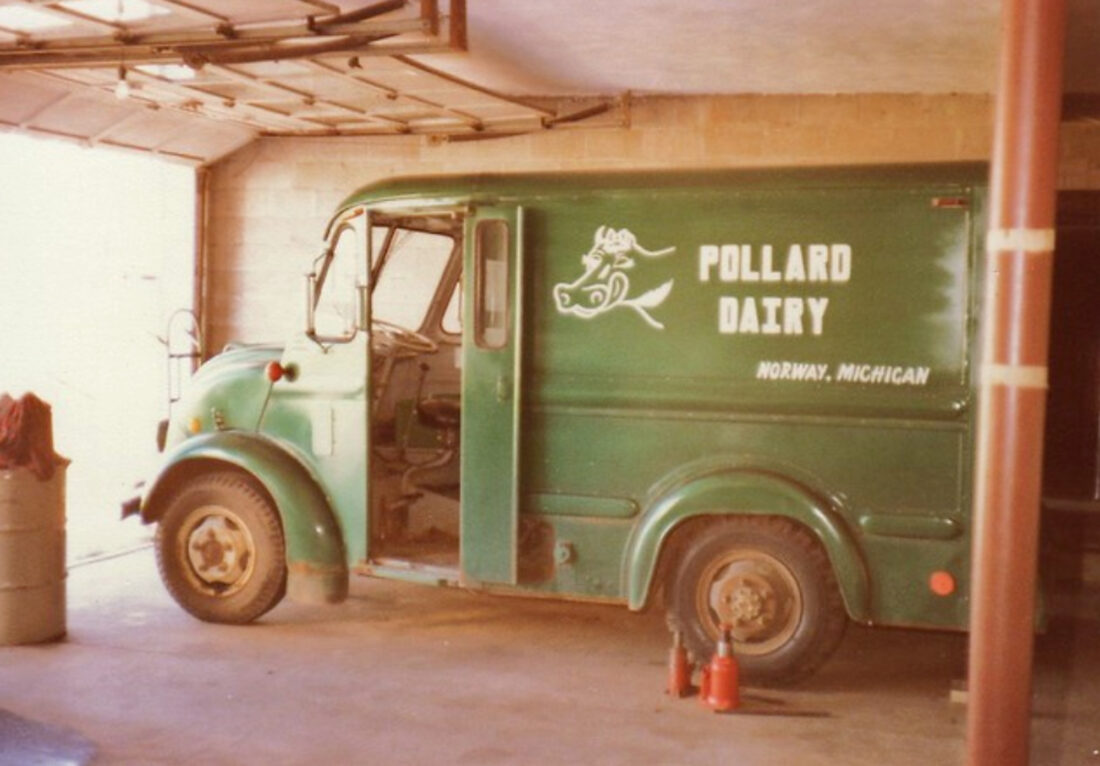
A photograph of a Pollard Dairy milk truck. (Contributed photo)
Her second find was discovered while browsing through an antique store in downtown Iron Mountain. It was a quart bottle that featured an unique graphic of a cow’s head. “I thought that would make a neat big flower vase,” Carlson said. “Well, years later, I had lots of flower vases that never saw flowers.”
In addition to the dairy bottles, Carlson collected bottle caps, spoons, advertising, signs and more. Over time, she branched out into more unique pieces, such as baby-top and cream-top bottles.
“I started to look for rarer milk bottles, too, like an original Thatcher milk bottle from the 1800s,” said Carlson, who is a member of the National Association of Milk Bottle Collectors.
Her hobby soon became more than collecting — it sparked an interest in the history behind each piece.
“I started talking with a lot of old dairy people, like (the late) Willard Osterberg of Aurora, Wis.,” she said. “I would take down notes that would lead me to do my own research.”
She gathered information from Facebook posts, Ancestry, newspaper articles, obituaries and census records. Using those resources and personal interviews, she began to piece together stories of local dairies.
For many years, Carlson filed her information away, intending to one day turn it into a book.
“A couple years ago, I finally said, ‘I need to do this now,'” she said, adding her first edition was in a three-ring binder.
Carlson started to collaborate with local historian Bill Cummings to put her works, as well as additional photographs, into a book format. The Dickinson-Iron Technical Education Center printed the first copies last year.
“They sold out at the Iron Mountain museum gift shop before the end of July,” she said.
The book’s second printing features new pieces of information and pictures.
Carlson highlights about 47 dairies, small and large, that were in operation from the late 1800s — the oldest she’s documented is Joseph Bergeron’s in Norway — to the 1970s, delivering milk to local residents.
“About half of these dairies were located in Florence County, most of them in Aurora and Homestead, with one in Spread Eagle,” she said. “When you look at a lot of those, their mailing address was Iron Mountain because that was where the post office was located.”
Over the years, a few of the original dairies branched off to include items such as ice cream.
Carlson explained the difference between a dairy farm and a dairy. “A dairy farm raises cows that produce milk, but they sell their supply to processors — usually dairies,” she said. “Some farms have their own dairies or a combination, supplementing their supply with milk from other farms.”
Carlson tried to represent as many local dairy operations as possible, though a few known names still have no available information.
She is also seeking information on the Joseph Prenevost Dairy in Waucedah.
“Biggest mystery dairy ever — there are caps galore for it, so we know it existed,” Carlson said. “There are probably more we don’t know about.”
Many local dairies at that time were small, one-man, one-cow operations. “They had more milk than their family could use, so they would sell it to neighbors,” Carlson said.
Over the years, she’s uncovered surprising finds such as Spencer’s Dairy, which grew into one of the larger facilities in the area — information she only learned in the last five or six years from a family member.
Her favorite is the Charles E. Ray Family Dairy, established in 1935. “The only reason I know this dairy existed was because a collector downstate shared all his information with me,” she said.
Asselin Creamery of Norway is a collector’s paradise, Carlson said, as she’s never seen a dairy with so many collectible pieces.
The most fascinating story came from the Fiorucci Dairy of Twin Falls. A family member related how some mine employees didn’t like that he’d left to start a dairy so his sons didn’t have to work in the mines.
“One day his men were on the way to town with the milk bottles, and were crossed by the mine guys who broke all their bottles and told them if the sons didn’t come to work in the mines they were going to destroy his shipment on a regular basis,” she said. “The next day he went with his milk delivery and when they got crossed again they shot the guys. When he came back they were gone. No one knew if they were wounded or he killed them, but he never had a problem again.”
When pasteurization became a requirement in Michigan in 1947, many of the small dairy businesses could not afford equipment, so they either sold their operations or produced bulk milk for sale to processors.
“I really had fun producing this book — I hope that it keeps some of its history alive,” she said.
A couple years ago, Carlson donated many of her local pieces to be displayed at the new home of the Menominee Range Historical Museum in Iron Mountain. “I tried to put together a display from as many dairies that could be represented,” she said.
Her program will begin with a short film produced by Pine Mountain Dairy in the 1960s to promote the Upper Peninsula dairy industry. The footage shows an airplane flying over an Asselin Dairy bottle, then follows the route to local farms where milk was collected and brought back to the dairy.
“It’s an old-fashioned narrated piece,” she said.
She received a copy that Clyde Unger, whose family owned Pine Mountain Dairy, provided to the Menominee Range Historical Society.
The remainder of the film will be shown at the end of the program.
Carlson’s program at the Jake Menghini Historical Museum will focus on Norway, the township and Waucedah dairies, including Pollard Dairy and Asselin Creamery.
Partners member Gayle Nicholson said they are excited to offer the program to the community. “This provides the perfect opportunity for our own residents to come in and see what we have right here in our museum as well,” she added. “A lot of times local people don’t go to what’s in our own backyard.”
Nicholson recalls taking her third grade class to Jake Menghini’s Cabin and he would always show the kids a little jug and tell the story of how his mother would give him a quarter to go down to the neighbors for milk.
“An interesting fact of local history is when the Norway-Vulcan Area Women’s Club formed in 1929, their first project as a service club was to get the cows off Main Street,” Nicholson said.
After the program, Carlson will offer advice on dairy pieces. Attendees are welcome to bring photographs if they don’t want to transport their items.
Anyone unable to make the presentation but who would like to get information on a dairy collectible can contact the Jake Menghini Museum office at 906-563-5586 and leave a message.
The book will be available for purchase at the program and in the gift shop at the Cornish Pumping Engine and Mining Museum in Iron Mountain.
Admission is free, but donations are appreciated. The Jake Menghini Museum is at 105 Odill Drive in Norway.
——–
Terri Caselaz can be reached at 906-774-2772, ext. 85241, or tcastelaz@ironmountaindailynews.com.
Local News
Forest fuelwood permits now available from DNR
LANSING, Mich. — State forest fuelwood permits are available for Michigan residents interested in collecting ...
Middle school Girls’ Dream Fair on May 14 at MTU
HOUGHTON — Middle school girls from across the western Upper Peninsula will gather at Michigan Technological ...

Iran war sends inflation soaring, consumers’ mood plunging
Documenting the dairies
Push continues for stronger government transparency law