Northern shoveler, American bittern pause within range for photographs
Northwoods notebook
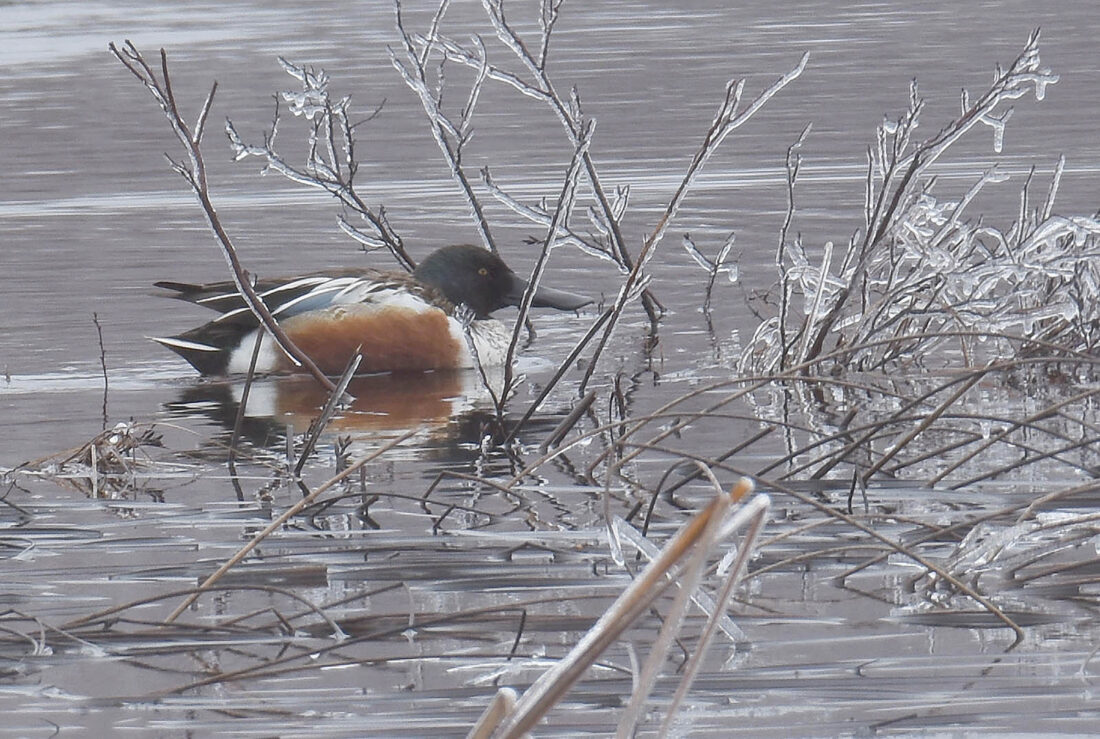
A northern shoveler took some time off from migrating at Six Mile Lake last Saturday after another round of icy rain moved through. (Betsy Bloom/Daily News photo)
After seemingly being halted by two rounds of icy rain late last week, the spring migration through Wisconsin appears to have gone into high gear this past week, with almost 4.6 million birds crossing the state overnight Tuesday into Wednesday morning, according to the Cornell Lab of Ornithology’s Migration Dashboard, https://dashboard.birdcast.org/.
And while the movement slowed down later in the week, conditions should be very good today and Monday to see another significant wave come through.
Already others in the Upper Peninsula have posted on Facebook northern flicker woodpeckers and yellow-rumped warblers, usually the first of the warblers to return. The rattling cry of sandhill cranes could finally be heard from a nearby forest pond at Six Mile Lake late this week, although others reported cranes farther south in the county as early as late March.
Killdeer were calling by Marketplace Foods and the former Kmart parking lot.
In downtown Iron Mountain, what appeared to be a green heron croaked as it flew over and a merlin — a small falcon that in winter can migrate as far south as Central and northern South America — was shrieking an alarm over something in the trees up the hill on Ludington Street.
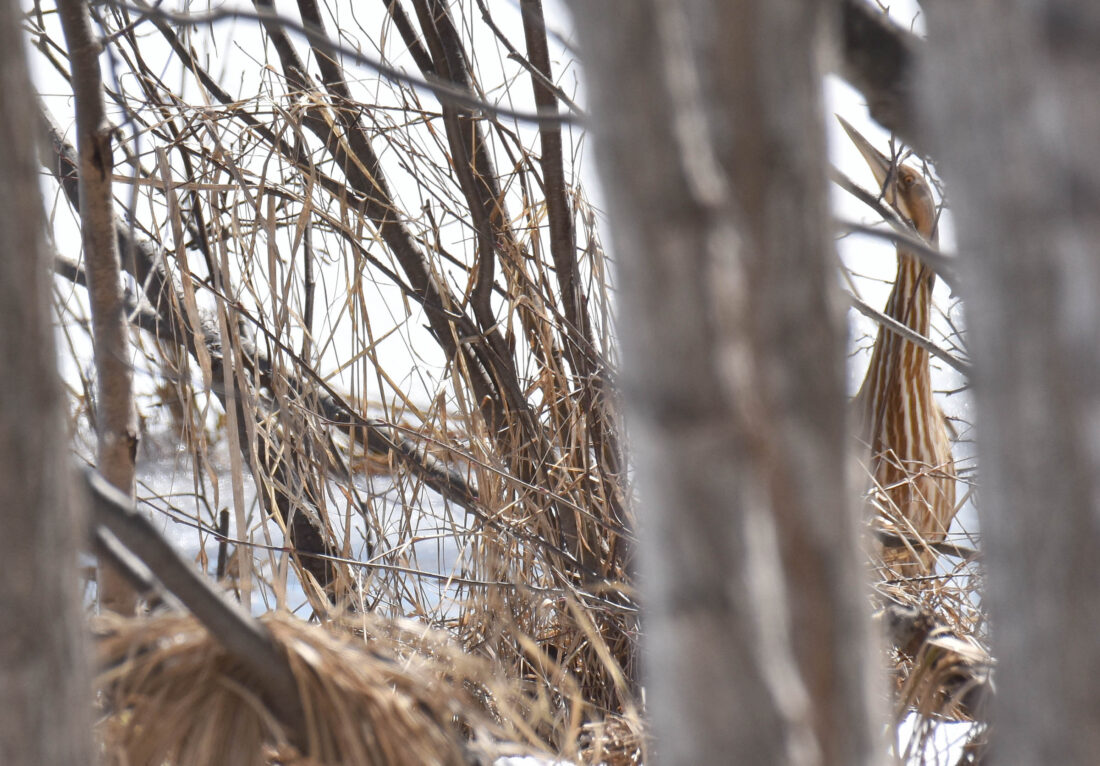
An American bittern demonstrates how its camouflage and habits helps it to remain inconspicuous Sunday among the trees and vegetation at Six Mile Lake. (Betsy Bloom/Daily News photo)
The Birding Wisconsin Facebook page had photos of yellow-bellied sapsucker woodpeckers, so I would not be surprised to see them this weekend, along with eastern phoebes, the flycatcher that regularly nests each summer on my mom’s quilting shop.
But Six Mile Lake still has very little open water, even where the drainage from Solberg Creek usually carves out an area in the ice, so common loons and other waterfowl may continue to be absent or scarce; this year even the hooded and common mergansers have not yet appeared in their usual numbers.
Even if the weekend does not bring anything new to the yard, it’s already been a notable spring for me personally, as I got the chance to encounter — and photograph — two birds I’ve not seen before at Six Mile Lake.
The first was loafing at the outlet where the lake feeds into Six Mile Creek, which over the years has been a great place to photograph waterfowl, as it usually offers open water even when the rest of the lake is still locked in ice.
It was keeping company Saturday with a pair of mallards, all probably having to make a stop due to the ice that fell overnight and into the morning, that still coated the nearby vegetation.
These birds all seemed intent on getting a nap in while having to wait out the conditions, so the duck that caught my eye wasn’t showing off the oversized bill that gives the northern shoveler its name but kept it coyly tucked into its back. Even then, the coloring of a drake shoveler is unmistakable.
It kept me waiting before it finally gave me a good view of its signature profile and even then was unwilling to come out from among the ice-encased grasses and stems. While frustrating at the time, it ultimately made for a better photo that illustrated the conditions.
That distinctive bill has comblike projections along its edges, called lamellae, “which filter out tiny crustaceans and seeds from the water,” according to Cornell Lab of Ornithology’s All About Birds website, https://www.allaboutbirds.org.
They also breed across Europe and spend the winter throughout Europe, Africa and India. But they are considered rare breeders in Michigan, though a few nests were confirmed in the Upper Peninsula — mostly in Houghton and Keweenaw counties and far eastern U.P. — along with a few locations downstate in the Michigan Breeding Bird Atlas II survey done from 2002 to 2008.
All About Birds shows its North American breeding range to primarily be the prairie pothole states in the west, central and western Canada and into Alaska.
It is considered most closely akin to blue-winged and cinnamon teals, and like the blue-winged will spend winters as far south as Central America, the Caribbean and even northern South America.
All About Birds said shovelers usually are “monogamous and remain together longer than pairs of most other dabbling ducks. They form bonds on the wintering grounds and stay together until just before fall migration.”
This one, however, appeared to be alone but for the mallard couple. It, along with the ice, was gone by Sunday.
Sunday, however, had another bird to occupy my time and camera, this one in the backyard. Barely visible through the trees along the shoreline, where a strip of water had opened up along the ice, was a silhouette that was enough to catch my eye.
Which is how I got lucky, because this bird is a master of remaining unseen.
American bitterns are a type of heron so well marked with streaks down throat and breast that when threatened it will point bill to sky and let the stripes blend in with the cattails, reeds and other tall vegetation.
This one gave that pose a try as I worked to get an in-focus image from between the trees. It took a lot of shots and putting up with photobombing deer convinced I’d come out to fill the bird feeders. Then I let it be.
While considered fairly numerous, American bitterns are very secretive, according to All About Birds. I’d only encountered one before, not by sight but sound, which All About Birds says is a more common way to know they’re around. American bitterns in spring have a distinctive, gulping call that All About Birds described as “pump-er-lunk” and “that sounds like the gulps of a thirsty giant.” I got to hear that out here in early summer 2021, and it was close enough to feel vibrations through the floorboards. It’s worth going to All About Birds to listen to the audio.
Like others in the heron family, American bitterns are predatory wading birds, feeding on insects, crustaceans, fish, amphibians, reptiles and small mammals — basically what it can manage to snap up with that sinuous neck and stiletto bill.
In Michigan, the American bittern is classified as a species of special concern, according to the Michigan Breeding Bird Atlas II. “The primary factor in American Bittern declines would seem to be the loss of wetland habitat: nearly half of Michigan’s original wetlands have been eliminated since European settlement, with many of the remaining areas seriously degraded,” Michael A. Sanders wrote in the MBBA II.
I don’t know if the bittern, like the northern shoveler, was just making a quick stopover before moving on, but I was grateful for the opportunity. It might be the only chance I’ll get.
I’d welcome reports on what you’re seeing out there as spring migration proceeds.
Betsy Bloom can be reached at 906-774-2772, ext. 85240, or bbloom@ironmountaindailynews.com.
-
- A northern shoveler took some time off from migrating at Six Mile Lake last Saturday after another round of icy rain moved through. (Betsy Bloom/Daily News photo)
-
- An American bittern demonstrates how its camouflage and habits helps it to remain inconspicuous Sunday among the trees and vegetation at Six Mile Lake. (Betsy Bloom/Daily News photo)
Local News
Northern shoveler, American bittern pause within range for photographs
Forest fuelwood permits now available from DNR
LANSING, Mich. — State forest fuelwood permits are available for Michigan residents interested in collecting ...
Middle school Girls’ Dream Fair on May 14 at MTU
HOUGHTON — Middle school girls from across the western Upper Peninsula will gather at Michigan Technological ...

Iran war sends inflation soaring, consumers’ mood plunging

Documenting the dairies