Spring is in no rush
April cold spells predicted after snow-filled March
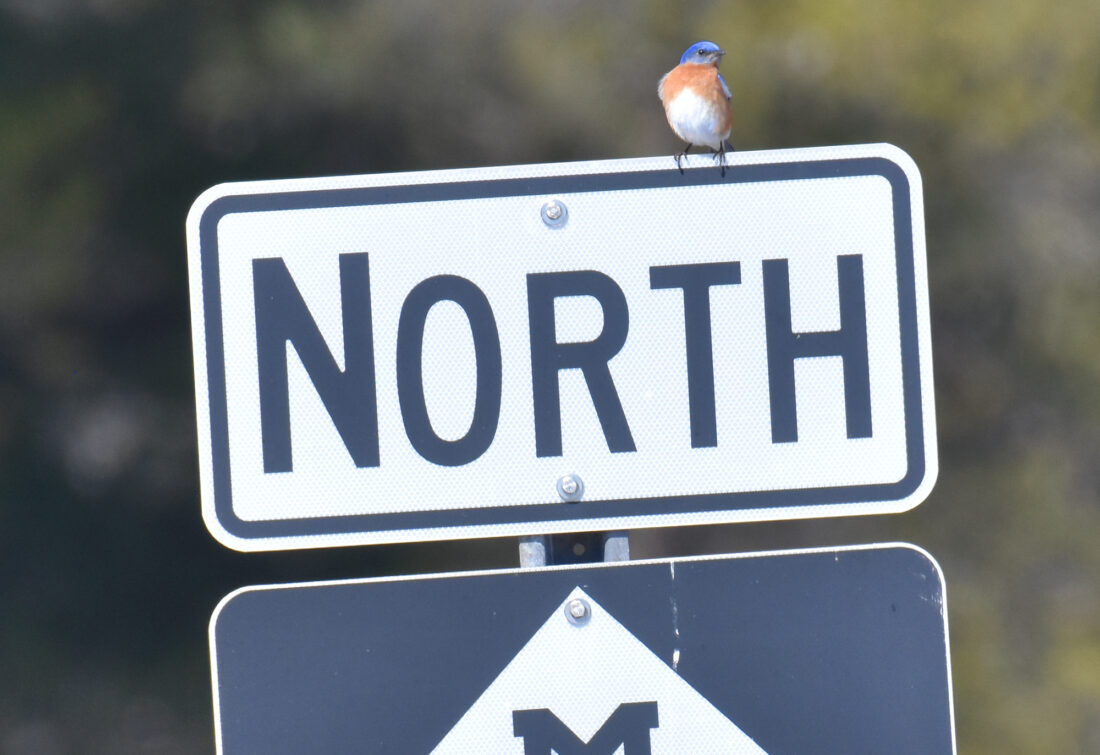
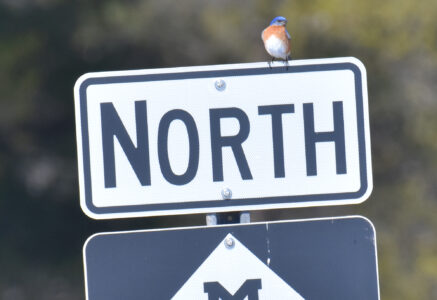
An eastern bluebird indicates the right direction to be headed during spring migration. This colorful male was perched on a sign along M-95 in northern Breitung Township in Dickinson County. The warmer weather through Monday should aid bird migration through the region. (Betsy Bloom/Daily News photo)
Mother Nature’s tug-of-war will continue to tease into next week as a hint of spring through Monday will be followed by plunging temperatures.
Monday’s predicted high at Iron Mountain-Kingsford is 71 degrees, while the highs Tuesday and Wednesday will be back in the 50s, according to the National Weather Service.
Rain is likely Sunday. Highs are expected to be in the 50s Saturday and the 60s Sunday. Looking ahead to next weekend, AccuWeather sees highs possibly in the 40s.
April’s bumpy forecast follows a chaotic March that saw record warmth followed less than a week later by a wicked, record-setting blizzard.
Temperatures during March were at least 5 degrees above normal on 14 days, according to observations at the Iron Mountain-Kingsford Wastewater Treatment Plant. Temperatures were at least 5 degrees below normal on 11 days.
Blizzard Elsa, which arrived at mid-month, delivered 25.5 inches of snow on top of a dump of 9.5 inches two days earlier. The 21 inches of snowfall measured from the previous 24 hours at 8 a.m. March 16 established a new one-day record for Iron Mountain-Kingsford.
The previous mark was 17 inches measured Jan. 4, 1971.
Meanwhile, the highest temperature last month was 61 degrees on March 9 — a record for that date — while the lowest was zero on March 17. Temperatures averaged 30 degrees for the month, which was 2 degrees above normal.
Snowfall totaled 35 inches — about 26 inches above average. It ranks as the second-snowiest March on record, just an inch below the 36 inches that fell in 1972.
To date, the season’s unofficial total of 75 inches of snow is more than a foot above average.
Liquid-equivalent precipitation in March totaled 2.38 inches, which was 0.7 inches above average. The U.S. Drought Monitor shows no areas of concern in the Upper Peninsula and northeastern Wisconsin.
A long-range forecast from the Climate Prediction Center is neutral on both temperatures and precipitation from April through June in the central Upper Peninsula and northeastern Wisconsin.
The outlook is influenced by La Nina, which is marked by sea surface temperatures in the eastern equatorial Pacific Ocean that are cooler than usual. La Nina’s warmer flip side — El Nino — may develop this summer, according to the CPC.
“Should El Nino materialize as currently favored, potential impacts during the late summer and early autumn support a very slight tilt toward below normal temperatures for an area near the Great Lakes, although confidence is low at this time,” said NWS forecaster Jon Gottschalck.
Much further ahead, a shift to El Nino would signal a warmer than normal winter for the region, the CPC outlook shows.
While March was very snowy and slightly warm locally, it was simply hot to the west. Ten states — Texas, Oklahoma, New Mexico, Colorado, Wyoming, Idaho, Utah, Arizona, Nevada and California — experienced their hottest March in 131 years, according to the National Oceanic and Atmospheric Administration.
AccuWeather reported that Yuma reached 109 degrees, breaking Arizona’s previous March record of 104. The temperature in California rose to 112 degrees at Buttercup and Squaw Lake, also a new state record for the month.
———
Jim Anderson can be reached at 906-774-2772, ext. 85226, or janderson@ironmountaindailynews.com.
Local News
Bay College Greenhouse to have plant sale May 8
Bailey to serve as graduation speaker at LSSU
SAULT STE. MARIE — Lake Superior State University will welcome longtime conservation leader Thomas C. Bailey as ...
Expanded primary care opens at VA Medical Center in IM
Spring is in no rush

Hometown Heroes banners to honor 24 in Kingsford