Taylor wins Wisconsin Supreme Court race, widening its liberal majority
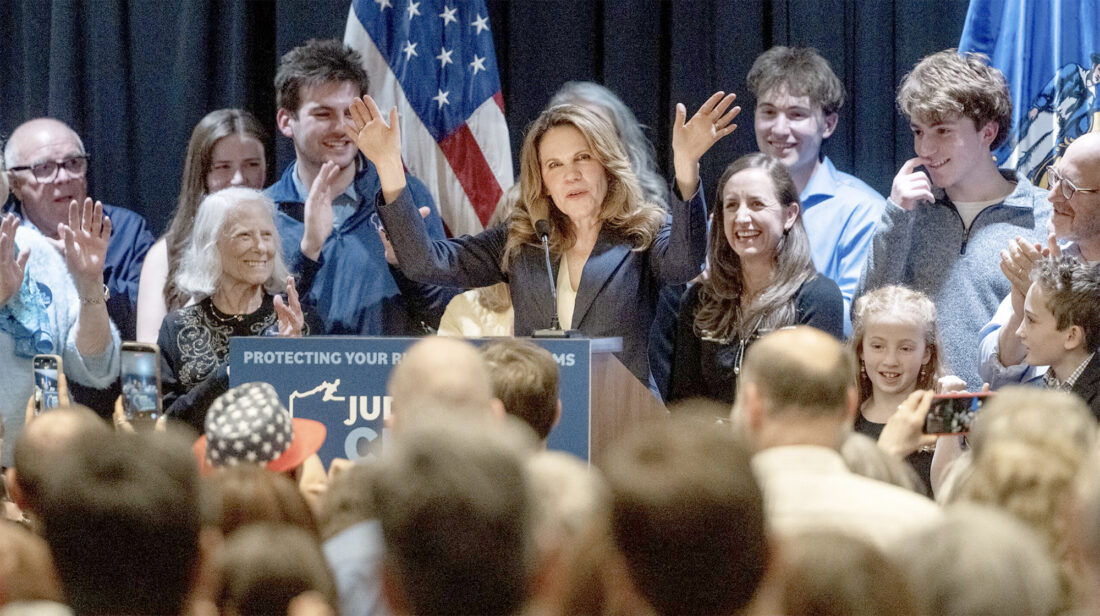
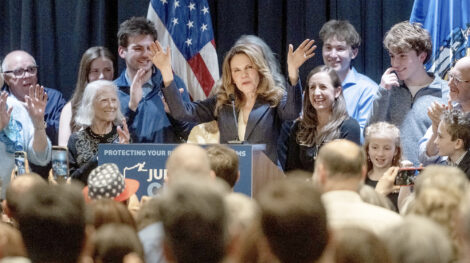
State Appeals Judge Chris Taylor speaks to supporters after winning her Wisconsin Supreme Court race, at her election night event Tuesday at the Madison Concourse Hotel in Madison, Wis. (Angela Major/Wisconsin Public Radio)
The Wisconsin Supreme Court’s liberal majority will grow after state Appeals Judge Chris Taylor was elected to a 10-year term Tuesday.
Her victory over her conservative opponent, Appeals Judge Maria Lazar, was declared by the Associated Press at 8:36 p.m. All results are unofficial until they’re certified in coming weeks.
Addressing supporters at a watch party in downtown Madison less than an hour after the race was called Tuesday night, Taylor said her victory was about democracy.
“Once again, Wisconsin, we showed the entire nation that we believe that the people should be at the center of government and the priority of our judiciary,” she told the crowd.
Taylor’s victory means that liberals will expand their majority to 5-2, effectively securing their ideological advantage until at least 2030. In recent years, the high court has handed down major decisions expanding abortion rights and overturning Republican-drawn legislative maps, and is expected to weigh in on important voting rights and labor cases.
But regardless of the night’s outcome, liberals would have held on to their 4-3 majority — first established with the high-profile election of Justice Janet Protasiewicz in 2023 and defended last year when Justice Susan Crawford emerged victorious from the most expensive court race in American history.
In the face of lower stakes, Taylor’s campaign received comparatively less fanfare. Fundraising, early voting and turnout numbers were much lower than in recent years.
But the financial advantage was nonetheless Taylor’s, as her campaign raised much more than Lazar, and outspent Lazar 6-to-1.
Taylor described her campaign as one about energizing ordinary Wisconsinites.
“People are hungry for a government that works for them,” she said. “People are hungry for a judiciary that … protects our rights, that affords all Wisconsinites equal justice under the law.”
And without naming President Donald Trump, she framed her win in the context of national politics.
“Politics has no place in the judiciary, and the judiciary is not a rubber stamp for any party, group or branch of government — including the federal government,” she said to cheers.
Taylor’s campaign was seemingly on sure footing from the moment she announced her candidacy. She got into the race in May and, within weeks, had earned the endorsement of the four sitting liberal justices, insulating her from any challenge from the left. Those justices joined Taylor at her victory party Tuesday night.
By contrast, Lazar was a relative latecomer to the race. She emerged as the conservative contender in October, after conservative Justice Rebecca Bradley announced that she would not run for reelection, setting up a surprise open race.
Justice Bradley’s term will run through the end of July. Taylor will take office Aug. 1.
Lazar’s election night party was more subdued, with reporters outnumbering around 30 supporters who talked quietly in the ballroom of the Ingleside Hotel in Pewaukee while country music played softly from overhead speakers.
At about 9:30 p.m., Lazar walked in and moved from supporter to supporter, shaking hands and hugging them. She took the stage and told the group she’d conceded the race to Taylor.
“I want to tell you that I could not have been more honored, more proud, more pleased, more humbled to be your candidate in this race,” Lazar said. “And I want to tell you not to fret, not to be upset, not to be sad. We can do that a little bit later.”
Things won’t get easier for conservatives any time soon. They’ll be on defense again in the 2027 election, when there will be another open race for the seat being vacated by conservative Justice Annette Ziegler. Conservatives would have to win that race, along with the 2028 and 2029 Supreme Court elections, in order to have a shot at flipping the court in 2030.
———
WPR’s Rich Kremer contributed to this story.
Local News
Bay College’s Student Poster Symposium to be April 22
ESCANABA — Bay College will host its ninth Student Poster Symposium from 4 to 6 p.m. Eastern time Wednesday, ...
Green Bay and Marinette lift bridges to close for inspections
GREEN BAY, Wis. — The Wisconsin Department of Transportation Northeast Region announces routine maintenance and ...

Long-term study highlights key drivers of potato beetle trends

Young entrepreneurs urged to sign up for Lemonade Day
Marinette tax proposal fails; Kennedy elected circuit court judge
Voters in Wisconsin's spring election turned down a Marinette County property tax request and elected Robert A. ...