Wisconsin’s Evers looks to issue first commutations in decades
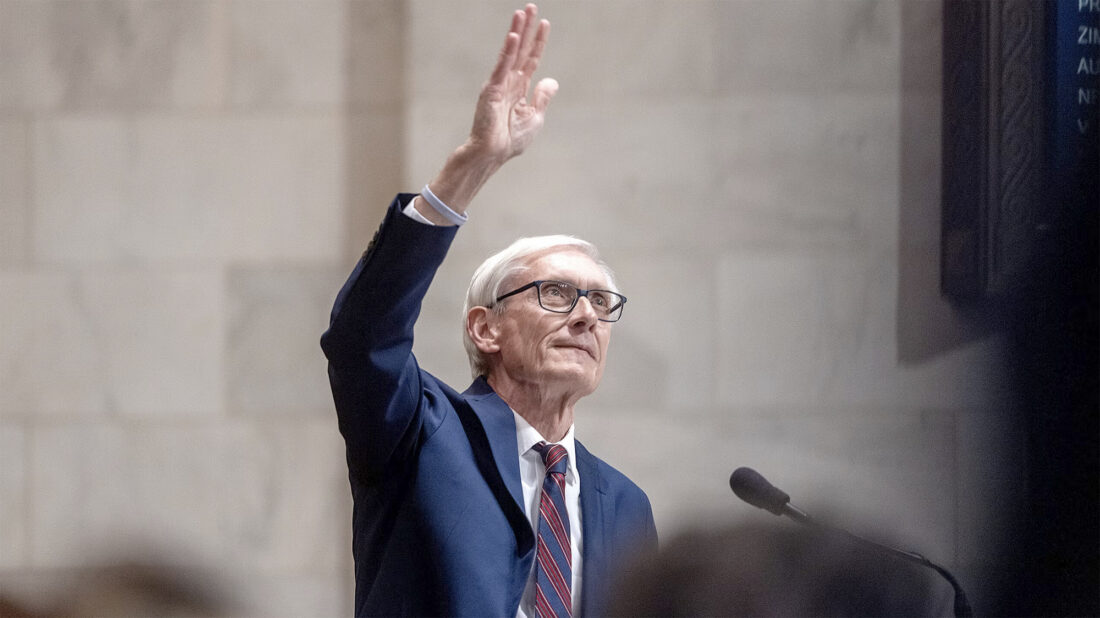
Wisconsin Gov. Tony Evers waves to people in the balcony before delivering the State of the State address Feb. 17 at the Wisconsin State Capitol in Madison, Wis. (Angela Major/Wisconsin Public Radio)
Democratic Gov. Tony Evers is taking steps to shorten some criminal sentences by handing down the state’s first commutations in more than two decades.
The governor announced Friday he had issued two executive orders to restart the commutation process in Wisconsin. That includes creating a new board to advise him on which sentences should be commuted.
Under Wisconsin’s Constitution, a governor can use commutations to cut short someone’s prison sentence. Commutations can also be used to cut back someone’s time on parole or extended supervision.
But for more than 25 years, Democratic and Republican governors have allowed that power to sit untouched. The last commutations in Wisconsin were issued by Republican Gov. Tommy Thompson who left office in 2001.
That could soon change.
“It’s time for Wisconsin to join red and blue states across our country and finally move our justice system into the 21st Century by reforming our criminal justice and corrections systems to improve public safety, reduce the likelihood that individuals will reoffend when they enter our communities, and save taxpayer dollars in the long run,” Evers said in a statement Friday.
After Evers announced he would not seek a third term for governor, pressure has grown from criminal justice reformers who have urged him to issue commutations before he leaves office in January 2027. So far, a crowded field of Democrats have announced they’re running on Nov. 3 to replace him. Republican 7th District U.S. Rep. Tom Tiffany of Hazelhurst has also thrown his hat in the ring.
While campaigning for his first term as governor, Evers said he supported cutting the state’s prison population in half. Instead, there are now more than 23,000 adults locked up in the state’s prisons, which is roughly the same as when Evers took office.
Since 1990, the state’s prison population has more than tripled, and the prison system is struggling with overcrowding.
In a statement Friday, the governor also called for changes from the Republican-controlled Legislature, which has halted many of Evers’ criminal justice reform proposals. That includes rejecting proposals to expand earned release programs and to raise Wisconsin’s default age for charging someone as an adult from 17 to 18.
“As our prison population continues to skyrocket, increasing costs to taxpayers on overtime and other resource needs, the Legislature must start working toward making long-term justice and corrections reforms a priority,” Evers said in a statement. “My administration will continue doing what we can as long as I am governor, but we cannot do it alone — the Legislature must get serious about this issue.”
Since taking office, Evers has issued more than 2,000 pardons, which is more than any other governor in Wisconsin history. Those pardons erase some of the consequences of a conviction, such as allowing people to hold certain professional licenses or to own a firearm.
Pardons, however, do not reduce the length of someone’s sentence, and therefore do not help shrink the size of Wisconsin’s incarcerated population.
Ex-Incarcerated People Organizing of Wisconsin and the State Public Defenders Office were among the groups celebrating Evers’ commutation announcement on Friday.
“For the many Wisconsinites who have done the hard work of redemption and are ready to come home, this is a chance to start anew,” State Public Defender Jennifer Bias said in statement. “For our state, this is an opportunity to heal the scars left by decades of over-incarceration.”
Under the new executive order, Evers will appoint up to 14 people with expertise in areas including “reentry services, victims rights (and) corrections,” to a Commutation Advisory Board. That board will evaluate applications for commutations, and issue a non-binding recommendation to the governor based on this criteria —
— The impact of commutation on victims, survivors and community members;
— Whether a commutation is consistent with public safety and in the interests of justice;
— An applicant’s prison conduct record; and
— An applicant’s personal growth and development since conviction, including the completion of rehabilitative programs, treatment, education and work history during their incarceration.
Evers has also called for prioritizing cases in which someone was sentenced as a minor. One of the governor’s executive orders creates a commutation application process that’s specific to youth offenders who were sentenced to life in prison.
“The human brain doesn’t fully develop until someone’s in their mid-20s,” Evers said in a video message. “But there are folks who are sentenced as kids decades ago who are currently serving life or near life sentences.”
These crimes will not be eligible for commutations, according to the governor’s office —
— Sexual assault;
— Physical abuse of a child;
— Sexual exploitation of a child;
— Trafficking of a child;
— Incest; and
— Soliciting a child for prostitution.
Local News
Pour with a Purpose set for Saturday in IR
CRYSTAL FALLS — The Contemporary Center will host its annual Pour with a Purpose event Saturday at Young's in ...

Sustainable Tourism Summit set for May 20-23 in Keweenaw

Michigan offers Urban and Community Forestry grants

UW board to vote on whether to fire system president

Marinette tax referendum is on today’s spring ballot