
Loons back on the nest at Six Mile Lake
Northwoods Notebook
Trending
FELCH TOWNSHIP -- Six Mile Lake again has nesting loons, raising the possibility a chick might be produced for a second straight year.
While scanning the small side pool where the lake flows into Six Mile Creek, I thought I caught sight of a loon in the water. That, to my embarrassment, turned out to be sunlight reflecting off a yellow pond lily. A visit to the optometrist might be warranted.
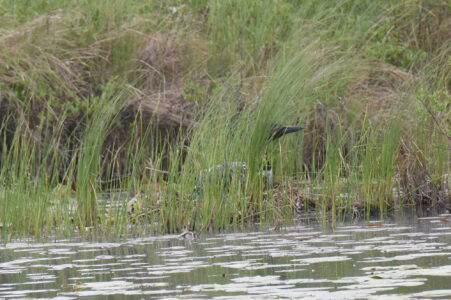
Then I panned over to where I’d seen some movement on shore, and caught a loon head and bill, tucked behind the grasses. I snapped only two photos and backed off, trying to keep from drawing an alarm call, as the loon was clearly well aware of my presence on the bridge over the creek long before I’d managed to figure things out.
It didn’t react, though, and was in the same location Friday.
How long the birds have been brooding is unclear. Common loons begin nesting in late May or early June, and take 26 to about 30 days to incubate one to two eggs, according to Cornell Lab of Ornithology’s All About Birds website, https://www.allaboutbirds.org.
So it could be weeks before hatching happens. I photographed last year’s chick June 20.
Ideally, those who use Six Mile Lake will avoid the nest area during this time, which shouldn’t be difficult, given the narrowness of the pool.
The Loon Preservation Committee website, https://loon.org, recommends staying at least 150 feet away from nest and, after hatching, adults with chicks.
But Jennifer Wycoff, visitors services/park ranger at Seney National Wildlife Refuge in Schoolcraft County, says people should take their cues by how the adult loons behave to judge what the boundaries should be.
Hear a yodel or that haunting tremolo cry? They are warnings given to a perceived threat. The famous “penguin dance” pose, when the loon rears up and flaps? “Definite ‘You are too close,'” Wycoff said.
Is the bird flattening down on the water or nest? It’s trying to hunker down to not draw attention.
In general, if the adults begin making noise or showing other signs of being disturbed, best to move on.
Another factor that makes the loons vulnerable to disturbance: Where they nest. Because loons have legs placed far back, they can’t walk on land but must push themselves along on their bellies. That forces them to nest close to the shore, where it can be swamped by rising lake levels or even the wake of a passing boat.
So powering down in the next month would be advised as well on the lake, Wykoff said, adding the lack of boating in Seney National Wildlife Refuge might be one reason it has such a good production rate for loons -- including the oldest loon on record, Fe, now thought to be at least 40 years old.
The downy chicks, sooty black with a white belly, are able to swim and ride on parents' backs within hours of hatching, according to All About Birds. They don’t remain long in the nest.
It will be just as important to give the loons a wide berth once they shift from nest to the full lake. The adults will be diving to feed the chicks, so boaters should “be mindful and attentive to driving habits” if they see any of the birds, Wykoff said.
Before last year, breeding loons had been absent from Six Mile Lake for roughly a decade, if not longer. But my parents regularly saw adults toting babies in the 2000s.
Loons are long-lived and tend to return annually to places where they’ve successfully nested. Fe is thought to have hatched between 40 and 50 chicks in her years at Seney National Wildlife Refuge, until the past few years with the same partner.
It would be a compliment to Six Mile Lake to have this iconic bird of the North Woods feeling comfortable enough to again raise chicks here.
“They are excellent indicators of water quality as they require crystal-clear lakes (which makes it easier for them to see prey underwater) with abundant populations of small fish,” All About Birds states.
Last year’s chick, unfortunately, went missing within a few weeks. Six Mile Lake harbors numerous predators that can snatch up a chick, even with parents as attentive as loons.
Let’s hope the pair now on nest has a better outcome. I’ll keep watch, from a discreet distance.
*****
On a related note, Larry Warren will present his program, "Loons, How to Enjoy and Protect," at 10 a.m. Saturday, June 13, at the Florence County Library, 400 Olive Ave. in Florence, Wis.
Warren has been a loon monitor for the past seven years. He will share photos and videos and report on the latest findings on the state of loon populations and how to protect them.
———
Betsy Bloom can be reached at 906-774-2772, ext. 85240, or bbloom@ironmountaindailynews.com.