
Still waiting to see if loon nest yields chicks
Northwoods Notebook
Trending
The watch continues on whether Six Mile Lake's loon pair will successfully hatch chicks this summer.
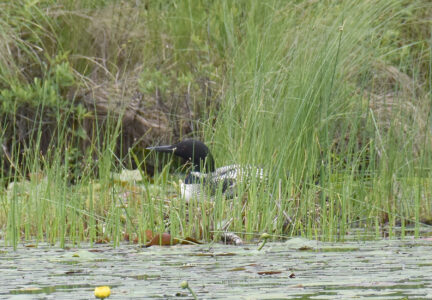
A loon was still on nest Friday, roughly two weeks since I'd spotted one among the tall grasses and other vegetation in a narrow side pool where the lake flows into Six Mile Creek.
While likely female, I can't assume. According to The Loon Preservation Committee website, https://loon.org, "Male and female loons share incubation duties equally, though research suggests that females tend to incubate more than males at night and towards the end of the nesting period."
It's unclear how long they might have been on the nest when I first noticed it June 5 -- the nest was relatively obscured, a nice use of cover for the otherwise large and conspicuous bird. So no knowing when the hatch might come.
Common loons normally begin nesting in late May or early June, and take 26 to about 30 days to incubate one to two eggs, according to Cornell Lab of Ornithology's All About Birds website, https://www.allaboutbirds.org.
I first photographed last year's chick on June 20, though it could have been out of the egg for days -- baby loons are ready to leave the nest within hours of hatching, riding on a parent's back. The 2025 chick appeared to be fairly small, though, so probably wasn't too old.
That's also assuming this year's birds are tending viable eggs -- because there's a potential hitch in the process.
A week ago, on June 12, I saw two people in kayaks fishing in the side pool, not far from the loon nest. As I was enroute to Green Bay with no time to stop, I could only wonder what kind of reaction the loons might have to the proximity of the kayaks and humans.
Experts advise that loons can be sensitive to human disturbance -- from sounding alarm calls to charging a watercraft or intruder to simply abandoning the nest. The Loon Preservation Committee website recommends staying at least 150 feet away from a nest and, after hatching, adults with chicks. Other sites call for 200 to 300 feet.
These two fishermen were virtually within casting range of the nest. I could not see if either of the loons remained, but have to figure they'd left with the nearby activity.
I didn't see them Saturday, but again was making a run to Green Bay and did not have time to make a thorough scan of the shoreline.
Luckily, Sunday had both loons not far off the boat launch. They’ve been on the nest daily since then, so at least they didn't abandon the nest. But if they had to break off incubating for an extended period, could that have compromised the eggs?
Looking online, it seems like the harm would be slight, even if the loons had to stay away for hours. Temperatures remained warm enough to keep the egg viable.
But it would be prudent to stay out of the side pool through the end of the month, or at least until it becomes apparent the loons are no longer on the nest.
Also keep this in mind, from The Loon Preservation Committee: "Chicks hatch roughly 24 hours apart. In the event of a nest failure loons may renest up to three times in the same year, though the willingness to renest may vary from pair to pair."
So if the pair have more than one egg or had to start over, the nesting timeline may be extended. Seney National Wildlife Refuge's famous Fe -- thought to be the world's oldest known common loon -- needed a second try to hatch chicks numbers 43 and 44 on July 6, 2025.
Let's hope patience with the loons pays off with chicks in the next few days or weeks.
Betsy Bloom can be reached at 906-774-2772, ext. 85240, or bbloom@ironmountaindailynews.com.