
Wildfire smoke makes for unhealthy conditions in region
Trending
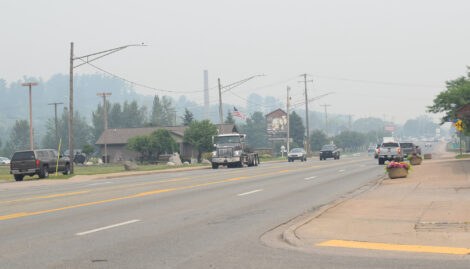
IRON MOUNTAIN -- The Upper Peninsula is in the grips of wildfire smoke at unhealthy, even hazardous, levels today that are expected to last through Thursday and perhaps into Friday.
Meteorologists at the Michigan Department of Environment, Great Lakes, and Energy issued a statewide air quality alert for elevated levels of fine particulate in the air. This has the potential to be a multi-day event from smoke caused by ongoing wildfires in Canada and northern Minnesota, EGLE advised.
Conditions may be difficult for sensitive groups statewide and there is a possibility that levels could reach the unhealthy range in some areas, which could affect otherwise healthy individuals, according to EGLE.
Some parts of the Upper Peninsula had already reported Air Quality Index readings in the hazardous range this morning, which is the highest level on the AQI scale. Negaunee had a reading of 623, well above the 301 and higher threshold.
It is considered hazardous for anyone to breathe under these conditions and the public is advised to limit time outdoors, EGLE said in a news release.
"Previous wildfire events emphasized how important communication is when wildfire smoke may impact Michigan's communities," said Annette Switzer, EGLE's Air Quality Division director. "We want to make sure residents stay informed and feel confident about how to protect themselves and their families."
Those who have asthma or another lung disease or cardiovascular disease should follow their physician's advice about medications and their management plan. Call the doctor if symptoms worsen when the AQI is Orange, or "Unhealthy for Sensitive Groups," or higher.
To otherwise deal with such conditions, the Michigan Department of Health and Human Services recommends:
Stay indoors
-- Close windows and keep outside doors shut.
-- Run air conditioning.
-- If your air conditioner has a fresh air option, close the intake.
-- Use an air filter in your HVAC system rated MERV-13 or better.
-- It is okay to use window air conditioning units. They should have tight seals between the unit and the window, and a recirculation mode that prevents pulling in outside air. Learn more about adjusting your air conditioner at EPA's Indoor Air Quality webpage, https://www.epa.gov/emergencies-iaq/wildfires-and-indoor-air-quality-iaq#:~:text=Make%20sure%20that%20the%20seal,more%20smoke%20being%20brought%20inside.
-- If you do not have air conditioning or an air filter, consider setting up a "clean room" where levels of smoke and other particles are kept as low as possible.
-- You can create a temporary air purifier with a 2012 or newer box fan and attaching a MERV-13 or higher air filter to it. Information is available at EPA’s page on Do-it-Yourself Air Cleaners, https://www.epa.gov/air-research/research-diy-air-cleaners-reduce-wildfire-smoke-indoors#Infographic.
-- Avoid activities that can create additional pollution, such as frying foods, sweeping, burning candles, vacuuming and smoking tobacco or other products.
-- Seek shelter elsewhere if you do not have an air conditioner and it is too warm to stay inside with the windows closed. Call or text 211 or contact your local health department to find out if there is a shelter or cooling center nearby. Or consider spending time in an air-conditioned public place, such as a library, mall, movie theater, etc.
If you must be outside
-- Consider using a mask. The best mask to use is a tight-fitting N95 or P100 respirator marked with "NIOSH." If those are unavailable or do not fit well, KN95 and KF94 respirators are an option. Learn more at bit.ly/EPA-masks.
-- Choose less strenuous activities (like walking instead of running) so you don't breathe as hard.
-- Shorten the amount of time you are active outdoors.
-- If you can, reschedule an activity to be outdoors when air quality is better.