
Wildlife, as well, will need relief from smoke
Northwoods notebook
Trending
The thick wildfire smoke that has dominated the region this week created hazardous air quality unlike anything most had ever experienced before, even in past severe wildfire years.
It led the Michigan Department of Environment, Great Lakes, and Energy to advise that everyone -- regardless of age or health -- reduce activity and remain indoors as much as possible, preferably in area that has air conditioning with a MERV-13 or higher-rated filter to strain out the ash particles.
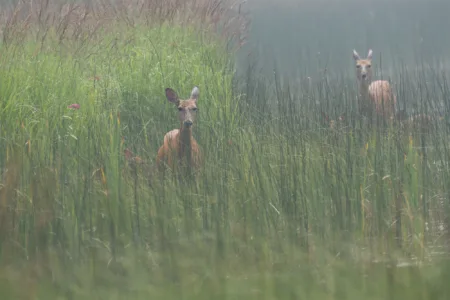
While humans and their pets have that option to take refuge, wildlife and larger livestock probably don't, which made me wonder what such severe conditions might do to the creatures that can't avoid breathing in the smoke.
While Brian Roell, large carnivore specialist for the Michigan Department of Natural Resources, was willing to talk about the potential effects, he cautioned that it's speculation -- in roughly five decades living in the Upper Peninsula, this is the worst he's seen.
"I don't ever remember ash falling out of the sky before when the fire wasn't nearby," Roell said Friday.
But he thinks most wild species should be able to endure the smoke and ash with limited ill effects as long as it doesn't last too long, such as weeks rather than days.
Baby birds that might have been more vulnerable when just out of the egg are mostly fledged now, Roell noted. Fawns and other young mammals have had about two months or more to grow bigger and stronger.
For them and the adults, "It's probably a nuisance, it's probably an irritant" but will cause no long-term damage, Roell said.
Anything that relies on sense of smell, such as predators, might have trouble tracking in such conditions, he noted.
That's one of the reasons why he fears the biggest effect might be on insects, which often use pheromones to find mates during their short breeding seasons.
As a beekeeper, Roell also worries his hives might suffer if the smoke sticks around. Smoke triggers honeybees to stick close to the hive, even gorge on the stored honey, thinking a fire might be coming that could force the colony to flee.
That instinct is why beekeepers use smoke to work with the hives but that's only for a short period, Roell said. Extend that time and the bees become disoriented, stop foraging and mortality can set in.
"It's not good," he said. The result could be fewer pollinators.
But again, Roell thinks the wildfire smoke probably will have minimal effect if it eases after a few days. In Marquette, where he works, conditions already had improved after rain fell Friday in the northern U.P., he said.
Dickinson County and the southern U.P. did not receive rain and local air quality remained rated as hazardous, the highest level on the Air Quality Index scale.
The EGLE forecast for the Upper Peninsula called for some improvement today, but the severe conditions were expected to return later Saturday and into Sunday. EGLE had extended the statewide Air Quality Alert into today, when it will re-evaluate the outlook for Sunday and Monday.
Betsy Bloom can be reached at 906-774-2772, ext. 85240, or bbloom@ironmountaindailynews.com.