
Wildlife group works to restore Lake Antoine pier
Outdoors report
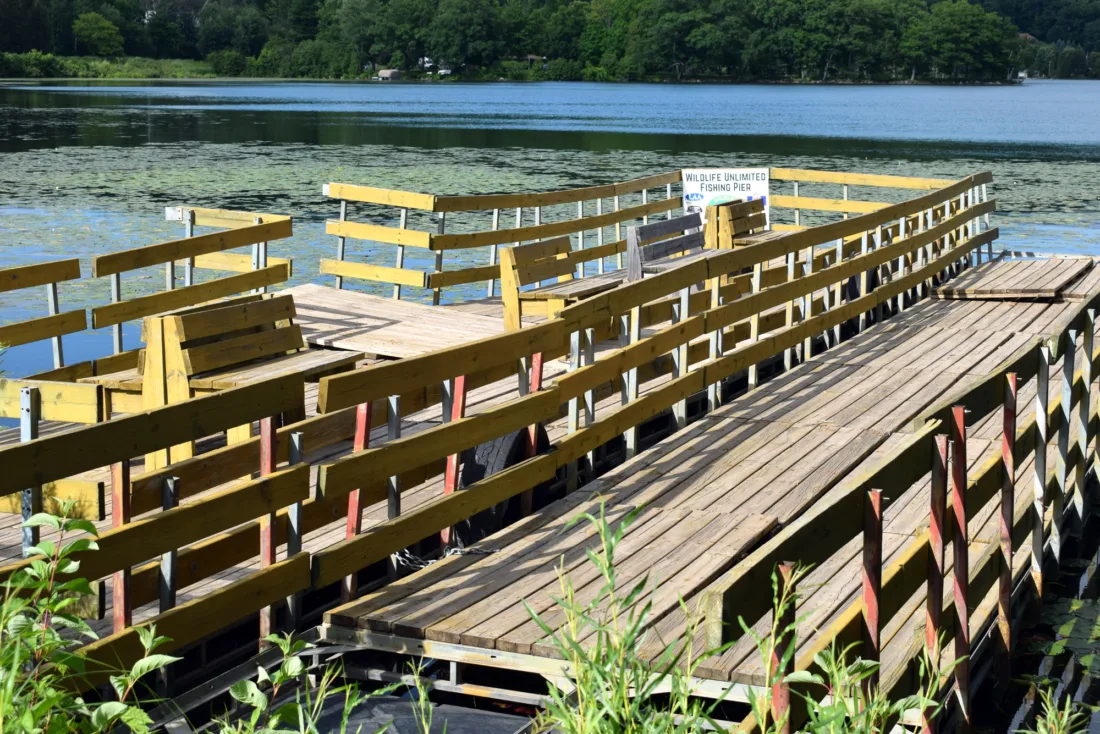
A Lake Antoine fishing pier remains shelved due to winter damage. Wildlife Unlimited of Dickinson County plans to repair or replace the structure, but it will be a significant expense. (Jim Anderson/Daily News photos)
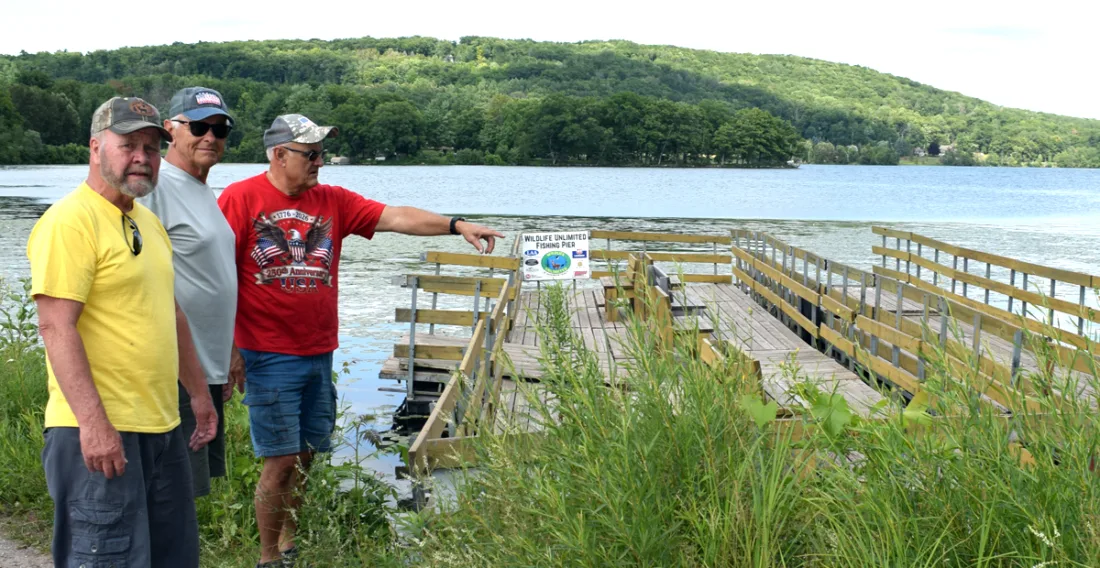
Wildlife Unlimited of Dickinson County members, from left, Bob Baker, Jim Nicolas and Dick Sherwood are organizing an effort to restore a fishing pier that's been installed annually for more than 35 years at Jim and Ida Goulette Park in Iron Mountain.
A Lake Antoine fishing pier remains shelved due to winter damage. Wildlife Unlimited of Dickinson County plans to repair or replace the structure, but it will be a significant expense. (Jim Anderson/Daily News photos)
Wildlife Unlimited of Dickinson County members, from left, Bob Baker, Jim Nicolas and Dick Sherwood are organizing an effort to restore a fishing pier that's been installed annually for more than 35 years at Jim and Ida Goulette Park in Iron Mountain.
Trending
IRON MOUNTAIN -- The public fishing pier at Lake Antoine -- built and maintained by Wildlife Unlimited of Dickinson County -- is out of service this year due to extensive ice damage. The pier at Jim and Ida Goulette Park has been in place for more than 35 years and has become a valued landmark in the area.
"Since we first brought the pier to Lake Antoine, we have removed it each fall and safely stored it along the shore away from open water, " noted Wildlife Unlimited's president Alex Manier. "Unfortunately, during spring breakup this year we had high winds at a time when ice was shifting on the lake which led to significant damage to the pier, something we had not experienced at any time in the past."
The non-profit group is in the process of getting bids to replace or repair the structure with plans to have it back for public use next spring. Over the years a number of community partners have stepped up to help maintain the pier in a safe condition.
Manier added, "This pier is an important contributor to our quality of life in the area, especially for seniors and young families who enjoy fresh air and fishing. Wildlife Unlimited is committed to get a pier back for everyone as soon as we can, understanding that this will be a significant expense."
Individuals or organizations interested in contributing to the pier restoration may contact Wildlife Unlimited at P.O. Box 2083, Kingsford MI 49802 or go to https://www.wudc.org/.
***
The Wisconsin Department of Natural Resources is accepting applications for the Hunter Recruitment, Retention and Reactivation -- or R3 --grant program. The deadline is Sept. 15.
The Hunter R3 grant supports projects that promote awareness, understanding and participation in safe, ethical hunting and hunting-related outdoor skills.
Past grant recipient projects include private land access programs for hunters, archery range upgrades for after-school clubs, support for hunting-related expos focusing on recruiting new or underserved audiences, learn to hunt and learn to shoot programs, high school clay target teams, 4-H shooting sports programs and more.
A total of $75,000 in grant funding is available.
Individual grant awards are normally limited to $25,000. Cost-sharing funds can be awarded to individuals or community-based organizations, Wisconsin tribes, universities and schools.
The grant is a sub-award of federal Pittman-Robertson Act funds and is administered as a reimbursement program. Applicants should plan to start projects approximately one year from the application deadline, according to the DNR.
For more, go to the DNR's Hunter R3 Grant Program webpage at https://dnr.wisconsin.gov/aid/HunterRecruit.html.
***
The Michigan DNR is accepting applications for off-road vehicle safety education grants to help fund certified instructors and ORV safety courses throughout the state.
Grant funding helps eligible organizations offer ORV safety classes led by certified instructors. The classes are required for all ORV operators under 16 years of age. The grant funding is appropriated from the Legislature and comes from Michigan ORV license and ORV trail permit annual fees.
County and local government agencies, school districts and colleges and universities are eligible to apply. The deadline is Aug. 1.
For more, go to https://www.michigan.gov/dnr/buy-and-apply/grants/le/orv-safety.
***
The Wisconsin DNR has announced that the sharp-tailed grouse hunting season will be closed for 2026. Permits and applications will not be available or accepted this year.
Each year, the Sharp-tailed Grouse Advisory Committee, consisting of government agencies, nongovernmental organizations, tribal interests and conservation groups, uses a variety of population metrics to make a recommendation about a potential hunting season. These include spring lek surveys, nesting success, winter survivability and habitat data.
Each of the four previous years have indicated an increase in the sharp-tailed grouse population; however, the committee evaluated the 2026 data and recommended to not hold a hunting season.
A limited hunting season was held in 2025, with 12 permits awarded for state hunters in Zone 10 -- the Crex Meadows Wildlife Area. The hunt resulted in five sharp-tailed grouse harvested from this zone. DNR managers said they expect the dip in the 2026 population estimate to be short-lived
For more information, go to https://dnr.wisconsin.gov/topic/hunt/sharptailgrouse.
***
Anglers fishing the Lake Michigan Salmon O Rama nearing Marinette, Wis., reported good catches of Chinook salmon. Chambers Island was the most popular spot, but fish were being caught all over the bay, according to the Michigan Department of Natural Resources.
Salmon were averaging between 8 to 14 pounds, with a few larger and smaller filling out the coolers, the DNR said.
The Michigan DNR reported this U.P. activity:
Little Bay de Noc: Yellow perch anglers reported catching some fish near the Escanaba Harbor and the mouth of the Escanaba River. Perch fishing in the head of the bay was slow, and anglers targeting walleye had limited success. Walleye fishing was slow, with anglers trolling crawler harnesses with bottom bouncers. Walleye anglers targeted deeper water along the bottoms of drop-offs. Some anglers reported catching eater-sized walleye near weed beds. Smallmouth bass anglers targeted rocky areas near steep drop-offs or flats adjacent to deep water.
Munising: Boating anglers trolling and jigging picked up a few lake trout around Grand Island and Wood Island. Anglers reported a slow bite for splake off the Anna River mouth.
Manistique: Chinook salmon anglers reported fair fishing. Trolling spoons and flasher/fly combos at depths of 50 to 90 feet of water was productive. Glow lures were commonly used during low-light periods of the day. Rainbow trout and a few lake trout were also reported.
Marquette: Lake trout anglers fished deeper than usual. Most anglers trolled north of White Rocks toward the area north of Granite Rock in 120 to 220 feet of water or jigged structure around White Rocks and the surrounding islands in about 140 feet of water.
Anglers began heading back out to Sand River and Shot Point, where they experienced fair success catching lake trout and brown trout in around 70 feet of water. The fish caught this week were holding deeper in the water column, unlike the previous two weeks when many fish were caught closer to the surface and were full of bugs.
Lake Independence/Big Bay: Fishing activity increased with most anglers targeting yellow perch. Anglers had the most success in 10 to 15 feet of water using natural bait.
Keweenaw Bay/Huron Bay: Anglers reported fair to poor fishing for coho salmon and lake trout while trolling. Anglers reported a slow to fair bite while jigging for lake trout, with most fish caught on natural presentations in waters ranging from 150 to 200 feet.
Traverse Bay/Portage Entry: Anglers trolling near structure in 60 to 100 feet of water reported good numbers of lake trout and a few coho salmon while using spoons and flasher/flies. Anglers also reported catches of smaller Chinook salmon in low numbers. Anglers jigging for lake trout reported a poor to fair bite when using natural and artificial baits, with a few fish being caught between 140 and 180 feet of water.
Ontonagon River: Anglers reported catching walleye in fair to good numbers. Both trolling and jigging proved to be successful methods for finding these fish. However, some anglers showed a preference for jigging. Shore anglers reported catching walleye and rock bass in low to fair numbers. Occasional catches of lake sturgeon were also reported.
Grand Marais: Boat anglers did very well targeting lake trout while trolling and jigging. A few reports of coho salmon being caught while trolling were also received.