
Little brown bats make late summer appearances
Northwoods notebook
Trending
What seems to be an annual rite of late summer happened Wednesday at The Daily News office.
Just after dusk, a big brown bat swooped through the newsroom, making figure eights above and around us, obviously searching for a way out. Luckily, we have a back door that opens straight to the outside -- no lobby -- and we know the drill. Once the door was propped open and we got out of the way, the bat made its exit without hesitation. Crisis averted.
I wish we could have recorded the whole episode, because the bat clearly demonstrated how unaggressive it was -- it veered and banked, studiously avoided contact with either myself or news editor Jim Anderson, even in the close confines of the newsroom.
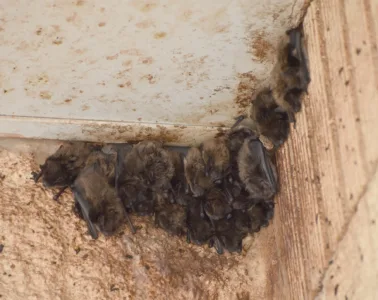
The encounter comes at a time when bats might be the most visible in the area, huddling in building corners and under eaves, sometimes in double-digit numbers. The mall area near the Tractor Supply Co. store on Iron Mountain's south side had clusters at almost every corner and post from Dunham's Sports all the way down to the entrance to Pet Supplies Plus.
The majority of these are juvenile little brown bats, born in June or early July, that have reached the age at which they can fly, said J. Paul White, a mammal ecologist with the Wisconsin Department of Natural Resources.
They've left their maternal colonies -- in buildings, tree trunks, bat houses or other sheltered sites -- to drift toward wintering sites, though hibernation won't begin until about October.
The adults, meanwhile, are entering breeding season, though the females will delay ovulation and store the sperm for about seven months, not starting development of the embryo until coming out of hibernation in the spring, according to the University of Michigan's Animal Diversity Web site, apnimaldiversity.org.
Unlike most small mammals, little brown bats usually produce only a single pup each year, White said. But they also live longer, with the oldest documented in Wisconsin reaching 32 years old, White said, adding that male didn't disappear until the onset of white-nose syndrome, or WNS. That helps to offset the slower rate of reproduction.
It has meant, however, the population crash in the past decade caused by WNS will take time to rebuild.
White-nose syndrome is a fungal disease that affects hibernating bats, sapping their resources in winter and causing them to emerge early while conditions are too cold, with no food supply. The disease was first detected in Wisconsin in March 2014 and devastated cave-hibernating bats such as little brown, tricolored and northern long-eared bats.
Yet little brown bats do seem to be on the rebound in Wisconsin, White said. The numbers still aren't close to pre-WNS days, but have shown improvement at summer roost sites over the past four years.
The news has not been as promising for tricolored, formerly known as the eastern pipistrelle, and the now federally endangered long-eared bat, White said. Their numbers remain dangerously low.
Luckily, the region's "tree bats" -- red, hoary and silver-haired -- migrate rather than hibernate, so have not been susceptible to WNS. And big brown bats favor spending winters tucked into houses or other structures rather than caves, in smaller groups, so seem to have dodged the decimation seen in the cave bats.
But the situation means bats should be spared whenever possible, to give the ones hit by disease a fighting chance to rebound, White said. They recommend leaving bats undisturbed in spring and early summer, even when found in places such as walls and roofs, as it might be a maternal roost with pups unable to fly yet. Exclusionary devices can be installed come late summer or autumn when the entire colony can be evicted without harm, he said.
As to the ones now hanging around buildings and entrances, "just leave them be," White said. They'll likely only remain about a week before moving on.
"Watch them from afar … enjoy their company from afar, because they’re not going to be there long," he said.
For more information about bats in Wisconsin, go to https://dnr.wisconsin.gov/topic/WildlifeHabitat/Bats.
For more on bats in Michigan, go to https://www.michigan.gov/dnr/education/michigan-species/mammals/bats.
Betsy Bloom can be reached at 906-774-2772, ext. 85240, or bbloom@ironmountaindailynews.com.