
Loon chick begins diving at Six Mile
Northwoods notebook
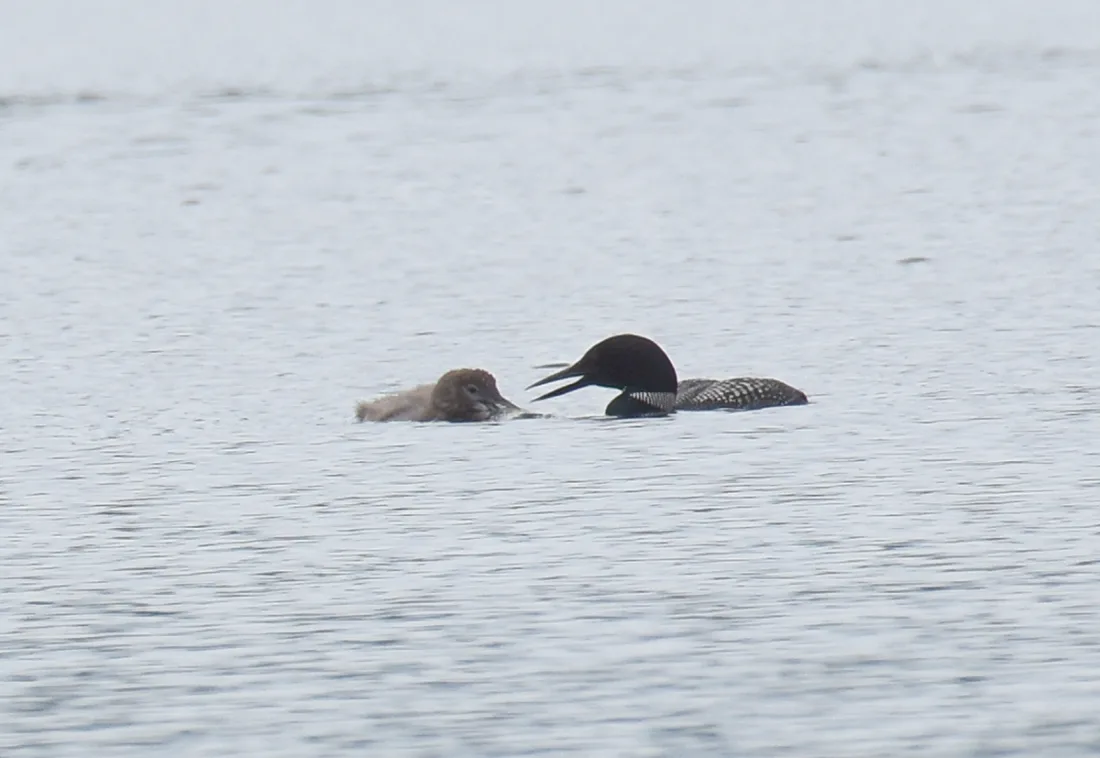
The common loon chick at Six Mile Lake is starting to switch from down to feathers and even taking some dives for food on its own, although the parents still provide plenty of food, like this fish. (Betsy Bloom/Daily News photo)
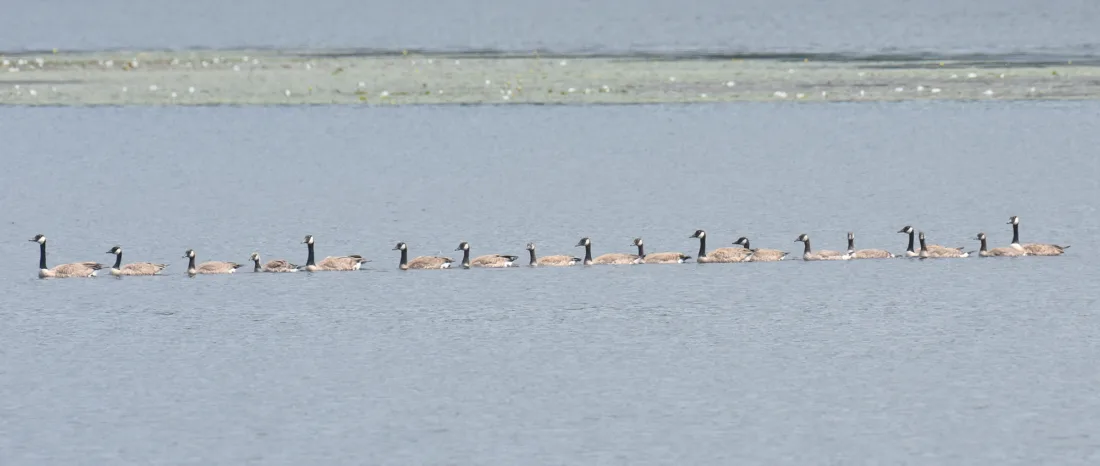
This string of 18 Canada geese and goslings regularly parades across Six Mile Lake as the young birds approach the age when they may begin exercising their wings. (Betsy Bloom/Daily News photo)
The common loon chick at Six Mile Lake is starting to switch from down to feathers and even taking some dives for food on its own, although the parents still provide plenty of food, like this fish. (Betsy Bloom/Daily News photo)
This string of 18 Canada geese and goslings regularly parades across Six Mile Lake as the young birds approach the age when they may begin exercising their wings. (Betsy Bloom/Daily News photo)
Trending
The summer of the loon chick continues at Six Mile Lake.
Last year, the first successful hatching on the lake within at least a decade ended with the chick disappearing in the first few weeks.
The story this year has been far different. Perhaps it was more experienced parents. Perhaps just conditions were better.
But the chick has thrived under the care of its two parents, who seem adept at keeping it fed.
While I've worried at times about those cruising around the lake coming too close, in reality people seem to have all but adopted the chick. They give the loon trio space.
I know my extended family has taken note of the chick's progress. We've had waves of visitors filling the house in July and all have eagerly reported on seeing the chick as they took the pontoon boat or canoe out, from when it was still riding on its parents' back -- apparently that's to help regulate the chick's temperature in those early days, as well as protect it -- to last weekend as it was transitioning from fuzz to feathers.
By Thursday, the loon chick was regularly diving, though its parents continued to feed it. It mimicked adult behavior by dipping its head underwater to its brow, scanning for fish underneath the surface.
Unlike the parents, loon chicks can walk upright on land, according to the Loon Preservation Committee website, loon.org. But at about three weeks, as their bodies grow and lengthen, the legs shift to the back, similar to their parents.
Comparing to the loon chick development page on the Loon Preservation Committee website, this chick looks to be about five to six weeks old, which would fit with when reports first began in late June. At that point, "They can capture small prey items for themselves but remain dependent on parents for food," the page advised.
Juvenile plumage won't be fully in until about eight to nine weeks, making it a better diver capable of capturing about 50% of its food, the website advised.
They'll begin exercising their wings and take practice flight at about 10 to 11 weeks. According to the website, one of the adults may head toward wintering areas, such as Lake Michigan or farther east, though the other will stay with the chick until roughly four months old, when it is fully independent and eating fish of similar size as adults.
The chick, however, usually remains on the lake where it hatched for a few weeks after its parents have departed, perhaps even into early winter before the ice sets in, according to the website.
It will keep the gray and white coloration that adults adopt in the winter that mimics the appearance of stormy waters until it matures to the familiar distinctive black and white checkerboard backs and white necklace at about age 2 or 3.
A reader who lives on Norway Lake asked why they now lack nesting loons after having them years ago. I can only answer that a breeding pair disappeared from Six Mile Lake for at least a decade after regularly producing chicks here in the 2000s.
Loon pairs form long bonds and usually come back to the same breeding areas annually. Perhaps something happened to the pair on Norway Lake, as appeared to have been the case on Six Mile Lake. In the early 2020s, a new pair began regularly lingering on the lake each spring, even seeming to scope out potential nesting sites, but didn't finally hatch a chick until last year. Online sources indicate while loons may appear on lakes as 3- to 5-year-olds -- and they favor returning to the general region where they were hatched -- it can take several years to find a mate and establish a territory. Most common loons do not breed until they reach about 6 years.
So it might be a matter of time. Hopefully the loons will find their way back to Norway Lake as well.
In contrast to the success at Six Mile Lake, one of the best-known areas for loons in the United States had a relatively poor year for reproduction in 2026.
The Seney National Wildlife Refuge in Schoolcraft County had only four of an estimated 15 to 16 pairs produce chicks this summer.
Among those that had no success this season were female Fe -- the oldest-known loon on record, believed to be at least age 40 -- and her former partner ABJ, second-oldest at what is thought to be age 39.
The reasons for the poor reproduction are unclear, but a severe outbreak of blackflies might have been a factor, said Jennifer Wycoff, visitors services/park ranger at the refuge. Loons may abandon nests if the biting blackflies become too aggressive.
Blackflies seemed to be nasty as well at Six Mile Lake this spring but thankfully didn't last long.
The loons have not been alone in developing well on Six Mile Lake this nesting season.
A string of Canada geese parades on the lake almost daily. Almost all of the goslings already have switched from yellow-gray down to the adult-like plumage of beige body and familiar black neck and head with white cheek patch.
The adults with the goslings likely are emerging from their summer molt right now, when they were unable to fly. Their fledgling goslings should begin learning to fly late this month.
We have a yardful of young eastern phoebes -- the resident pair managed two batches this year, the last with three that fledged. They switched it up, starting in spring on the lights above the pole barn door and then a second round on the quilt shop lights in July; usually it's the other way around.
Traffic at the hummingbirds feeders has picked up as well, with fledglings joining adults. The adult males are aggressive now, driving off the others, but likely soon will cede the north to the younger generation. Some males may already have departed, having accomplished what they came here to do; they play no role in raising the nestlings. They, too, leave early to create less competition for the next generation.
But keep the hummingbird feeders up, as the females and young of the year should remain for another two to four weeks.
Betsy Bloom can be reached at 906-774-2772, ext. 85240, or bbloom@ironmountaindailynews.com.