
Lynx are native to UP, but very rarely seen
Northwoods notebook
Trending
The news last month that the first new species of wild feline in roughly a century had been discovered in South America made me think of our own native cats in the Upper Peninsula.
All three of North American native cats that can be found north of the Mexican border states have been seen here. Only the bobcat is common, though.
And while the cougar might be making a comeback in the U.P. -- cubs were documented for the first time in a century in Ontonagon County in March 2025 and again with their mother in December 2025 -- the Canada lynx likely will remain a rare and fleeting visitor, said Brian Roell, large carnivore specialist for the Michigan Department of Natural Resources.
Wild as much of the Upper Peninsula might appear, it's just not suitable habitat for what Roell calls "the gray ghost" of North America's cats.
Lynx prefer the deep boreal forest, where they are snowshoe hare specialists, Roell said. They are supremely adapted to moving across snow, with long legs and broad, well-furred paws.
The Upper Peninsula is considered at the southern edge of the northern boreal forests, which is why Roell thinks the region probably never had a robust population of lynx even in pre-settlement days.
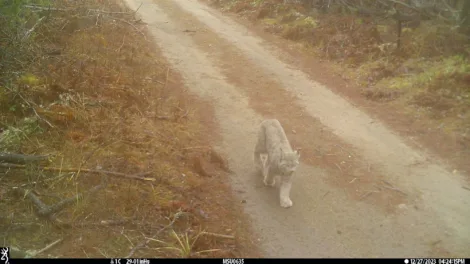
The U.P. now averages about one lynx a year, usually detected by trail camera, Roell said. The DNR has roughly 1,300 cameras in the field, in a grid spaced about 100 square miles apart, set up to monitor the wolf population across the region. Taking about 6 million to 7 million photos a year, they prove useful for other species as well, including the lynx.
Lynx are thought to come from Ontario, possibly island-hopping while ice is on the Great Lakes, Roell said. That's borne out by the fact most of the reports come in the eastern U.P. counties, with the farthest west he's heard being Marquette County.
Like the cougars until recently, the lynx appear to be transient, perhaps searching out new territory when populations of the cat are high to the north. None have turned up again on the same cameras. The one year they had two lynx photographed at different locations, they were close enough it probably was the same animal, Roell said.
He has no idea where they go, either -- if they pass through the U.P. or return to Canada. Minnesota, in its far north, is the only Midwestern state with a known lynx population; the other states are Maine and northeastern New Hampshire in the east and Washington, Idaho, Montana, Wyoming and Colorado in the west.
"It would be wonderful to get a (tracking) collar on one and see," Roell added. But considering the scarcity, the chances of a lynx sticking around long enough to trap and collar appear slim, he said.
Another factor that has the lynx at a disadvantage in the U.P. has been the spread of bobcats.
Though they appear larger, lynx are about the same size as bobcats and do not fare well in competition with that closely related species, Roell said.
The expanding range of bobcats points up the final reality against lynx thriving in the U.P.: climate change. The boreal forest is shifting as average temperatures rise, with its signature species going north with it.
It led the U.S. Fish and Wildlife Service to deem the Upper Peninsula to be "non-critical" habitat for the lynx, Roell said.
"With the lynx, they're going to be real climate-change losers. That's the unfortunate part," Roell said, adding their main prey, snowshoe hares, may be on the same path, though that species has shown some recent resurgence in the U.P.
But he still encourages people who have trail cameras set up on their property to report if they get a possible image of the "gray ghost" cat. While it's likely a bobcat, it can't hurt to take a look, as even with AI assistance it can take the DNR months to go through the millions of photos taken by its cameras each year.
"They're just cool," Roell said.
Betsy Bloom can be reached at 906-774-2772, ext. 85240, or bbloom@ironmountaindailynews.com.